Edward Butler is a quietly-spoken man, but no-one should mistake a gentle nature for him being someone who lacks resolve.
His stance on behalf of himself and his family, on behalf of his neighbours, and on behalf of the wider community has already changed the relationship between the landowners and people who feel they have the right to walk around farmland with their dogs on the loose.
Last week’s report in the Irish Farmers Journal recounted the events that occurred on his farm, at Danesfort, Co Kilkenny, on 3 February, 2024.
Edward Butler’s encounter with three men trespassing on his land with loose hunting dogs resulted in a court case where one of the trespassers, Jimmy O’Reilly of Kilbarry Halting Site, Co Waterford, was accused of threatening to kill Edward Butler.
A jury of 12 men and women in Kilkenny Circuit Court heard the evidence, including footage from the dashcam on Butler’s jeep.
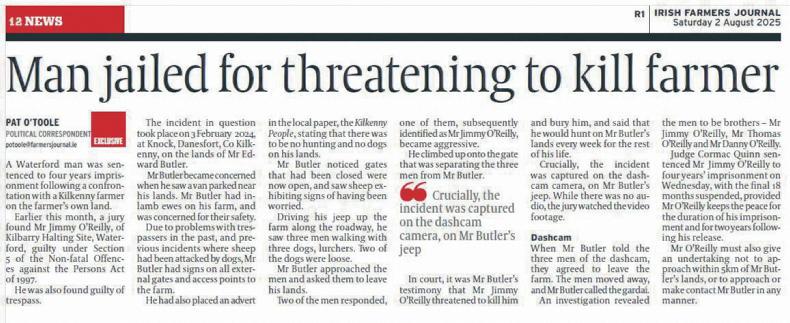
Last week's story in the Irish Farmer's Journal
They unanimously found O’Reilly guilty, and on 29 July he was sentenced to four years imprisonment by judge Cormac Quinn. It’s a landmark verdict, one that should offer comfort to everybody who feels they are prisoners on their own property.
In Ireland today, thousands of farm families feel unable to protect their lands, their livestock, and their property.
Edward Butler showed bravery in the face of intimidation and aggression.
But he believes that unless a change is made to the law, farmers will continue to be vulnerable to people on their land without permission, placing their animals
at risk.
The events of 3 February, 2024 were far from the first time Edward Butler’s land and livestock had been exposed to trespassers with loose hunting dogs. It’s fair to say that Butler had been gaining understanding of what was needed to prove trespass over many episodes on his land.
Only a month earlier, he received a call from a neighbour, informing him that a group of eight men with dogs were entering his land.
When he arrived at his field, which contained his in-lamb sheep flock, he was shocked to see the group of men had the ewes penned into a corner of the field.
They were blocking the sheep’s escape while up to eight lurcher dogs were mauling the flock.
This practice, he later discovered, is known as ‘blooding the dogs’. It is used to train the dogs to the taste of blood and encourage their appetite for hunting.
A number of sheep had to be put down, their injuries were so severe.
Others lost their lambs, leading to a very difficult lambing season as the full impact became apparent. Edward even discovered that a couple of ewes has had their teats bitten, meaning that their lambs couldn’t suckle. The damage and financial losses were severe.
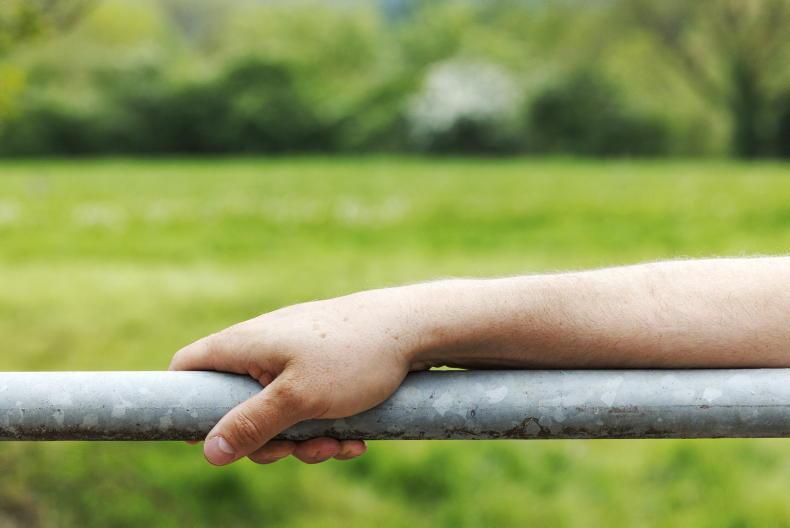
The events of 3 February, 2024 were far from the first time Edward Butler's land and livestock had been exposed to trespassers with loose hunting dogs. \ Donal O' Leary
This was the seventh occasion in two years that Edward had encountered illegal trespassing and hunting with lurcher dogs on his farm.
It was the incident that encouraged him to invest in recording equipment in the form of a dashcam on his jeep. He also increased security across his farm.
“I was forced to install a number of security cameras, motion detectors, and lights. I placed locks on farm gates. I also changed the grazing platform of the sheep flock in order to keep them within sight of the house as much as possible,” he says.
Butler had previously gone to considerable efforts to ensure no-one would inadvertently come onto his land without permission.
He had placed signs indicating ‘No hunting, No dogs’ on every external gate and at the lane entrance. He had also taken out a public notice in the local paper The Kilkenny People to the same effect.
Gangs using the motorway network to hunt
Edward Butler’s farm was attractive to gangs with dogs for a number of reasons. First of all, it is close to the motorway network, so it was easy to travel to.
Secondly, his farm is a sheep and suckler farm in a predominantly tillage area.
This leads to people coming onto his land, particularly when crops are growing high in tillage fields.
“There are no other sheep on the 2,000 acres of land surrounding my farm,” he says “but these gangs from counties Cork, Waterford, Wexford, Carlow and Tipperary are using the motorway network to travel great distances day and night to specifically hunt in fields containing sheep.”
Thirdly, Danesfort, less than 10km south of Kilkenny city, is in an area where hares are prevalent.
And hares attract hunters and their dogs.
Hares are a protected species, hunting them in the wild is illegal in Ireland since 1930. However, proving that people are hunting hares is difficult.
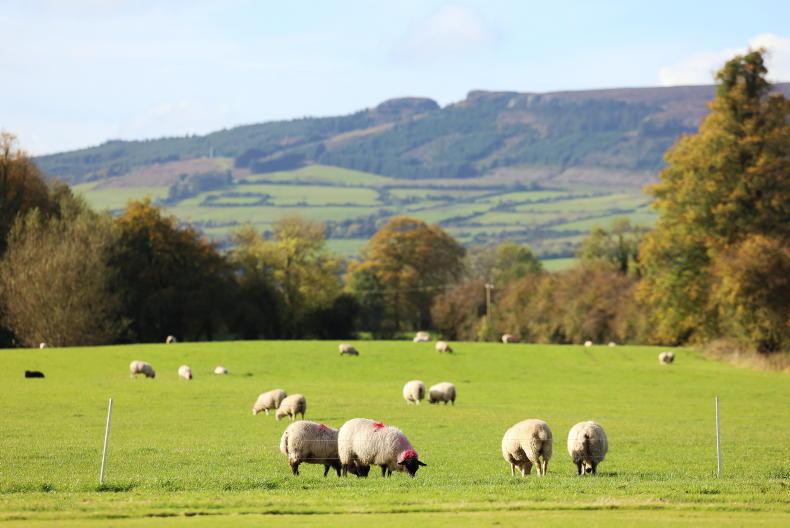
Stories abound of gangs hunting at night. This includes the traditional “lamping” using illumination to view the chase between the hare and the pursuing hounds, but also using expensive “night vision” equipment to monitor proceedings. Of course, not all people who own hunting dogs are seeking to trespass on farmland. Most such dog owners are members of gun clubs, and only enter land where permission has been obtained.
But a minority have no regard for the law, and some of these have no regard for the wellbeing of livestock.
There is yet another aspect to people walking around farmland with dogs.
It can provide cover to people who are scoping the landscape with a view to burglary. There have been a number of thefts of farm property in the Danesfort area.
None of this makes Danesfort particularly unique. “The things happening on my farm, and across my parish, are happening all over Kilkenny,” says Butler.
Indeed, they are happening all over the country.
Since the news broke of the court case and its decisive and groundbreaking outcome, Butler has been contacted by people he knows from all over the country, congratulating him on his resolute determination to get justice, and recounting similar trespass and intimidation.
People have to respect that farms are workplaces
Edward Butler has been reflecting on all that he has been through. His hope is that the court case brought in relation to the events that occurred on his farm can be a prelude to a new relationship between farmers, particularly livestock farmers, and the law.
This is not about closing farmland from people who want to walk it with due regard for the land and its occupants. Closing gates as you have found them, keeping dogs on a lead when on farmland, keeping dogs away from cattle and particularly sheep, especially sheep that might be in-lamb, is not an unreasonable ask by farmers.
“This is our place of work, and anyone coming on to a working farm for any reason should respect that fact. Many people may not realise that dogs don’t have to attack cattle or sheep to do harm to them. The presence of dogs will upset sheep. It may cause them to huddle in a corner, and the stress can cause problems in pregnancy.”
Cattle can stampede from dogs, breaking fences. If they break out to a road, that puts the general public at risk. Butler believes that the majority of incidents of aggressive trespass involve a relatively small group of people.
And he is convinced that a simple change in the law could have a big impact on them.
Changing the burden of proof
Butler has thought deeply about the whole situation, and has a proposal that he believes is worth considering. This involves changing the burden of proof of trespass.
“Instead of forcing the farmer to prove that no permission was granted, why not require the trespasser to prove that they had permission, thus removing the farmer from the process,” he says.
“If the trespasser cannot demonstrate permission to the gardaí, then he or she faces an on-the-spot fine.
“The biggest obstacle preventing prosecution is fear, the fear of retaliation,” he continues.
“Farmers are afraid to sign a statement because of the ‘they know where I live’ factor’.”
If the trespass law was reversed, then the farmer would not be required to give a statement or appear in court therefore removing this fear factor.
“Take the handcuffs off the gardaí and put them on the criminals,” Butler says “Change the trespass law and I believe the gardaí will be able to finally stop this aggressive hunting which is troubling rural Ireland for decades.”
Butler has nothing but praise for the gardaí.
“I have always found the Thomastown gardaí to be excellent, proactive and professional. They put many hours of work in bringing this case to its successful conclusion.”
He also has praise for the judge, jury, prosecution service and the staff in Kilkenny Circuit Court for their time and support.
And he believes that a simple change in the balance of the law could make farmers feel safer on their property.
Something he himself has already done by his actions.
Edward Butler is a quietly-spoken man, but no-one should mistake a gentle nature for him being someone who lacks resolve.
His stance on behalf of himself and his family, on behalf of his neighbours, and on behalf of the wider community has already changed the relationship between the landowners and people who feel they have the right to walk around farmland with their dogs on the loose.
Last week’s report in the Irish Farmers Journal recounted the events that occurred on his farm, at Danesfort, Co Kilkenny, on 3 February, 2024.
Edward Butler’s encounter with three men trespassing on his land with loose hunting dogs resulted in a court case where one of the trespassers, Jimmy O’Reilly of Kilbarry Halting Site, Co Waterford, was accused of threatening to kill Edward Butler.
A jury of 12 men and women in Kilkenny Circuit Court heard the evidence, including footage from the dashcam on Butler’s jeep.
Last week's story in the Irish Farmer's Journal
They unanimously found O’Reilly guilty, and on 29 July he was sentenced to four years imprisonment by judge Cormac Quinn. It’s a landmark verdict, one that should offer comfort to everybody who feels they are prisoners on their own property.
In Ireland today, thousands of farm families feel unable to protect their lands, their livestock, and their property.
Edward Butler showed bravery in the face of intimidation and aggression.
But he believes that unless a change is made to the law, farmers will continue to be vulnerable to people on their land without permission, placing their animals
at risk.
The events of 3 February, 2024 were far from the first time Edward Butler’s land and livestock had been exposed to trespassers with loose hunting dogs. It’s fair to say that Butler had been gaining understanding of what was needed to prove trespass over many episodes on his land.
Only a month earlier, he received a call from a neighbour, informing him that a group of eight men with dogs were entering his land.
When he arrived at his field, which contained his in-lamb sheep flock, he was shocked to see the group of men had the ewes penned into a corner of the field.
They were blocking the sheep’s escape while up to eight lurcher dogs were mauling the flock.
This practice, he later discovered, is known as ‘blooding the dogs’. It is used to train the dogs to the taste of blood and encourage their appetite for hunting.
A number of sheep had to be put down, their injuries were so severe.
Others lost their lambs, leading to a very difficult lambing season as the full impact became apparent. Edward even discovered that a couple of ewes has had their teats bitten, meaning that their lambs couldn’t suckle. The damage and financial losses were severe.
The events of 3 February, 2024 were far from the first time Edward Butler's land and livestock had been exposed to trespassers with loose hunting dogs. \ Donal O' Leary
This was the seventh occasion in two years that Edward had encountered illegal trespassing and hunting with lurcher dogs on his farm.
It was the incident that encouraged him to invest in recording equipment in the form of a dashcam on his jeep. He also increased security across his farm.
“I was forced to install a number of security cameras, motion detectors, and lights. I placed locks on farm gates. I also changed the grazing platform of the sheep flock in order to keep them within sight of the house as much as possible,” he says.
Butler had previously gone to considerable efforts to ensure no-one would inadvertently come onto his land without permission.
He had placed signs indicating ‘No hunting, No dogs’ on every external gate and at the lane entrance. He had also taken out a public notice in the local paper The Kilkenny People to the same effect.
Gangs using the motorway network to hunt
Edward Butler’s farm was attractive to gangs with dogs for a number of reasons. First of all, it is close to the motorway network, so it was easy to travel to.
Secondly, his farm is a sheep and suckler farm in a predominantly tillage area.
This leads to people coming onto his land, particularly when crops are growing high in tillage fields.
“There are no other sheep on the 2,000 acres of land surrounding my farm,” he says “but these gangs from counties Cork, Waterford, Wexford, Carlow and Tipperary are using the motorway network to travel great distances day and night to specifically hunt in fields containing sheep.”
Thirdly, Danesfort, less than 10km south of Kilkenny city, is in an area where hares are prevalent.
And hares attract hunters and their dogs.
Hares are a protected species, hunting them in the wild is illegal in Ireland since 1930. However, proving that people are hunting hares is difficult.
Stories abound of gangs hunting at night. This includes the traditional “lamping” using illumination to view the chase between the hare and the pursuing hounds, but also using expensive “night vision” equipment to monitor proceedings. Of course, not all people who own hunting dogs are seeking to trespass on farmland. Most such dog owners are members of gun clubs, and only enter land where permission has been obtained.
But a minority have no regard for the law, and some of these have no regard for the wellbeing of livestock.
There is yet another aspect to people walking around farmland with dogs.
It can provide cover to people who are scoping the landscape with a view to burglary. There have been a number of thefts of farm property in the Danesfort area.
None of this makes Danesfort particularly unique. “The things happening on my farm, and across my parish, are happening all over Kilkenny,” says Butler.
Indeed, they are happening all over the country.
Since the news broke of the court case and its decisive and groundbreaking outcome, Butler has been contacted by people he knows from all over the country, congratulating him on his resolute determination to get justice, and recounting similar trespass and intimidation.
People have to respect that farms are workplaces
Edward Butler has been reflecting on all that he has been through. His hope is that the court case brought in relation to the events that occurred on his farm can be a prelude to a new relationship between farmers, particularly livestock farmers, and the law.
This is not about closing farmland from people who want to walk it with due regard for the land and its occupants. Closing gates as you have found them, keeping dogs on a lead when on farmland, keeping dogs away from cattle and particularly sheep, especially sheep that might be in-lamb, is not an unreasonable ask by farmers.
“This is our place of work, and anyone coming on to a working farm for any reason should respect that fact. Many people may not realise that dogs don’t have to attack cattle or sheep to do harm to them. The presence of dogs will upset sheep. It may cause them to huddle in a corner, and the stress can cause problems in pregnancy.”
Cattle can stampede from dogs, breaking fences. If they break out to a road, that puts the general public at risk. Butler believes that the majority of incidents of aggressive trespass involve a relatively small group of people.
And he is convinced that a simple change in the law could have a big impact on them.
Changing the burden of proof
Butler has thought deeply about the whole situation, and has a proposal that he believes is worth considering. This involves changing the burden of proof of trespass.
“Instead of forcing the farmer to prove that no permission was granted, why not require the trespasser to prove that they had permission, thus removing the farmer from the process,” he says.
“If the trespasser cannot demonstrate permission to the gardaí, then he or she faces an on-the-spot fine.
“The biggest obstacle preventing prosecution is fear, the fear of retaliation,” he continues.
“Farmers are afraid to sign a statement because of the ‘they know where I live’ factor’.”
If the trespass law was reversed, then the farmer would not be required to give a statement or appear in court therefore removing this fear factor.
“Take the handcuffs off the gardaí and put them on the criminals,” Butler says “Change the trespass law and I believe the gardaí will be able to finally stop this aggressive hunting which is troubling rural Ireland for decades.”
Butler has nothing but praise for the gardaí.
“I have always found the Thomastown gardaí to be excellent, proactive and professional. They put many hours of work in bringing this case to its successful conclusion.”
He also has praise for the judge, jury, prosecution service and the staff in Kilkenny Circuit Court for their time and support.
And he believes that a simple change in the balance of the law could make farmers feel safer on their property.
Something he himself has already done by his actions.





SHARING OPTIONS