


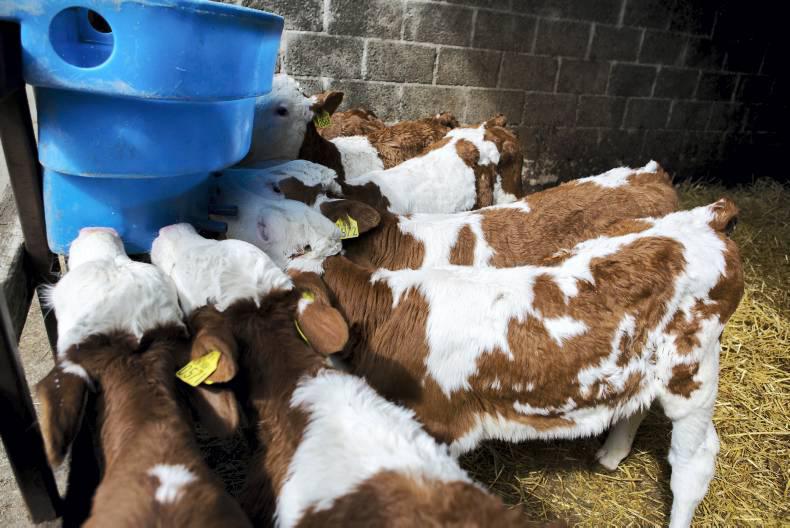
The “blade farming” model run by ABP in Northern Ireland (NI) was officially launched by Agriculture Minister, Michelle O’Neill this week.
The principle behind the model is that calf suppliers, rearers and finishers all receive a margin, but in return must follow strict protocols, meet targets and supply on a contract to an agreed specification.
“In essence we are asking farmers to give up a bit of their independence,” said Arthur Callaghan, the ABP co-ordinator for blade farming in NI.
It has similarities to the integrated rearing and processing model for poultry, operated so successfully in NI by Moy Park. While some might question the financial commitment and margins available, there is no doubt that the Moy Park model has helped to provide a sustainable income on many family farms.
Integration in the beef sector in NI has not really happened to date and this represents a first step along that road. The beef market is now more volatile than in the past, and the fluctuations in price seen in recent months are unsustainable for many finishing operations.
One way to help manage that volatility across the sectors is for more integration in the supply chain.
The blade farming model works by paying a fixed price for cattle reared to an agreed protocol. The end price is known in advance and designed to leave a margin for the rearer and finisher.
“A margin in excess of £100 per head to be shared between the rearer and finisher is readily achievable should protocols be adhered to, and on-farm efficiency be maximised,” insists Arthur Callaghan.
“Every input cost is included, from finance, utilities, veterinary and medicines, mortality and waste, feed and forage, transport, etc. We review the costs every three months and set the end price accordingly,” he said.
The key to the model is that it will actually work in practice and deliver the promised margin when the advice is followed. That is where the experience of blade farming comes in. Although it is new in NI, the model has been working in Britain since 2001, with protocols developed across a range of finishing systems.
Health plan
“Producers who sign up get a health plan and management guide. It covers every system, including where cattle are reared and finished indoors on different diets, to systems utilising grazed grass,” explained Arthur.
Farmers must follow the agreed management protocol for the system they are using. The most efficient, for example, an excellent manager of grass, can potentially realise higher margins.
As well as following a management guide, producers must also meet production targets at various stages. There are three categories of farmers involved: calf suppliers, calf rearers and finishers, each must follow the protocol and meet agreed targets along the way.




SHARING OPTIONS