



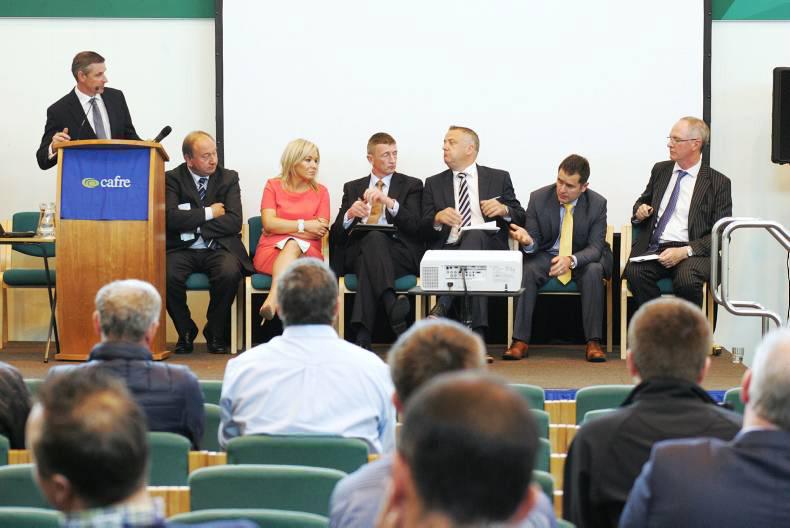
The conference hall at CAFRE Greenmount had enough seats out to cater for 500 people attending the Ulster Farmers’ Union (UFU) dairy summit last week.
Representatives from local banks, feed companies and dairy processors were all in attendance. Local TV crews were there to record the anger of farmers. Except that the farmers didn’t turn up. Take out all the industry representatives, there was certainly less than 100 and maybe even less than 50.
It was left to UFU president Ian Marshall to explain the poor turnout. “It is a reflection of the nature of farming in NI. There is immense pride in the industry. Farmers will speak to the UFU, banks and advisers privately about their concerns, but not in a public forum,” said Marshall.
Perhaps the meeting came a few weeks too late, and there is less momentum now. Perhaps something more radical, such as a protest, might draw more support. Perhaps Agriculture Minister Michelle O’Neill got it right when she suggested that farmers were talked out, and it was time for action by the European Commission.
To be fair to the UFU president, he has a difficult task keeping the entire membership on side and not being seen to favour one sector over another. His credibility with some dairy farmers has probably been damaged by his decision to quit milking cows on his home farm earlier this year. That was a subject he broached head-on at the start of the summit, when he explained that the decision was down to losing conacre land due to CAP changes and losing some key staff on the farm. “My decision was down to these circumstances, not because I had some inside information on dairy markets. That is not the case,” said Marshall.
He acknowledged that there isn’t always a lot of support from one sector to another. Other farmers blame dairy producers for pushing up the price of conacre. Some maintain that arable growers only work five weeks per year. Other farmers point to the large subsidies coming to some beef producers. “It is important that we recognise current prices across the sectors are a concern for us all. We must stick together as farmers,” urged Marshall.
Despite a few tentative signs that world dairy markets are starting to recover, with the Global Dairy Trade (GDT) auction from two weeks ago up 14.8%, this is from an extremely low base cautioned Trevor Lockhart, chief executive of Fane Valley Co-op.
He maintained that the equivalent GDT price in NI for this autumn and early winter works out at just 12p/litre.
European markets are delivering higher prices, but still not a realistic return, he said. Given that a number of processors are utilising their own resources to maximise the price paid to producers, he suggested that there continues to be more downward than upward pressure on the market. That is reflected in the UFU milk price indicator (MPI), which is showing a milk price of 15.25p/litre for September milk. According to UFU president Ian Marshall, their MPI has been “frighteningly close” to actual prices paid this year.
When asked if the market was likely to dip to this level for September supplies, Fane Valley Group CEO Trevor Lockhart was a bit more circumspect. “It is too early to say; probably not,” he replied.
However, with milk prices down 46% since early 2014, he said it was vital that the European Commission took action to put a higher floor in the market.
“Commissioner Hogan seems to take the view that the market should sort it out and if farmers go to the wall, then so be it. It is an astonishing thought process from the person charged with agriculture responsibility in Europe,” said Lockhart.
He described the suggestion coming from the office of the Commissioner that it would take up to 18 months to change intervention prices as “not good enough” and maintained that “if there is a will, there is a way”.
However, he also acknowledged that the industry must look at what measures can be taken to insulate farmers against volatile prices in the future. A couple of weeks ago, Defra secretary Liz Truss announced that a working group is being set up to look at a futures market and possible insurance for dairy products in the UK. In the Republic of Ireland, a number of processors offer farmers the option of locking in a proportion of their supply at a fixed price.
“It would be progress, but it will require an attitude change from all of us,” warned Lockhart.
He maintained that any potential contracts on offer might not be reflective of the spot market. “It could be a long-term contract at 25p or 26p, which might be 2p to 3p below spot prices at the time. It would be a judgement call to go for long-term stability over short-term spikes,” he said.
Minister defends Going for Growth
Given the financial pressure on farmers across many sectors, it has left many wondering about the relevance of the Going for Growth report of the Agri-Food Strategy Board.
“I accept that Going for Growth is not that attractive to you when you are struggling to survive,” said Agriculture Minister Michelle O’Neill.
She also pointed out that the core of the strategy is about fairness in the supply chain, the need to access new markets, etc, not about producing more.
“It is the right strategy. It will deliver in the longer term,” said the Minister. However, she acknowledged that more work must be done on supply chain issues. She has tasked the Agri-Food Strategy Board with delivering a stronger supply chain – in the coming weeks, farmers, processors and retailers are to be brought together to discuss how some of the problems can be addressed.
On specific issues within the dairy sector, the Minister said that she was doing all she could to help farmers. She has pushed the case for increased intervention prices with Defra secretary Liz Truss and Commissioner Hogan and will attend the extraordinary meeting of the Council of Agriculture Ministers in Brussels on 7 September.
She has also highlighted the problems caused by volatile prices with her colleagues in the NI Executive and asked them to consider more local food sourcing for public sector contracts and the potential to devolve taxation powers.
Be proactive with your bank
According to Robert McCullough from Danske Bank, there hasn’t yet been large numbers of dairy farmers looking for additional finance from the banks. However, with many farmers set to move into a phase of higher cost production, and with prices remaining low, he acknowledged that tough times lie ahead. “Be proactive, talk to your bank. Engage early,” said McCullough.
When approaching a bank, he said that a forecast of cashflow was crucial, along with the most recent set of accounts and an up-to-date creditor position. He also highlighted the “sometimes alarming” hire purchase (HP) debt on some farms and encouraged farmers to ask about the possibility of deferring some of this debt.
In terms of the actual help from Danske Bank, McCullough said that in most situations an increase in the overdraft facility was all that was required. Since last autumn, the bank has also offered a dairy support loan, which is an injection of cash into a business. It is an interest-only loan, with repayments made when the business has the capacity to pay.
However, in a small number of cases, it would be irresponsible to lend more money, said McCullough. There is the option of the bank giving farmers an “interest holiday” until they make adjustments to their farm business. He maintained that less than 10 farmers are currently in this position.
Looking ahead, McCullough said that farmers should avoid unnecessary capital expenditure, and look to improve efficiency. He would also favour some form of processor contracts and remains convinced that the long-term prospects for the sector are good. But he also delivered a blunt message. “Some people would be better to exit the industry. You need to have courage to make those decisions. There is life outside dairy farming.”
Beware cutting feed costs
With poor milk prices, there is a temptation to try to take out costs by feeding less, or lower quality concentrate. However, according to Owen Brennan from Devenish Nutrition, making such a decision may have long-term consequences. “Cost reduction, yes; but not at the expense of animal health or welfare. It would be perverse if you can’t take advantage of an uplift in price when it does come,” said Brennan.
Despite feed costs being at a five-year low and ration prices being back to £38/t from their peak, Brennan acknowledged that the feed bill could now make up between 50% and 60% of a milk cheque. However, each £25/t reduction in ration price is worth around 1p/litre in reduced costs, so it has a relatively low potential to change the bottom line, he said. At present, there are around 50 feed mills in NI, and between them they have about £150m of credit on farms.




SHARING OPTIONS