



The law of unintended consequences. In 2012, my colleague Darren Carty was looking over the results of the 2011 sheep census.
I asked him if we could break it back against the comparative figures for 2005, which was the first year of the national sheep and goat census.
2005 was also the last year of sugar beet processing in Ireland. During the debate around whether to keep Mallow factory open (Carlow had been closed by Greencore in March 2005), I was one of many who pointed out that one of the consequences of the loss of the sugar beet sector would be a massive contraction in sheep numbers.
Sheep farming in counties such as Wexford was closely linked to sugar beet. Surplus beet was fed to ewes and to fattening hoggets.
A Tanco Cleanafeed was a standard piece of equipment on most sheep farms. Ewes and hoggets both would graze the beet tops, resting grassland and shortening the housed period.
Crunching the numbers
So Darren and I crunched the numbers and, sure enough, between Laois, Carlow, Wexford, Kilkenny, Tipperary and Cork - the six main beet-growing counties - there was a huge fall-off.
The total number of sheep across those counties had contracted from 932,990 down to 700,737. That’s a 25% drop in only six years.
Yes, sheep numbers dropped in the rest of the country too, but by nowhere near as high a percentage.
In total, the national flock fell in size from 4.01 million to 3.48 million. The overall fall-off was only 13.7%. The drop in the other 20 counties, where sugar beet was less important, was less than 10%.
The sheep sector had indeed been dealt a massive blow by the closure of the sugar beet industry. The law of unintended consequences.
Stock and stubbles
Why am I speaking of this over a decade later? Because it seems that the sheep sector is about to be hit with another bout of 'friendly fire' (I’m being extremely generous in inferring that David Dilger’s tenure of Greencore was ever friendly to farmers, but that’s all history now, so bygones).
This blow comes from a decision made with little fanfare or warning. But a blow that could affect sheep farming in the counties with a significant amount of tillage farming, as much or perhaps more than the closure of sugar processing, and the loss of about three-quarters of the beet grown in this country. We still grow about 10,000ha of beet, almost all fodder beet, and all for feeding to livestock.
The Minister has said to inspectors that as people may not have been aware of this requirement
The decision is that taken by the Department of Agriculture that livestock grazing cover crops must have a grass lie-back.
Initially, the insistence was that every hectare of cover crop grazed would require a hectare of grass lieback. Following a massive outcry, Minister for Agriculture Charlie McConalogue intervened and there was an amendment.
Instead of a 50:50 proportion, a 30:70 proportion would be needed. In other words, if a farmer has 7ha of cover crop, they will only need 3ha of grass for a sufficient lieback.
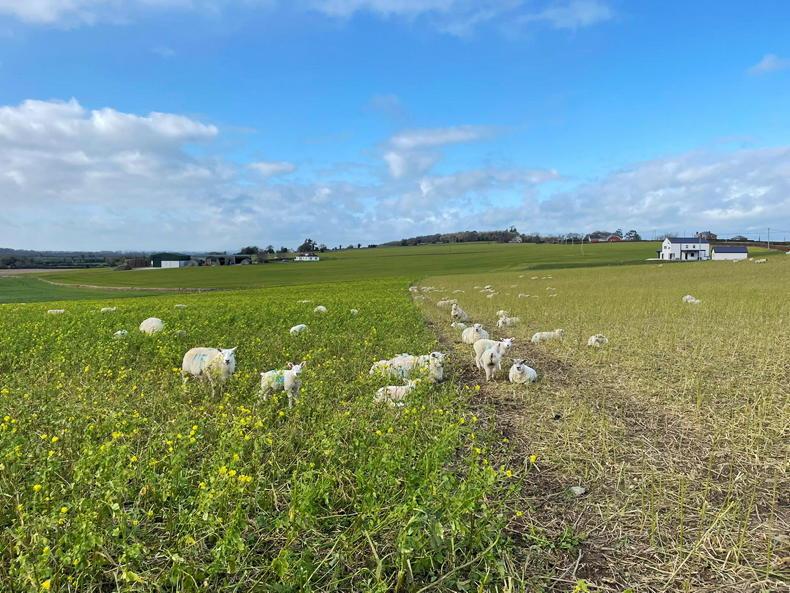
The arguments against this decision have mostly been made at this stage. They are pretty simple. Cover crops are mostly on tillage farms, which mostly don’t have grass fields adjacent to them, so a grass lie-back is not achievable.
We’ve been told the Minister has said to inspectors that as people may not have been aware of this requirement when planning or planting cover crops, they should “consider non-compliance on a case-by-case basis”.
That’s all very well and good, but this now leaves the farmer at the mercy of the mood and attitude of whatever inspector or Department official comes on to their land. It’s yet another source of stress.
Of course, some farmers couldn’t give a fiddlers about the Department, its inspectors, and won’t worry about any of this.
However, other farmers are affected by the knowledge that they could fall foul of regulations and find it an added stress, dreading the call or letter from the Department telling them they are eligible for inspection or that some satellite has picked up sheep or cattle on their cover crop with no discernible lie-back.
Perhaps this last is needless apprehension, I have no idea whether satellite photographs can be used for such a purpose.
But the fact is that farmers do fear such possibilities. They fear them, particularly if money is tight after a very difficult year for tillage.
It may be that cover crop has been grown to set for cash or to graze the farmer's own stock.
It’s worth looking at exactly what the Department said in its response to the Irish Farmers Journal this week.
“Harvested cereal stubbles would not be considered as a suitable lie-back space, as further grazing activity by livestock in these areas and during these periods could remove soil cover as required under GAEC 6.”
Firstly, I think the statement means to say that soil removal is prohibited under GAEC 6 rather than required by it. But that’s merely a grammatical error.
The statement continues as follows: “Furthermore, harvested cereal stubble must have regard for the stubble management requirements as set out under Ireland’s current nitrates regulations.”
It seems that the nitrates section of the Department of Agriculture are saying that stubble is not suitable to carry stock in the post-harvest season.
Implication
It’s this other implication of the Department’s statement that is more serious.
Stubbles are not only unsuitable as a lie-back for cover crop, it seems stubbles are no longer considered suitable to carry livestock in any circumstance. And for the sheep sector, this is a massive problem.
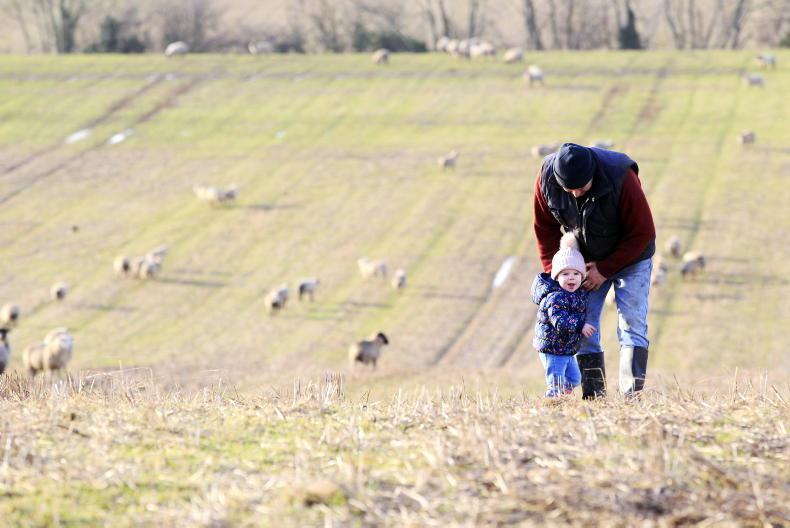
Sheep love stubbles. Store lambs graze on the stubbles, benefitting from herbs and cleaning up weeds.
It cleans lambs up, the diet augmented by the fact that they are on ground carrying no worm burden.
Similarly, when ewes have been flushed and mated, they are often moved on to stubbles.
Resting the grass, breaking the life cycle of some worms and grazing the weeds and herbs. I would imagine that on organic farms, this is particularly valuable.
I don’t know if the relevant section that made this decision have a scoobies that this practice is so established
A high proportion of store lambs are brought on to stubbles. Sheep farmers in Leitrim or Kerry mightn’t realise that this issue affects them, but when mountain lambs land into the main finishing specialist counties, which broadly are the tillage counties, they are often introduced to the delights of stubbles. Indeed, tens of thousands of lambs are meal-fed on stubbles.
Do they think that grass fields will not suffer under sheep in the winter months? Perhaps the Department now think that sheep should be housed for long periods like cattle? Or finished on slats in yards?
Sheep don’t like being housed for long periods, not in Ireland’s wet and often mild winter conditions.
They sweat and get sick, their feet suffer unless their straw bed is constantly refreshed and it’s not easy to keep a dry bed under sheep in wet weather.
Arbitrary
The Department seems to be lurching from arbitrary edict to arbitrary edict and tillage farmers have had a few experiences of this recently.
For much of last year, they insisted that all stubble ground had to receive a post-harvest cultivation.
Then, following complaints that some bird species are dependant on stubbles, they changed the rule, announcing instead that you had to leave one-quarter of your stubble uncultivated. A complete about-turn.
I have just had to spray all the land that I didn’t cultivate last autumn with a pre-harvest glyphosate application.
I had to use a high rate to kill off the weeds and grasses that are strangling the barley crop or else the combine would not have been able to harvest it.
Our min-till system means we aren’t ploughing down the growth in the spring. The ability to propagate weeds in the autumn and to disc them up before they seed has been taken away from us in those uncultivated fields.
The fields were really dirty this spring and pre-tilling glyphosate was not very effective. The need to spray off fields also meant we missed out on the February planting window completely, with pretty disastrous consequences.
Research
Where is the research behind any of these decisions? Is taking such field-by-field management options away from farmers the correct approach?
Farmers are professionals, they are the experts on what works best in their own fields. Taking so many decisions out of farmers' hands might help the Department to feel that it is being proactive, but the frustration among farmers is growing year by year.
Yes, the Department has shown flexibility where weather conditions mean mandatory actions are not easily achieved within the allotted timeframe.
But in a harvest as difficult as this, until the dispensation is given that cover crops or post-harvest cultivation has more than 14 days post-cutting, it’s an additional headache. And there are enough headaches as it is.
Desktop farming
There is a danger of poaching of ground in the winter, whether it’s grass, stubble or cover crop. There are a number of variables that will determine the level of risk, including stock type, stocking rate and weather conditions.
I wonder if the people making the decision to take livestock off stubble were thinking of cattle grazing cover crop and forgot about the humble sheep?
The reality is that we can’t produce food in labs - not yet - and we can’t eliminate all risk. We have to manage risk and we do need farmers to be responsible.
We need them to not leave sheep standing in muck or leave troughs or feeders in the same place for weeks. But the same risks apply to grassland in winter.
Every farmer I've spoken to thinks this looks like a bad decision.
Farming is real life, it’s not a simulator game on a laptop or console. And the desktop farming within the Department needs to be aware of the compromises we have to make every day as farmers, working with the vagaries of weather and ground conditions.
Taking stubble ground out of sheep production is a massive step. I really hope that the decision has been thought through, but I’m far from convinced it has been.
And it’s too easy to blame the Minister. There are thousands of staff making thousands of decisions in dozens of sections within the Department.
The Minister cannot be across every detail of all of these decisions. However, Charlie McConalogue is politically accountable for the decisions his Department makes. And every farmer I've spoken to thinks this looks like a bad decision.
We need to minimise the risk to our soil structure and to our waterways from our soil. But the risk to a vital sector seems higher than any reward that will be gained by this decision. It must be fully justified or withdrawn.



SHARING OPTIONS