



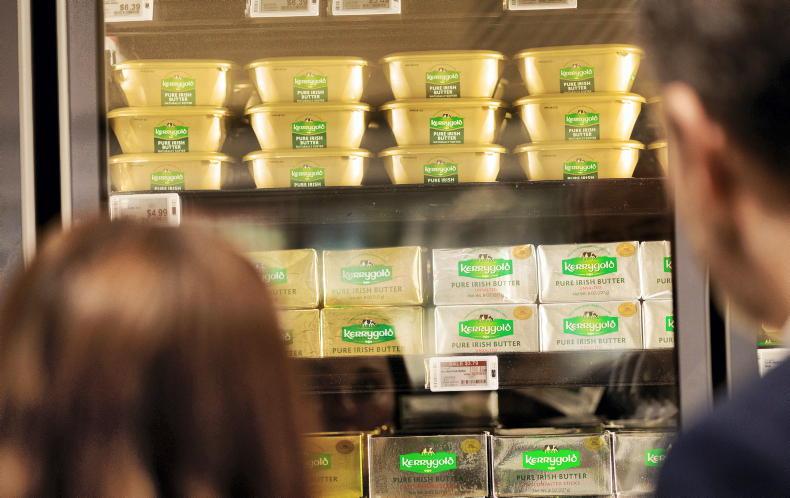
The decision of Tirlán to supply Irish butter to US retail giant Costco for its own Kirkland brand has caused the deepest conversation about the structure of our dairy sector in my memory.
The facts are well established at this stage. Tirlán’s butter will be sold as grass-fed butter, which is a premium product.
As such, it will be up against Kerrygold, THE grass-fed butter. The Kerrygold brand is entirely owned by Irish dairy farmers, including Tirlán suppliers, through Ornua.
Ornua is an unusual construct, a co-op owned by co-ops. Tirlán is the largest shareholder, with about one quarter of the shares in Ornua. That doesn't give it proportionate voting power. Each of the eight co-ops in Ornua has one vote, so North Cork has the same voting power as Tirlán. In this regard, you could say Ornua is like FIFA.
Everyone I've talked to has an opinion. Some people believe Tirlán should be forced out of the room, forced to sell its shares in Ornua and leave it to the other seven co-ops, that Tirlan’s focus and vision of its future is now incompatible with being within Ornua.
Golden handcuffs
I've talked to people who believe Ornua should be sold while maintaining golden handcuffs that make sure that it continues to sell only Irish products.
Who could it be sold to? It would probably have to be a company with global reach; a Nestle or Kraft. Others believe that selling to such a multinational would be the death knell of Kerrygold.
Instead, a strategic partnership is what it needed, with the likes of a Friesland Campina, someone who would have an ideological compatibility with the co-op model, but still have global reach.
Then there are those who say Ornua stay as it is, working on behalf of the farmer shareholders who supply the milk that allows all these fabulous dairy products, not just Kerrygold butter, protein batter, skim milk powder, milk itself, yogurt, cheese strings, to be produced.
I've even talked to some people who believe the opposite of the first proposal, people who believe that Tirlán should buy Ornua. It certainly has the cash to do so. Tirlán built up the a billion in cash reserves and could afford it.
Politically, would it be possible? Do you think the other co-ops would sell to Tirlán and allow it a controlling hand on their future destinies? To be honest, I don’t think so.
Crossroads
But everybody seems to agree that we've come to a crossroads. The relationship between Ornua and the co-ops who own it needs to evolve.
Ornua faces new challenges in working side by side with the Irish co-ops that own it, because the volume of Irish dairy produce means they are increasingly selling into the same market.
It's now over 60 years since Tony O'Reilly, the then-CEO of the Irish Dairy Board, created the Kerrygold brand and Kerrygold Butter is mind-blowingly famous, an Irish brand to rank with Guinness and Waterford Glass. But Waterford Glass went to the wall, so nothing is guaranteed into the future.
I remember when Eddie Macken burst on the world showjumping stage in the 1970s globally, with his two wonderful horses named Pele and Boomerang.
Then the Irish Dairy Board got involved as a sponsor and Pele, a name that symbolised class and quality on a football pitch, became Kerrygold, a name which symbolised class and quality on a supermarket shelf and in a butter pack.
It was a masterstroke, particularly in Germany, where Macken was based. The Irish Dairy Board / Ornua have protected and exploited the Kerrygold brand, always maintaining its presence at the very top tier of food offerings, the premium and premier butter, particularly in Germany and more recently in the United States.
The German market has proved challenging over the last decade for a whole variety of reasons, but the US market has steadily grown.
Kerrygold occupies little more than 5% of the US butter market
All through this time there have been other Irish butters exported. We can't eat it all ourselves. Some was sold as own brand, not marketed as Irish. But never to the extent of the Kirkland deal.
Kerrygold occupies little more than 5% of the US butter market, as own-brand butter sells hundreds of thousands of tonnes annually. The general understanding is that Ornua has prioritised maintaining the elite brand status of Kerrygold, including keep a high price point, while always looking to increase volume.
And now Tirlán has decided to enter that vast own-brand market, meaning there will be a large volume of Irish butter on shelves at a very different price point to Kerrygold.
Conundrum
At the centre of this entire conundrum is the reality that the Irish dairy sector has increased output by 50% in less than a decade. In fact, it effectively achieved that landmark within five years of the end of quotas.
Ornua has had to sell a lot of extra product, in volume terms, but what it will not do is sell butter at commodity prices.
Kerrygold is Kerrygold, an elite brand that must be priced as such. It’s been that way for 60 years and it’s been a winning formula, so why change.
One thing I don't know, and can’t know, is the price Ornua gets for Kerrygold butter. We know what price it costs the consumer, but we don't know the wholesale price.
One person highlighted to me last week that if Kerrygold was wholesaling at anything like $6/kg more than the Costco Kirkland is wholesaling for, that would generate a massive fund to return to the constituent co-ops.
North of 50,000 tonnes of Kerrygold butter is sold every year in the US alone. A $6/kg margin over other Irish butter would create $300m of profit just from the US market from Irish butter.
That would leave massive headroom for huge dividends to the Irish co-ops. Remember, Ornua only retains a sliver of profits and returns everything else back to the constituent co-ops.
Obviously, it has to pay for its own growth, expansion and development - butter, cheese and other dairy commodities won’t sell themselves. But if there was even $200m of profit from Kerrygold sales in the US, you would imagine that the dividend paid back to the co-ops would be more than the €74m paid out last year.
There are questions over whether prioritising price point and branding over volume is the right approach
There are the retail prices and then there are the wholesale prices that the Irish co-ops, including Ornua, get from supermarkets for their products, be they own brand, premium brand, self-brand, with Kerrygold perhaps standing alone as an elite brand.
There are questions over whether prioritising price point and branding over volume is the right approach in the light of the massive increase in Irish dairy product volumes.
Perhaps the salient question is: what is the appropriate strategy to assist the Irish co-ops to sell this increased volume of product at the best possible price?
If we go back to 2015, a number of questions concerned farmers, observers and supporters of the Irish dairy industry. We were planning for 50% expansion through successive sectoral blueprints, from Food Harvest 2020 onwards.
That first document was created in 2010 in the shadow of the quota era, but in the knowledge that dairy quotas were going in 2015. This had been clearly stated by then-EU agricultural commissioner Marianne Fischer Boel in 2008.
In the sure and certain knowledge that opportunity was about to knock, some big questions were posed.
Could Irish dairy farmers increase their output as planned? They have.
Could the co-ops increase their processing capacity to cope with all this extra milk? They did.
Would farmers have to pay for that expansion? By and large, they haven't. The co-ops have largely absorbed processing expansion, although obviously it affected the price that could be paid for milk. But fears that there would be significant levies on milk for at least the first decade post-quota have not been realised.
The other big question was, could we sell all this extra product? I know Ireland's a small country in relation to the size of global farming and a 50% increase in Irish output is not of global significance, but every litre of milk, every kilo of butter and every packet of powder has to be sold.
A lot of the heavy lifting fell on Ornua to sell all this extra product and it did so. All the product is being sold.
Ornua can say that that has been done without compromising the Kerrygold brand, which in turn doesn’t compromise the bonus Ornua pays back to the co-ops' farmers for the product they sell.
That bonus payment for Kerrygold is something in the region of €250/kg, providing a big share of the €74m paid out in 2025.
There is a consensus that some co-ops are hugely dependent on Ornua and not just because of that bonus payment.
Ornua has sales and marketing expertise that some of the smaller co-ops could never replicate internationally.
Ornua also supplies market insights to co-ops. It offers training, advice and expertise that helps the board and management of co-ops.
It also supplies cashflow; Ornua pays on the day when it takes product from a co-op. It is effectively a bank for the Irish co-ops.
This is massive for a co-op experiencing trading difficulties.
There is a general belief that if Ornua was to go away in the morning, if it was to be sold, even if the Kerrygold brand was to survive, the loss of those support services to smaller co-ops and the loss of the cashflow could be enough to put one or more co-ops under.
Ornua has successfully maintained and developed the Kerrygold brand for 64 years.
But no other brand of that status has been developed since (not that that is easy) and a lot of eggs are still in the Kerrygold butter basket in terms of premium price and a brand that identifies Ireland as (apologies) the cream of the crop.
Parallels
There are two parallels I looked at when I was trying to get my head around where the Irish dairy industry could go with butter.
The first was orange juice. When you go into a supermarket, you have premium brands such as Tropicana and Innocent at a significantly higher price point.
Next comes own-brand, freshly squeezed orange juice, which would be typically a 20% to 30% discount on the premium brands.
Then you have brands such as Squeez, which comes in at a price point a little under the premium own-brand. Finally, you have budget own brands. The premium brands are twice the price of the cheapest ones. But it’s all orange juice.
In our family, we joke that you can tell how well off we are, or how broke we are, depending on the brand of orange juice we're loading into the shopping basket.
We’re not alone. People are prepared to pay a significant premium for orange juice over other orange juice. There's room on the shelves for all these products, but in this case provenance doesn't matter. It's not orange juice from Brazil or orange juice from Spain.
So let's have a look at another product, one where provenance does matter. I think most people in Ireland agree that our butter is the best and that marketing butter as Irish and getting people to pay a premium for it is a valid goal.
There is a product that is not just identified by its country of origin, but by a specific region of the country that it comes from. Sparkling wine is produced in many places. But only sparkling wine produced in the province of Champagne can be called champagne. It's set apart from other sparkling wines by location, origin and by price point.
Almost all champagne is dearer than any other sparkling wine. But if you go in to buy a bottle of champagne, they'll say how much do you want to spend? You can spend more than a few euros, so that you can spend €50, €500, €5,000 or €50,000.
If you want to buy champagne, a premium product, you will always pay a premium price, but within the brand, there are layers of branding.
I think we can create a market where Irish butter is always a premium product, but where within that there are tiers of pricing and branding.
Irish butter is a generally perceived internationally as a quality product. That is based on the reality of the quality of Irish butter and by the strength of the brand that Kerrygold is.
There is a future in which all Irish butter exploits those strengths, but it won't happen by itself. There needs to be a strategic plan in place to bring that about. That would need to be agreed between all the co-ops and Ornua.
It will require coherence and co-operation. It wouldn’t happen overnight, the tiered branding must be carefully, gradually developed. But it would underpin the viability of every co-op were it to happen.
It won't be easy, but it would be worthwhile. I don't think we should sell Ornua, I think we should rebuild Ornua into a company leading a multi-tiered Irish dairy product offering - always quality, always premium and always recognised as Irish.



SHARING OPTIONS