



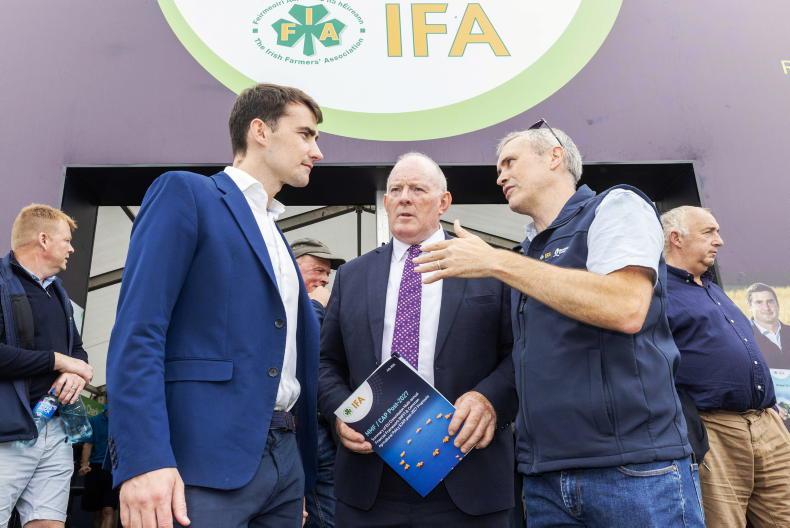
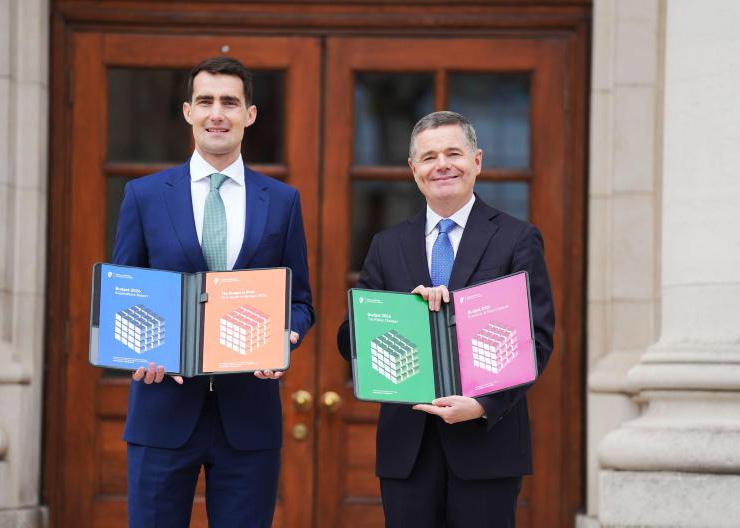
Whenever I hear Martin Heydon - or indeed any other Government minister - talking about the budget, prudence is the watchword.
The absolute caution being exhibited contrasts sharply with last year’s Late Late Toy Show of a budget.
There really was something for everyone in the audience, as the Government cranked up for the general election campaign.
So what’s changed? The country is absolutely flying economically and yet we're all apprehensive.
I think it’s mostly because the world seems to be in a state of chassis, as Sean O'Casey memorably said.
It feels like the world is slipping into the grip of authoritarianism. Unless you believe in the “strong man” theory epitomised by Bismarck in 19th century Germany, it’s hard not to be dismayed at the fact that people who dub themselves as strong men are setting the global agenda.
Defining moments
On conflict, on diplomacy, on trade, on what constitutes freedom, the previous broad consensus that existed across the western world has eroded.
The sight of Donald Trump, in his address to the United Nations General Assembly, admonishing the United Nations itself, is one of the defining moments of 2025.
Political discord and trade disputes dominate in an era of disinformation. Against that backdrop, Ireland seems relatively calm and relatively prosperous.
However, there is an ongoing housing crisis and our health service is stretched and will continue to be.
Constant medical advances mean we can improve the treatment offered to people with critical and life-threatening illness, but new techniques, equipment and medication cost a lot of money. That's the backdrop to our budget negotiations.
The Government is saving up for a rainy day because the world is no longer as safe a place as it was 10 or 20 years ago.
Security and cyber security are live issues; we saw in Dublin Airport last weekend just how dangerous and debilitating cyber-attacks can be.
The Government sounds like an Irish twentysomething being asked to go to a stag or to go racing, to go to a concert or the NFL game on Sunday, a bit of a splurge. And they're saying, I'd love to, I want to, but I'm saving to go to Australia.
It feels like the Government is saving up for us all to go to Australia. Maybe that’s the plan - to bring us all to the most remote part of the world, as it goes to hell in a handbasket - the Nevil Shute plan.
Money for nothing
Whatever the plan, the clear messaging is that there's not much in the kitty for farming.
I don't think it will be possible for the Government to get away without putting some money into the tillage sector.
It won't be the €60m the Irish Farmers' Association is looking for, but the Government will probably have to match the €100/hectare payment that Charlie McConalogue paid out last year.
The Kildare self-declared tillage farmer (Heydon) can hardly fall short of what the Donegal sheep farmer’s son (McConalogue) gave.
I think that outside of that, there's nothing in the bank. The reality is that TB is eating into resources within the Department of Agriculture.
There are even noises that some of the money for a tillage payout will have to be found by shaving other schemes. All will be known in 10 days’ time.
Presidency on the line
While that plays out, we will be in the heart of the presidential election campaign. We now have the campaign defined around three candidates, with two others who came quite close.
Maria Steen and Gareth Sheridan took different routes in their search for a nomination, but both fell just short.
There are calls for electoral reform and claims of exclusion. I think certainly we should explore the former - there is nothing wrong with stress-testing the strength of our democracy, but I am not shrouded in sympathy for claims that the whole thing is a fix.
Sheridan sought the endorsement of four local authorities. He got two endorsements - in Kerry and Tipperary - and came desperately close in Meath, falling one vote short.
There are 31 local authorities in all, so perhaps four is a fair number to demand - perhaps it could be less.
County councillors are elected by the people and represent a wide political spectrum, so it’s not entirely true to describe it as an anti-democratic system.
Meanwhile, Maria Steen gained the support of 18 members of the Oireachtas, falling just two short of the 20 required.
Fingers were pointed at Fianna Fáil and Fine Gael for blocking her candidacy, but that hardly reflects the reality of the maths of our Oireachtas.
There are 174 TDs and 60 senators, a total of 234. Fianna Fáil have 48 TDs and 19 senators - 67 in total. Fine Gael, meanwhile, has 38 TDs and 17 senators, giving them a total of 55.
That means there are 112 members of the Oireachtas not in either of the two traditionally dominant parties of Irish political life. And Maria Steen only needed 20 of them.
The commentary that Maria Steen represents a significant part of the Irish population, who are conservative on social issues, is accurate.
This is a perspective that held sway in Irish life for most of our relatively short history. Perhaps the turning point was the election of Mary Robinson, a progressive on social issues, as president 35 years ago.
Some saw the defeat of the referenda last year, relating to the definition of a family and the description of the role of women in the home as a swing back towards conservatism.
The presence of Maria Steen in the election would have meant an eloquent voice for a conservative perspective. She might well have won.
I’m not sure if it’s correct to describe conservatives as excluded by the system, a system devised by De Valera and other social conservatives.
If you look at the political landscape, you see a lot of social conservatives in both Fine Gael and Fianna Fáil.
Both parties have two wings - one conservative, the other centrist and more liberal. These wings have existed in both parties for decades, but the conservatives were in the majority, both in terms of voters and TDs, until relatively recently. Now they are clearly in the minority in both.
Parties to the right of Fianna Fáil and Fine Gael have failed to gain traction. The Progressive Democrats was a curious mix, economically right of centre, socially mostly progressive. They grew more conservative as the party’s reach and membership contracted.
Fianna Fáil and Fine Gael clearly occupy a similar part of the political spectrum, but both have quite a wide wingspan. Do social conservatives need to coalesce within one or other and try to dominate it? Or do they start up a new party?
Perhaps it isn’t the goalposts that need moving, so much as the teams that need changing.
Jack will be missed
Closer to home, Friday saw the announcement that Jack Kennedy is leaving the Irish Farmers Journal.
Jack has been my colleague since I joined the paper 18 years ago and has been my editor since 2022.
He’s always been engaging and supportive, great to bounce ideas off. He will be missed and my best wishes go to him in his future endeavours and good health and happiness to himself, Abigail and the children.



SHARING OPTIONS