To accept the principles behind the reduction in the derogation from 250kg N/ha to 220kg N/ha would set a dangerous precedent, likely leading to the scrapping of the derogation altogether.
This was the stark message from a gathering of farmers and industry personnel at the Horse and Jockey in Tipperary earlier this week.
One of the biggest flaws is in the criteria set by the European Commission (and accepted by the Irish Government) to use four parameters to measure water quality.
Nitrate levels in rivers and groundwater is just one metric. Eutrophication, or risk of eutrophication, is another parameter and this looks at phosphate levels, as well as nitrogen in water.
Ill-informed decision
The issue here is that while nitrates can be almost wholly attributed to farming, the same cannot be said of phosphate, with forestry, urban wastewater and sewage all major contributors.
How will reducing the stocking rate on a couple of thousand highly regulated farms reduce phosphate pollution caused by factors outside of these farmers’ control?
If we project ahead and if the same criteria is applied at the next Nitrates Action Programme review, what hope is there of maintaining any derogation?
In selecting the new limit of 220kg N/ha, the Commission applied no scientific knowledge.
An after-the-fact Teagasc research project found that some small improvement in water quality may be attainable, but that other measures would bring much greater improvement. This demonstrates how ill-informed the decision to cut stocking rate is.
It is a fact that livestock don’t produce nitrogen, they just recycle nitrogen that they consume. So, increasing or decreasing stocking rate on its own won’t influence nitrogen losses.
Bringing in a lot of extra feed or spreading a lot of extra nitrogen to support a high stocking rate will increase the risk of nitrogen losses.
Reducing nitrogen losses through feeding less of and lower protein concentrate feeds, by spreading less chemical nitrogen and, very importantly, through improved slurry management (longer storage periods and targeted application), have far greater impacts on reducing nitrogen losses and all of these come at a lower cost to farmers than cutting cow numbers.
The chart (Figure 1) compares nitrate levels in three Irish rivers in the south and east; the Barrow, Blackwater and Slaney, with data going back to 1979.
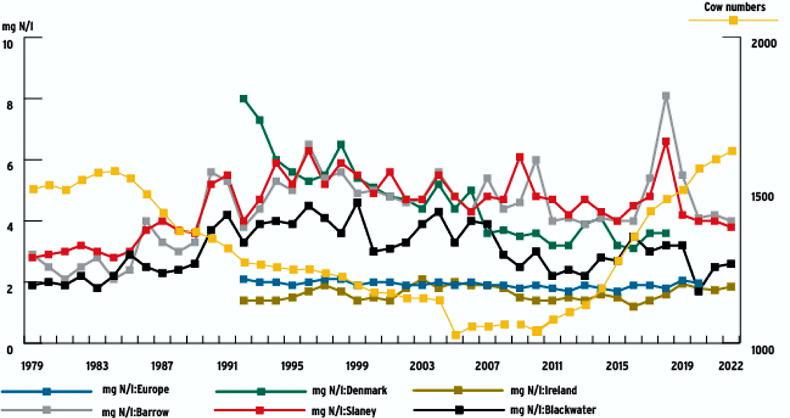
Figure 1: Nitrate in rivers: Ireland v Europe and cow numbers by year (source: EPA, European Environment Agency, CSO).
It also looks at nitrate levels for all Irish rivers, all European rivers and rivers in Denmark from 1992 to 2022. It also shows dairy cow numbers from 1979 to 2022.
Showing a longer time span of data dispels the narrative that water quality in Ireland has only deteriorated since 2013. As the chart shows, nitrate levels in Irish rivers fluctuate over time, but are still better now than they were in the 1990s and 2000s.
The notion that nitrate levels are rising as a result of dairy expansion is not borne out by the data with nitrate levels at their highest, when dairy cows at their lowest.
The source of the data used in this table comes from multiple sources including the EPA, European Environment Agency and CSO data.
It is important to note that nitrate levels in the three rivers Barrow, Blackwater and Slaney between 1979 and 1992 are based on median concentrations, while mean concentration is used from 1992 to 2022. This might explain why levels are lower pre-1992.
Derogation
Some commentators are saying that the nitrates derogation, by its nature, was only ever a temporary measure. This is not true.
It is written into the Nitrates Directive that countries who can demonstrate that they have a long growing season and have crops with a high nitrogen uptake are entitled to a derogation, provided it doesn’t impede on the objectives of the Directive to improve water quality.
Losing the nitrates derogation will shut the door on the current and future generations’ ability to farm profitably at an appropriate stocking rate relative to what grass the farm can grow.
The decision to reduce the derogation now leaves the door open for it to be reduced again in the future.
In the absence of sound science to support such a decision, the Irish Government and the Commission need to give Irish farmers confidence that all future decisions will be based on science.
As things stand, farmers are understandably uncertain about making investments in their farm in areas such as slurry storage, because they don’t know if they’ll be permitted to milk the cows they have in the years ahead.
That is just one perverse outcome of the current situation.
To accept the principles behind the reduction in the derogation from 250kg N/ha to 220kg N/ha would set a dangerous precedent, likely leading to the scrapping of the derogation altogether.
This was the stark message from a gathering of farmers and industry personnel at the Horse and Jockey in Tipperary earlier this week.
One of the biggest flaws is in the criteria set by the European Commission (and accepted by the Irish Government) to use four parameters to measure water quality.
Nitrate levels in rivers and groundwater is just one metric. Eutrophication, or risk of eutrophication, is another parameter and this looks at phosphate levels, as well as nitrogen in water.
Ill-informed decision
The issue here is that while nitrates can be almost wholly attributed to farming, the same cannot be said of phosphate, with forestry, urban wastewater and sewage all major contributors.
How will reducing the stocking rate on a couple of thousand highly regulated farms reduce phosphate pollution caused by factors outside of these farmers’ control?
If we project ahead and if the same criteria is applied at the next Nitrates Action Programme review, what hope is there of maintaining any derogation?
In selecting the new limit of 220kg N/ha, the Commission applied no scientific knowledge.
An after-the-fact Teagasc research project found that some small improvement in water quality may be attainable, but that other measures would bring much greater improvement. This demonstrates how ill-informed the decision to cut stocking rate is.
It is a fact that livestock don’t produce nitrogen, they just recycle nitrogen that they consume. So, increasing or decreasing stocking rate on its own won’t influence nitrogen losses.
Bringing in a lot of extra feed or spreading a lot of extra nitrogen to support a high stocking rate will increase the risk of nitrogen losses.
Reducing nitrogen losses through feeding less of and lower protein concentrate feeds, by spreading less chemical nitrogen and, very importantly, through improved slurry management (longer storage periods and targeted application), have far greater impacts on reducing nitrogen losses and all of these come at a lower cost to farmers than cutting cow numbers.
The chart (Figure 1) compares nitrate levels in three Irish rivers in the south and east; the Barrow, Blackwater and Slaney, with data going back to 1979.

Figure 1: Nitrate in rivers: Ireland v Europe and cow numbers by year (source: EPA, European Environment Agency, CSO).
It also looks at nitrate levels for all Irish rivers, all European rivers and rivers in Denmark from 1992 to 2022. It also shows dairy cow numbers from 1979 to 2022.
Showing a longer time span of data dispels the narrative that water quality in Ireland has only deteriorated since 2013. As the chart shows, nitrate levels in Irish rivers fluctuate over time, but are still better now than they were in the 1990s and 2000s.
The notion that nitrate levels are rising as a result of dairy expansion is not borne out by the data with nitrate levels at their highest, when dairy cows at their lowest.
The source of the data used in this table comes from multiple sources including the EPA, European Environment Agency and CSO data.
It is important to note that nitrate levels in the three rivers Barrow, Blackwater and Slaney between 1979 and 1992 are based on median concentrations, while mean concentration is used from 1992 to 2022. This might explain why levels are lower pre-1992.
Derogation
Some commentators are saying that the nitrates derogation, by its nature, was only ever a temporary measure. This is not true.
It is written into the Nitrates Directive that countries who can demonstrate that they have a long growing season and have crops with a high nitrogen uptake are entitled to a derogation, provided it doesn’t impede on the objectives of the Directive to improve water quality.
Losing the nitrates derogation will shut the door on the current and future generations’ ability to farm profitably at an appropriate stocking rate relative to what grass the farm can grow.
The decision to reduce the derogation now leaves the door open for it to be reduced again in the future.
In the absence of sound science to support such a decision, the Irish Government and the Commission need to give Irish farmers confidence that all future decisions will be based on science.
As things stand, farmers are understandably uncertain about making investments in their farm in areas such as slurry storage, because they don’t know if they’ll be permitted to milk the cows they have in the years ahead.
That is just one perverse outcome of the current situation.
SHARING OPTIONS