


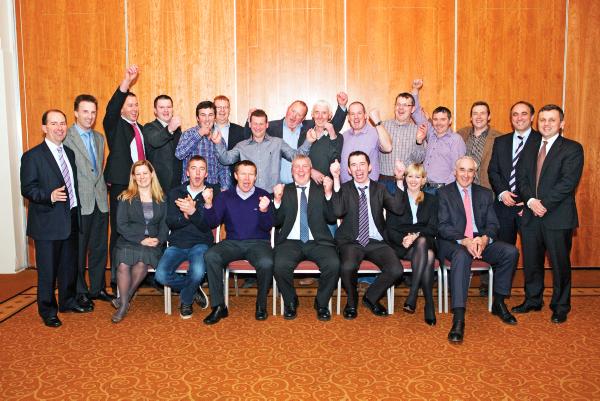
The group, led by chairman Brendan McGarry and group facilitator Jim Moyles, were crowned overall winners and received a cheque for €6,000. The project was based on improving health and safety on their farms and developing a template that other groups could follow to better improve safety on all their farms.
The west Offaly group came out on top of 10 shortlisted finalists just ahead of the Fanesiders discussion group from north Louth and south Monaghan, the Grassmasters discussion group from near Skibbereen and the Crookstown discussion group from near Cork city.
In their presentation to the judges yesterday, group members Aidan Kenny, Hughie Egan and Brendan McGarry described how when they first started discussing the idea of taking on a health and safety project, some members thought it wasn’t worthy of merit.
Aidan said: “Like most farmers, when we first started talking about this project, the eyes either went up to heaven or down to the floor. However, when we discussed the statistics that farmers are 10 times more likely to be killed at work than other professions, the group soon decided it was worthy of focus and if one life was saved or one injury prevented then it would be well worthwhile.”
Since February, the group has met 14 times and each of these meetings included some component of health and safety. One of the first tasks completed by the group was to complete the electronic risk assessment tool on www.farmsafely.com
The website breaks down farm safety into nine separate headings or hazards ranging from precautions for children and older farmers to improving personal health of farmers. Over the course of nine on-farm group meetings, the group spent time discussing one individual category or safety hazard and how it applied to both the host farmer and the other group members. As a result of this, the group produced a farm case study booklet with photographs illustrating hazards identified on members’ farms and the corrective action taken.
During the year, the group also had a presentation from health and safety inspector Anthony Morahan and a full days training from Farm Relief Services. They spoke to insurance companies FBD and Aviva and both companies gave assurances of a possible group discount once the project was completed.
Farm safety equipment was purchased in bulk for the group for items such as PTO shaft covers and dust masks from local companies Belmont Plant and Equipment and Brosna Safetywear.
A total of 226 corrective actions, or on average 16 actions per member, were taken to improve farm safety on member farms. On Tuesday, when questioned about what they felt helped completion of the project, they suggested their decision to assign group mentors who were very familiar with computers to lead specific safety areas was a key move to get other group members familiar with the website and computer use.
Three lead mentors had the passwords and login numbers for the farm safely website and could check if members of their team completed the risk assessment tool.
Aidan said: “We got great buy-in from group members when we set out the tasks to be completed. The HSA website (www.farmsafely.com) is very easy to use and navigate and eventually we see a time coming when it will be compulsory to complete such a tool.”
After reading details of the project in the mid-term review published in the Irish Farmers Journal in July, Tommy O’Sullivan from the Health and Safety Authority (HSA) contacted the group and encouraged the group to enter a European wide safety competition. As a result, the Offaly project has been selected as the Irish entry to go forward to the European Good Practice Awards.
The contact names and numbers
South Offaly (Operation cost control) - Eoin 087-9968442 email: eointoohey@vodafone.ie
Kilkenny (Host farm evaluation sheet) – Bill 087-2943387 email: billokeeffe@eircom.net
Gorey (Herd Health Plans) – Alan 086-3104283
email: alanthomaspoole@gmail.com
West Offaly (Operation lifesaver) – Aidan 086-8277456 email: kenny.annette@gmail.com
Forge (Natural service sires) – Mike 087-9879795
email: msbateman@eircom.net
Crookstown (Genomics for fertility) – Jerome 086-2795582 email: jmdesmond@eircom.net
Navan (Stress & mental health) –TJ 087-8183062
email: tjmeegan@iol.ie
Grassmasters (Dairy Dashboard) – Jerome 087-2363401
email: jeromeomahony@gmail.com
Clonakilty (Labour efficiency) – Tommy 086-8414685 email: dunowenfarm@eircom.net
Fanesiders (Pairs for profit) – PJ 086-8161428
email: boylanpjb@eircom.net
Milk solids texting
Reserve overall winners and joint winners of the innovation for industry category were the Grassmasters discussion group with their project ‘the Dairy Dashboard’. In this project, the 18 dairy farmer members set out to design a simple web-based application that would deliver real time information to the group members instantly on their smart phones or computers rather than waiting on weekly, monthly or quarterly reports. They wanted to be able to compare the value of the milk solids which was collected from their farms and compare against group members almost instantaneously so that they could change management to improve performance quickly before a negative trend developed.
The information supplied to their phones or computers is presented in kilogrammes of milk solids and euros per cow to provide a universal comparison. Since the project started, both Lisavaird and Drinagh co-ops are now sending text messages to all suppliers showing the milk solids collection and the value of one kilo of milk solids based on the previous month’s milk price. Group member Dan McCarthy said: “Getting information in the proper language, we want results in milk solids and the value of milk in euros. Allowing us to make a comparison with other group members will allows us to make changes to management to improve performance.”
Pairs for Profit
Reserve overall winners, the Fanesiders discussion group, won the innovation for groups category with their project ‘Pairs for Profit’. Essentially, the 14 members of the group divided up into pairs and visited each other’s farms on a regular basis to look closely at fertility on each other’s farms. They have a mix of spring and autumn suppliers in the group on many different soil types with many different cow types. At the start of the year, they felt ongoing fertility issues were a constant drain on profits and high empty rates were not reducing despite genetic improvement. As there are 16 members in the group farms were visited infrequently so the group divided into eight pairs and each member visited partner farms on six specified dates in 2012. Three decisions taken from visits were written and shared with all members. As a result of the intense focus on fertility, the group felt they have reduced calving interval by five days, reduced empty rate by 3%, six week in-calf rate has improved by 2% and submission rate increased. The group had training on body condition score and discussions with vets and specialists and all now understand the fertility reports produced by ICBF. When questioned, James O’Connor said: “We have a policy of full disclosure of all information in our group and the very fact of one person coming into your farm to check up on you puts pressure on you to act and understand.”
Durable Genomics
Joint winners of the innovation for industry category and reserve overall winners were the Crookstown discussion group with their project ‘Genomics for fertility’. This group decided to genomically test their replacement heifers to establish a reliable and more accurate proof of their EBI. Secondly, the top 20% of cows were examined in terms of durability to test if the cows with good fertility and production were leaving more profit as a result of their genetic make-up. They wanted to establish whether any additional profit is possible by selecting dams with a good track record for future replacements profit potential. Based on their findings, they suggest the industry should accelerate sexed semen development so they can be used on high durability cows. They suggest farmers should genomically test maiden heifers to get a better picture of dams’ genetic potential as their research clearly shows a link between daughters and dam. They also suggest farmers should endeavour to breed replacements from the calvings in the first six weeks and they found calves from heifers have an equal chance of surviving as those born from cows. Group member Dick Cronin said: “Every farmers gets a dairy cow report from ICBF and it needs to be studied carefully and it has some excellent information.”
KEY POINTS
Mid-term review
Discussion groups presented a mid-term review to the judges in July. Two weeks ago, the groups delivered an end of project report detailing the idea, process and the outcomes of the project. Six judges awarded marks to the projects and on Tuesday each group presented their project and answered questions to an audience of 250 dairy farmers and industry representatives.
The 2012 marking system was:
The idea – 20 marks
Evidence of group activity – 20 marks (All members involved, part of group meetings)
Benefits to other groups & industry – 20 marks (template and applicability)
Increased productivity and profit – 10 marks (Evidence)
Measurement and reporting systems – 10 marks (Reporting systems and final report)
Evidence of scoping and research – 10 marks
Presentation, including Q&A – 10 marks.
In allocating marks for a project, judges could only award marks based on what was articulated in the submitted report.



SHARING OPTIONS