If progress is measured in doing better than you did the previous time, Ireland can already mark this Women’s Rugby World Cup as a win of sorts.
The competition gets underway on Friday night as hosts England take on the USA, with Ireland’s campaign beginning against Japan in Northampton on Sunday. Having failed to qualify for the 2021 edition, just being there marks an uptick in the Ireland graph.
Prior to third-placed finishes in the last two Six Nations Championships, Ireland finished without a win as recently as 2023. The end of a precipitous fall after winning a grand slam in 2013 and then reaching the World Cup semi-finals the following year.
Fiona Coghlan was captain for both of those milestones and retired from international rugby after 2014. Having seen plenty of disappointment in the decade since, she is looking forward with anticipation.
“First off, I’m really excited that they’re back on the world stage and back at a World Cup,” she says.
“After not being there the last time, after that hugely disappointing qualification campaign, seeing them back at the top table is brilliant.
“In terms of how they do, I think the way the pool falls for them – Japan first, then Spain – you go after them hard and you guarantee yourself a quarter-final.
“Then, what you choose to do after that with the New Zealand game, that’s up to the coaches. Nowadays, you play every weekend, whereas we used to play every four days and you have a bigger squad now as well. I’m confident they can get to a quarter-final.
“Looking at the other pool, that game might turn out to be against France, and you just don’t know about France – they were really poor last week against England and I think Ireland might fancy their chances because of the Six Nations game this year. They felt like they got away from them.
“I’m confident that they’ll get to a quarter-final and then anything after that is a bonus.”
If Ireland do qualify from their group, they would be contesting a first knockout World Cup game since that epic run of 2014. Coghlan has been impressed with how the fortunes have been turned around.
“The 2017 World Cup was disappointing,” she says, “my former teammates were still playing and I knew they were better than what I was seeing on the pitch.
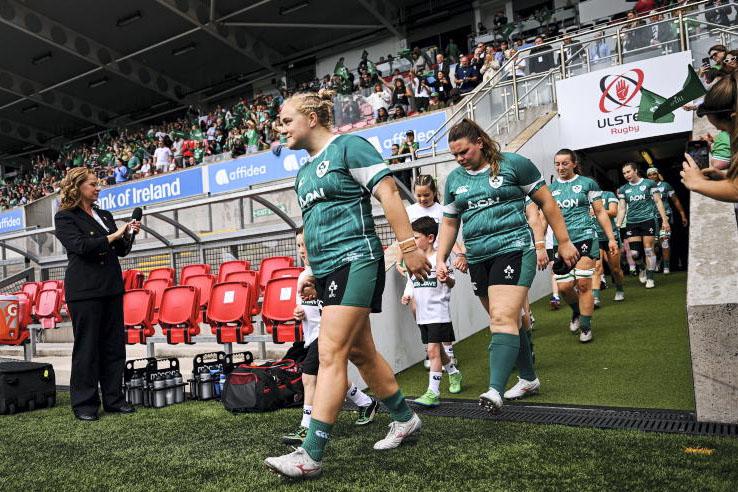
Cliodhna Moloney-MacDonald of Ireland before the Women's Rugby World Cup warm-up match between Ireland and Canada at Affidea Stadium in Belfast. \ Ramsey Cardy Sportsfile
“That was really tough to look at because you’re like, ‘I know you’re capable of better than this.’ Then, it got worse again – you think you’re at the bottom and then something else happens!
“In fairness to the current squad, I think their trajectory in the last 18 months has been really impressive.
“To go from the depths of not qualifying, not making a World Cup, to then winning WXV3 [an annual tiered competition], third in the Six Nations, then in WXV1, they beat New Zealand, they finished second and then they come back in the Six Nations, where they finished third again.
“I know that the Scotland game was hugely disappointing for them as well, but I think their trajectory has been really positive.
“It just shows when they’ve gone professional, the support around them, the talent in the country, that it’s there.
“The progress has been fast, but I think taking the next step is going to be slower.”
Changing to professional status isn’t a magic bullet, of course, as it has to be under-pinned by serious effort.
“I was at the team’s send-off for the World Cup and they spoke a lot about what they did,” Coghlan says.
“Seán Ryan was mentioned, he came in changing their culture, their purpose about what they were, so there was a lot of off-pitch stuff that they actually did first.
“They spoke about having honest conversations and things like that. And that just seemed to really cement their identity and the ‘Green Wave’.
“I know that can be a bit of a cliché and a slogan and a tagline, but that’s what they have all bought into now.
“I think the pathways are improving and you see young players now stepping up. Obviously, when you go professional, there’s going to be physical gains, because you’re getting the recovery and everything supported around it as well. So I think it is a mixture of things.”
Squad announcement
Hand-in-hand with that has been the increased levels of interest in Irish women’s rugby and the sport as a whole.
The squad announcement video on social media garnered a lot of positive attention. Such exposure brings increased expectations but Coghlan feels there are more positives than negatives.
“To be fair, I thought that video announcement was the best of any of them, It was brilliant.
“It’s just that awareness piece, that a lot of people didn’t know about women’s rugby back ten years ago – it was basically that World Cup, even more so than winning the Grand Slam the previous year.
“Women’s rugby in general has totally transformed in terms of TV coverage, sponsors involved, numbers playing, standards of the games – now it’s a World Cup with 16 teams as opposed to 12 previously.
“The whole landscape has changed and that brings added pressure that probably wasn’t there before, but the squad have an expectation of themselves as well.
“But, I think fundamentally, the big thing is that young girls can see that, there’s an Irish women’s rugby team and they’re at the top of the game, and if they reach that level, that potentially could be a job for them, down the line.”
It seems it will all be on the line for team Ireland this month.
If progress is measured in doing better than you did the previous time, Ireland can already mark this Women’s Rugby World Cup as a win of sorts.
The competition gets underway on Friday night as hosts England take on the USA, with Ireland’s campaign beginning against Japan in Northampton on Sunday. Having failed to qualify for the 2021 edition, just being there marks an uptick in the Ireland graph.
Prior to third-placed finishes in the last two Six Nations Championships, Ireland finished without a win as recently as 2023. The end of a precipitous fall after winning a grand slam in 2013 and then reaching the World Cup semi-finals the following year.
Fiona Coghlan was captain for both of those milestones and retired from international rugby after 2014. Having seen plenty of disappointment in the decade since, she is looking forward with anticipation.
“First off, I’m really excited that they’re back on the world stage and back at a World Cup,” she says.
“After not being there the last time, after that hugely disappointing qualification campaign, seeing them back at the top table is brilliant.
“In terms of how they do, I think the way the pool falls for them – Japan first, then Spain – you go after them hard and you guarantee yourself a quarter-final.
“Then, what you choose to do after that with the New Zealand game, that’s up to the coaches. Nowadays, you play every weekend, whereas we used to play every four days and you have a bigger squad now as well. I’m confident they can get to a quarter-final.
“Looking at the other pool, that game might turn out to be against France, and you just don’t know about France – they were really poor last week against England and I think Ireland might fancy their chances because of the Six Nations game this year. They felt like they got away from them.
“I’m confident that they’ll get to a quarter-final and then anything after that is a bonus.”
If Ireland do qualify from their group, they would be contesting a first knockout World Cup game since that epic run of 2014. Coghlan has been impressed with how the fortunes have been turned around.
“The 2017 World Cup was disappointing,” she says, “my former teammates were still playing and I knew they were better than what I was seeing on the pitch.
Cliodhna Moloney-MacDonald of Ireland before the Women's Rugby World Cup warm-up match between Ireland and Canada at Affidea Stadium in Belfast. \ Ramsey Cardy Sportsfile
“That was really tough to look at because you’re like, ‘I know you’re capable of better than this.’ Then, it got worse again – you think you’re at the bottom and then something else happens!
“In fairness to the current squad, I think their trajectory in the last 18 months has been really impressive.
“To go from the depths of not qualifying, not making a World Cup, to then winning WXV3 [an annual tiered competition], third in the Six Nations, then in WXV1, they beat New Zealand, they finished second and then they come back in the Six Nations, where they finished third again.
“I know that the Scotland game was hugely disappointing for them as well, but I think their trajectory has been really positive.
“It just shows when they’ve gone professional, the support around them, the talent in the country, that it’s there.
“The progress has been fast, but I think taking the next step is going to be slower.”
Changing to professional status isn’t a magic bullet, of course, as it has to be under-pinned by serious effort.
“I was at the team’s send-off for the World Cup and they spoke a lot about what they did,” Coghlan says.
“Seán Ryan was mentioned, he came in changing their culture, their purpose about what they were, so there was a lot of off-pitch stuff that they actually did first.
“They spoke about having honest conversations and things like that. And that just seemed to really cement their identity and the ‘Green Wave’.
“I know that can be a bit of a cliché and a slogan and a tagline, but that’s what they have all bought into now.
“I think the pathways are improving and you see young players now stepping up. Obviously, when you go professional, there’s going to be physical gains, because you’re getting the recovery and everything supported around it as well. So I think it is a mixture of things.”
Squad announcement
Hand-in-hand with that has been the increased levels of interest in Irish women’s rugby and the sport as a whole.
The squad announcement video on social media garnered a lot of positive attention. Such exposure brings increased expectations but Coghlan feels there are more positives than negatives.
“To be fair, I thought that video announcement was the best of any of them, It was brilliant.
“It’s just that awareness piece, that a lot of people didn’t know about women’s rugby back ten years ago – it was basically that World Cup, even more so than winning the Grand Slam the previous year.
“Women’s rugby in general has totally transformed in terms of TV coverage, sponsors involved, numbers playing, standards of the games – now it’s a World Cup with 16 teams as opposed to 12 previously.
“The whole landscape has changed and that brings added pressure that probably wasn’t there before, but the squad have an expectation of themselves as well.
“But, I think fundamentally, the big thing is that young girls can see that, there’s an Irish women’s rugby team and they’re at the top of the game, and if they reach that level, that potentially could be a job for them, down the line.”
It seems it will all be on the line for team Ireland this month.





SHARING OPTIONS