


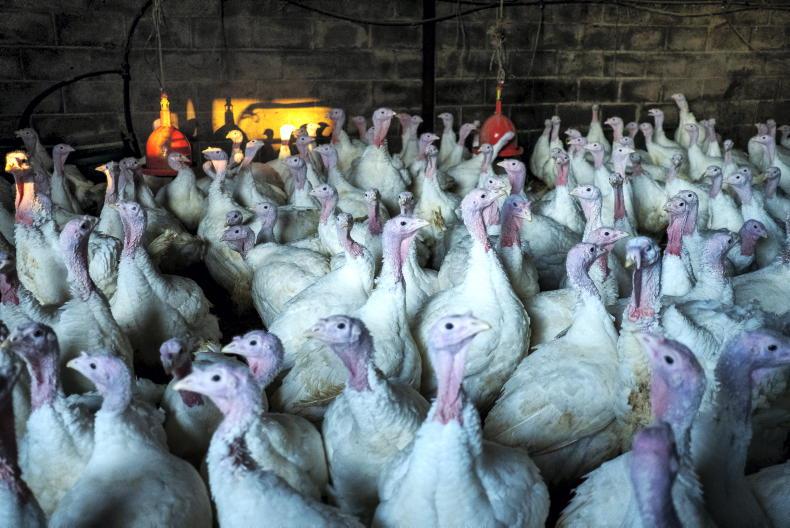
A woman employed seasonally for 20 years by a Co Carlow poultry farm has been awarded redundancy at the Workplace Relations Commission (WRC).
Teresa Kane was able to produce a signed employee handbook given to her by her former employer JR Boning (Ireland) Ltd at the commencement of her employment in 2004.
Representatives for the turkey farm she worked on did not attend the WRC hearing.
However, in a submission, Joe Rice, representing the respondent JR Boning, said no records were available prior to 2019.
It was the respondent’s case that Ms Kane’s employment was terminated at the end of each season. Between 2019 and 2023, Ms Kane worked lengths each year varying between six and 10 months.
Ms Kane said she worked 39 hours each week, sometimes seven days per week, mostly from summer to Christmas time, at the farm in Meadowbank, Kellistown, Co Carlow.
Ms Kane said she was employed from August 2004 up to the farm’s closure in March 2024, which she was not informed of.
When she discovered the closure in August 2024, she wrote to the respondent seeking a redundancy payment.
As she did not receive a response, she referred the matter to the WRC.
She said she only received a P45 after each season in the first few years and then did not get anything. She said she did not get regular payslips.
Decision
WRC adjudication officer, Seamus Clinton, awarded Ms Kane a lump sum statutory redundancy payment under the Redundancy Payments Acts 1967-2012.
The redundancy was ordered from the start of employment on 4 August 2004 to the date of her termination on 17 December 2023.
Mr Clinton said JR Boning ascertained that it terminated Ms Kane’s employment at the end of each season, but did not submit any evidence and did not attend the hearing to clarify this.
The adjudication officer said he was “not satisfied” with JR Boning’s submission that Ms Kane was not entitled to redundancy because the employee handbook stated:
“The business is seasonal by its very nature. Consequently, at certain times, layoffs, short time working and redundancies may be necessary.”
Ms Kane had continuous employment for 20 years, Mr Clinton said, and had attained seniority within the business.
“She was effectively a regular employee although did not work for several months each year due to the nature of the business.
“This is consistent with the complainant’s testimony that she worked every year for 20 years and was effectively a permanent employee, although did not work for several months each year,” added Mr Clinton.
He said throughout this employment she had assumed rights to a contract of indefinite duration in accordance with the Protection of Employees (Fixed Term) Work Act 2003.
Under this act, he said Ms Kane was in continuous employment and was dismissed by her employer due to redundancy.





SHARING OPTIONS