


Anthelmintic resistance (AR) is one of the biggest challenges to the future health and profitability of the sheep industry. Task 3 of the Sheep Technology Adoption Programme (STAP) aims to help farmers come to terms with the problem of anthelmintic resistance at farm level.
Whether participating in STAP or not, faecal egg counts (FEC) are very useful in helping to prepare a dosing programme on every farm. It is important that the results of such tests are interpreted correctly. The objective of this article is to provide guidance to farms on interpreting such tests.
STAP Faecal test
The objective of Task 3 of STAP is to carry out a faecal test to help to establish if there is a level of parasite resistance to the commonly used anthelmintics (i.e. White drench; Benzimidazole (1-Bz), Yellow drench; Levamisole (2-LV) and clear drench/injection Macrocyclic Lactone (3-ML) (includes Ivermectin).
This test must be carried out between 1 June and 20 September 2013, in accordance with the terms and conditions of STAP. It involves:
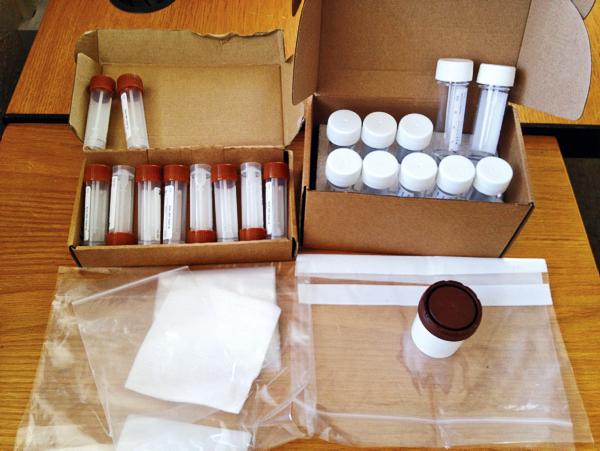
Taking a faecal sample sometime after 1 June and having a Faecal Egg Count carried out by an approved laboratory.
Dosing with an anthelmintic from one of the three groups described above immediately after taking the sample.
Repeating the FEC either seven days post-dosing if a Levamisole (2-LV) was used or 14 days post-dosing if Benzimidazole (1-Bz) or Macrocyclic Lactone (3-ML) doses were used.
This test gauges the efficacy of the anthelmintic used. It gives an indication of the anthelmintic inefficiency. It does not necessarily indicate anthelmintic resistance or otherwise as other factors influence the test result.
||PIC2||
INTERPRETING TEST 1
For the purposes of Task 3 under STAP, most of the approved laboratories are reporting on the level of eggs present in faecal samples for the following:
1 – Strongyle worms which include mainly
2 – Trichostrongylus, Cooperia and Teladorsagia spp.
3 – Nematodirus spp.
Coccidial oocysts
While Cooperia included at 1 above is not particularly pathogenic and in general is of little concern, their eggs are similar to the other strongyle eggs and it will contribute to the FEC (De Waal, 2013, personal communication).
Some laboratories are also reporting on the number of:
Strongoloides, which is a threadworm and is far less pathogenic and should not be confused with the Strongyles.
Moniezia, which is a tapeworm and again not of major concern.
Lungworms, (including Dictyocaulus sp.) and is generally of low significance.
||PIC3||
Strongyle species
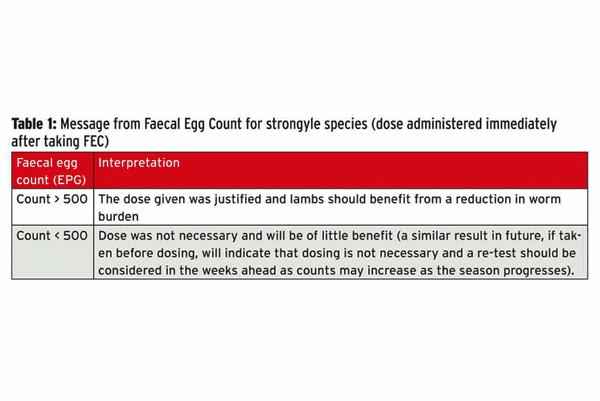
Having taken sample 1 of the STAP faecal test, lambs will have been dosed after sampling and before receiving the test result. The main worms of concern for lambs from 1 June onwards are the Strongyle worm species. The message to be taken concerning Strongyles from this first test is summarised in Table 1.
Nematodirus spp.
Assuming that by mid to late June, lambs will be greater than 10 weeks old, a high egg count for Nematodirus is probably of little significance because:
Lambs tend to become resistant to Nematodirus from 10 to 12 weeks of age.
Egg production tends to be high when the number of larvae in the gut are low.
There are several species of Nematodirus with Nematodirus battus being the only pathogenic species for lambs. The worm eggs identified in the egg count may also include non-pathogenic species.
||PIC4||
However, if lambs show signs of black scour, straining, dehydration and generally being unwell, Nematodirus could be causing the problem and a dose may be justified. Furthermore, a dose may be considered to reduce the worm egg burden being passed onto the pasture for next year.
Coccidia
Where the level of coccidian oocysts is high, there may or may not be a problem.
Lambs tend to be infected with small numbers of coccidian parasites and develop immunity to these parasites from about eight weeks of ages. However, the immunity will not develop if the lambs do not have some exposure to coccidia. Furthermore, husbandry and management may lead to high challenge and even immune animals may develop clinical symptoms (De Waal, 2013 personal communication).
As with Nematodirus, there are several species of coccidia that are non-pathogenic and these may give rise to the high oocyst count in the test.
On the other hand, the coccidia present may in fact be pathogenic. Therefore, if there is an unexplained scouring or lack of thrive, the results should be discussed with a veterinary surgeon as coccidia may well be the cause.
Other species
Strongoloides, Moniezia and Dictyocaulus spp. are far less pathogenic in sheep than the groups of parasites discussed above. High egg counts should only be of concern if there is some unexplained problem, such as excessive coughing among lambs (not common) which may be associated with a high level of lung worms.
INTERPRETING TEST 2
The purpose of taking the second test is to determine the efficacy of the anthelmintic used following taking the initial test. Therefore, the result of this test must be examined in conjunction with the first test.
The proportional reduction in egg count is important. While dosing is generally not recommended at counts of less than 500 strongyle eggs per gram, the proportional reduction in egg numbers can be calculated at much lower counts. This is calculated as follows:
((egg count test 1) – (egg count test 2)) X 100
egg count test 1
If the result is >95%, it is considered there is no problem with the anthelmintic.
If the result is <95%, it is considered there is a problem and anthelmintic resistance is likely if dosing guidelines were adhered to correctly.
Decisions based
on FEC result
Whether participating in STAP or not, faecal egg counts are very useful and can provide valuable information. They can be used to:
Help determine the need to treat animals or not.
Help time treatments better.
Test the efficacy of the treatment.
Reduce the number of treatments where anthelmintics are used excessively.
Obtain information on the level of contamination going onto pasture.
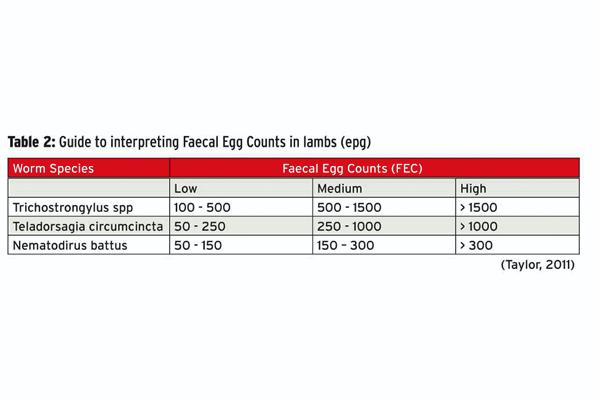
Table 2 provides a guide to interpreting low, medium and high faecal egg counts in lambs in terms of eggs per gram for the main pathogenic roundworm species in Ireland.
When Strongyle worm egg counts are in the medium to high category in lambs during the early summer months, a dose is usually justified.
SCOPS, (Sustainable Control of Parasites in Sheep), is an industry-led group in Britain that represents the interests of the sheep industry. This group has produced a technical manual with advice which is just as relevant for farmers in Ireland as in Britain. The full manual is well worth a read and can be accessed on the following website: http://www.scops.org.uk/content/SCOPS-Technical-manual-4th-Edition-June-2012.pdf.





SHARING OPTIONS