



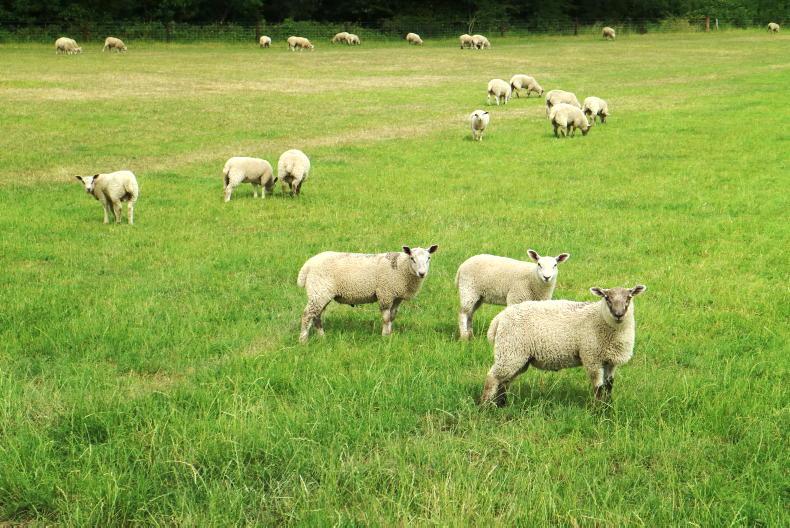
Drought management: There is massive variation in grass supplies across the country.
The southeast is obviously most affected but there are also pockets in counties in the midlands and west facing challenges on dry, free-draining soils.
In such cases there is little option but to supplement lambs to keep them moving.
Failing to do so will only result in lambs requiring a much longer finishing period and in the worst cases, having their growth stunted. Feeding concentrates will reduce grass demand.
An allocation of 1kg concentrates will on average reduce grass dry matter intake by 0.6kg/head/day.
The optimum level of supplementation will depend on grass supplies. Where grass supplies are in an OK position, then an allocation of 0.3kg to 0.5kg concentrates will enhance performance.
However, where grass supplies are depleted or swards are practically scorched/burnt then performance will be poor and lambs will be nearly entirely reliant on the level of supplementation to drive performance. In such cases, supplementation will need to be increased to 0.7kg to 0.8kg to keep performance at a reasonable level (daily liveweight gain ranging somewhere from 150g to 180g).
This level of supplementation may be most suitable to lambs which are a significant distance from finishing and would end up consuming very high levels of concentrates, if fed high amounts. It is also more suitable to ewe lambs which will be retained for breeding with the aim of keeping these lambs thriving until grass supplies recover. A forage source will also be required.
A better response to feeding higher levels of concentrates will be achieved from feeding ram lambs intensively, as such lambs have the ability to achieve a better feed conversion ratio than wether or ewe lambs. Ram lambs also have a lower risk of going overfat.
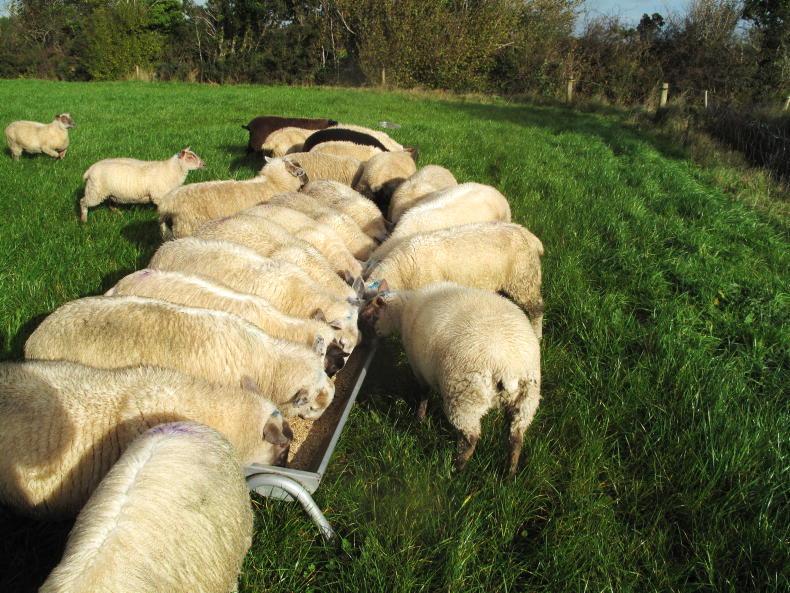
Targeted feeding in troughs will suffice while where lambs are fed ad lib; they will consume 1.3kg to 1.4kg concentrates daily while individual lambs will consume upwards of 1.7kg/day during the finishing phase. It is vital that lambs are built up to ad lib feeding levels gradually.
Next week’s notes will deal closer with management of ewes but where grass supplies are depleted, then forage supplementation is vital.
Slaughter performance: There are continued reports of lambs killing poorly, which is not surprising given the tighter and poorer-quality grass supplies that lambs have been offered in recent weeks. Some farmers are reporting ram lambs in particular killing poorly with kill outs as low as 40% and even lower for aged ram lambs that are possibly shy on fat cover.
Other farmers are reporting lambs which would normally kill out in the region of 44% to 45% at this stage of the year killing 2% to 3% below the norm. This is resulting in some cases where lambs are being drafted at light weights at risk of killing at less than 17kg carcase weight and subject to a price penalty. Where there is any doubt regarding kill outs, it is wise to err on the side of caution and to increase drafting weights or to consider selling live.
There is an economic response in feeding lambs a restricted level of concentrates to underpin performance and boost slaughter performance. This will not kick in overnight however and to get the benefit lambs will need to be supplemented for a few weeks before drafting for slaughter.



SHARING OPTIONS