



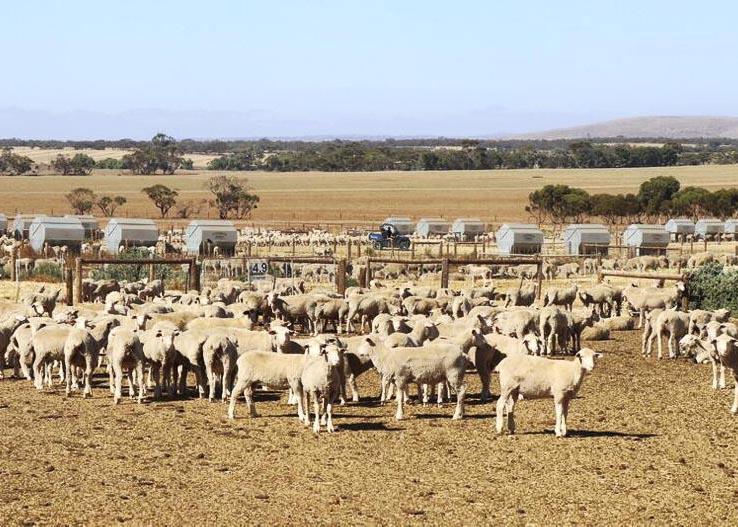
The latest Meat Livestock Australia (MLA) sheep industry projections are predicting a quick turnaround in fortunes for Australian sheep numbers. The Australian national flock has been hit hard by consecutive below-average seasonal conditions across many regions, resulting in numbers reducing by 6.4% and recorded at 74.2m head as of June 2025.
The forecast recovery in production is stemming, in part, from past experience on how the sector responds to drought.
MLA states that after liquidation phases output averages tend to increase as flocks become more efficient – “lower-performing animals are culled, while producers retain and multiply the genetics that deliver higher marking rates, faster growth and better feed conversion”.
MLA explains that this pattern was clear after drought in the 2000s with the subsequent rebuild settling at an average production level approximately 25% higher than before.
A similar lift of 23% was recorded after dry conditions that ended in 2019. The scale of the rebuild is expected to be more cautious this time around but lamb production is expected to come within 4% of the record high in 2024 and reach an even higher level in 2027, as detailed in Figure 1.
The big driver in the production increases has been carcase weight with the industry steadily increasing average carcase weight.
As also reflected in Figure 1, average carcase weight has increased from approx 20kg in the early 2000s to about 25kg currently.
This has been aided by growth in sheepmeat exports to the US market, which has a preference for larger cuts, and a continued switch from flocks retaining sheep for wool and converting to meat production.
Significant numbers of wool-dominant Merino systems have been replaced by meat breeds or Merino production systems with a greater focus on meat production.
The dip in carcase weights seen in 2023 to 2024 was reflective of poor feed-quality in parts of the south which pushed higher numbers of lighter and unfinished lambs on to the market.
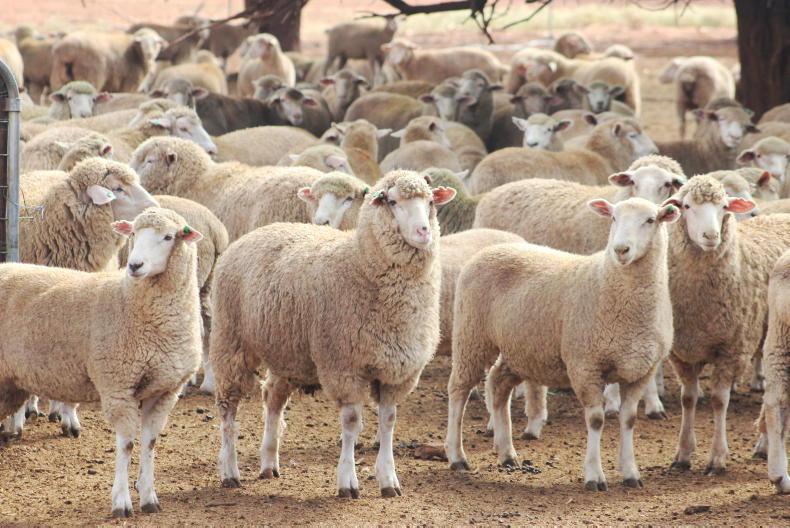
A stabilisation in seasonal conditions is expected to give rise to a recovery in carcase weights through 2026 and 2027, while the experience of recent years’ droughts has established large-scale intensive finishing operations which now need throughput to stay in operation. Many such systems are focused on bringing sheep to heavier carcase weights to maximise output.
Lamb carcase weights are forecast to increase by 0.7kg in 2025 to average 24.5kg followed by a further 0.4kg increase in both 2026 and 2027.
Lamb throughput started the year strongly but the report predicts that it will tighten towards the end of the year and this situation is materialising at present.
Lamb slaughter in 2025 is forecast to reach 24.9m head which would represent a decline of 5.8% on 2024.
Throughput is forecast to tighten further before it recovers as farmers look to rebuild and possibly retain a higher number of replacements.
This is expected to have a minimal effect with MLA also predicting that farmers will look to retain their existing ewes for longer after culling hard in recent years.
The outcome is lamb throughput predicted to tighten by 2.2% to 24.3m head before rebounding strongly in 2027 and increasing by 5.4% to 25.6m head.
This, combined with increased carcase weights, is predicted to underpin lamb production increasing from 607,000t in 2026 to 651,000t in 2027.
This is significantly above the record level of 630,000t in 2024.
The supply forecast also accounts for lower live exports which are being phased out.
Ewe throughput in 2024 increased by 20% to reach 11.78m head.
Throughput is expected to fall to 9.65m head in 2025 and experience another significant decline to 8.16m head in 2026, before returning to more normal levels in 2027.
Tighter supplies of Australian sheepmeat on the global market helps to sustain a floor under price. The volumes discussed above are at such a level that if market performance dips in one Australia’s key export markets it could mean more supplies being diverted to other markets.
New Zealand sheep farmers know the full consequences of such a scenario having grown sheepmeat exports to China to 50% of their export volumes and subsequently losing market share to Australian sheepmeat exports.
This has put increased pressure on exports in recent years with farmgate prices trending about €1/kg behind Australia.
The increase in Australian exports has to date found a home in increased demand from the US market in particular and increased exports to China as mentioned above.
From a European context Australia is focused on growing exports to the UK market following the agreement of the UK- Australia Free Trade Agreement which came in to place mid-way through 2023.
The agreement gives Australia access to a tariff-free quota which will increase from 30,556t in 2024 to 75,000t in 2032.
The latest data from the Australian Government Department of Agriculture, Fisheries and Forestry shows that Australia has filled 43% or 15,350t of its UK-Australia tariff free quota for 2025 of 36,111t.
Australia also has a historic World Trade Organisation (WTO) tariff-free quota with the UK for 13,335t of sheepmeat and as of 13 October 2025 has filled 95% or 12,596t. It has a smaller EU quota under the same WTO agreement of 5,851t and has filled 87% or 5,121t of this quota.
The projected figures are based on the assumption of a return to normal seasonal weather conditions. MLA explains that medium-term projections are based on recent weather conditions and three-month outlooks while long-term projections are based on average seasonal conditions.
It explains that the regions of Victoria, South Australia and Southern New South Wales have experienced 18 months of below-average seasons and that sustained rainfall will be required before a recovery takes hold.
Improved pasture and water availability could trigger faster rebuilding – especially in southern Australia where the majority of the national flock is located. Conversely, a return to drought-like conditions would mitigate recovery.



SHARING OPTIONS