



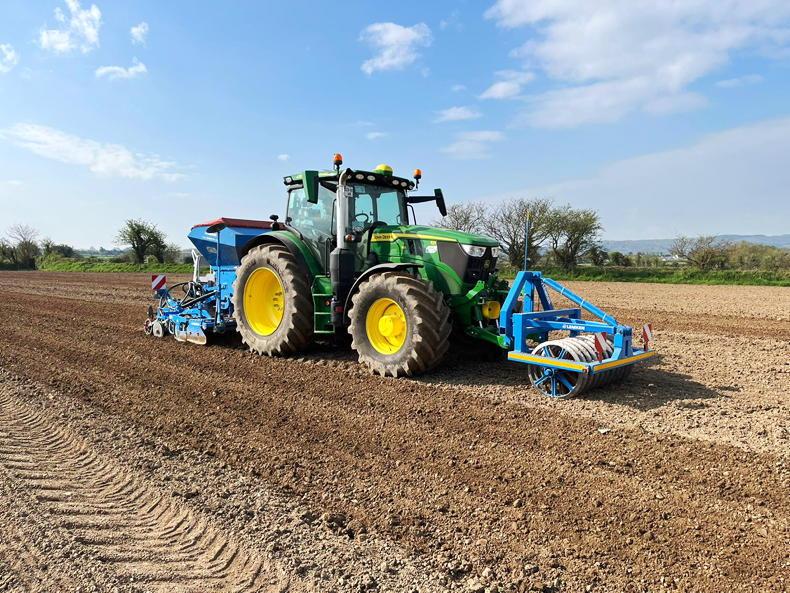
Damien says there has been 168mm of rain in Kilkenny since 8 March. The past week, however, has allowed fieldwork to be caught up on.
Winter barley was given 100kg N/ha on 3 April and was finished last Friday with 35kg N/ha bringing it to a total of 190kg N/ha. The barley had some cleavers, volunteer beans and wild oats to be cleaned up, so Zypar (0.75l/ha) and Axial Pro (0.6l/ha) were applied on 4 April, along with CeCeCe 750 (1l/ha) and Moddus 250 EC (0.2l/ha). Last Friday, it received its first fungicide spray of Proline (0.5l/ha) and Comet (0.6l/ha) but is relatively clean regardless.
The winter wheat received 100kg N/ha on 3 April and the same herbicide and growth regulator mix as the barley a day later.
The third last leaf is starting to peep, with the T1 fungicide timing a week away.
Damien says septoria has kicked on in the past week and is widespread in the crop.
The winter oats received 65kg N/ha on 27 March. Ceraid (1.4l/ha), Cameo Max (45g/ha) and Hurler (0.75l/ha) were applied on 4 April, with Proline (0.5l/ha) and Talius (0.2l/ha) following three days later. Damien notes the crop is quite clean, with little to no mildew.
The winter oilseed rape is in full flower.
A field that was grazed by pigeons has been brought up to 225kg N/ha, while high-GAI fields received 140kg N/ha in total.
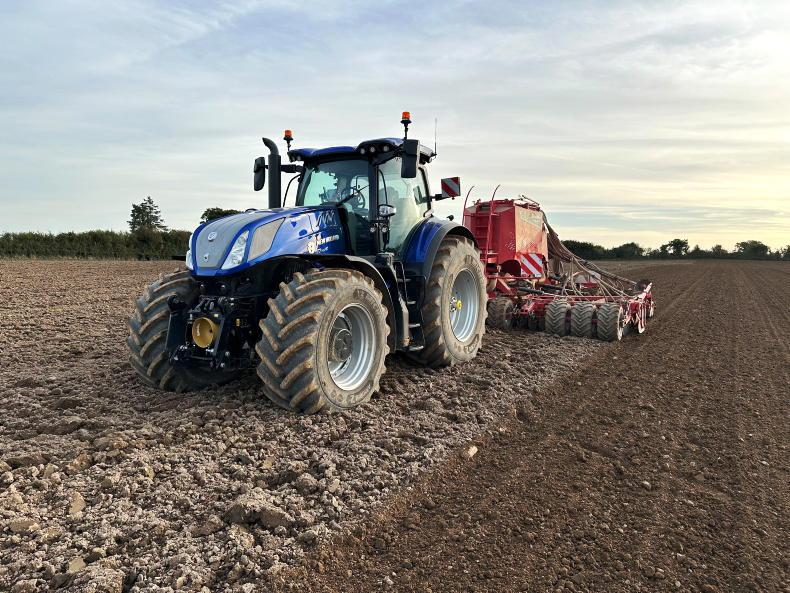
Damien drilled spring barley over the Easter weekend. The Department of Agriculture’s variety evaluation trials were sowed along with barley for the farm.
Damien hopes to sow more barley and oats this week. The spring beans, oats and wheat planted in early March have emerged well despite the rain.
The spring beans did not receive a pre-emerge herbicide as Damien had hoped to do when we last spoke. However, there has been good emergence, and Damien hopes that an application of Basagran SG will keep the weeds at bay.
The winter oilseed rape on Eamonn’s farm is beginning to flower and has been brought up to between 125kg and 155kg N/ha depending on the field. The only further nitrogen it will receive will be N16 foliar nitrogen.
The winter barley looks excellent. It received a T0 of Trinity and Comet at 0.5l/ha each, in addition to Holdup (1l/ha), Moddus 250 EC (0.25l/ha), zinc, and manganese. T1 was applied this week, with Trinity and Amistar applied at 0.5l/ha along with Medax Max (0.4l/ha). All nitrogen has now been applied. The winter wheat is between GS31 and 32 depending on drilling date, and leaf three is between 50 and 100% emerged. It has received its main split of nitrogen, and currently sits at 155kg N/ha. A T1 spray of Alonty, Holdup 750, and Moddus 250 EC will be applied this week. At T0, Eamonn applied Thiopron, K2, and Medax Max.
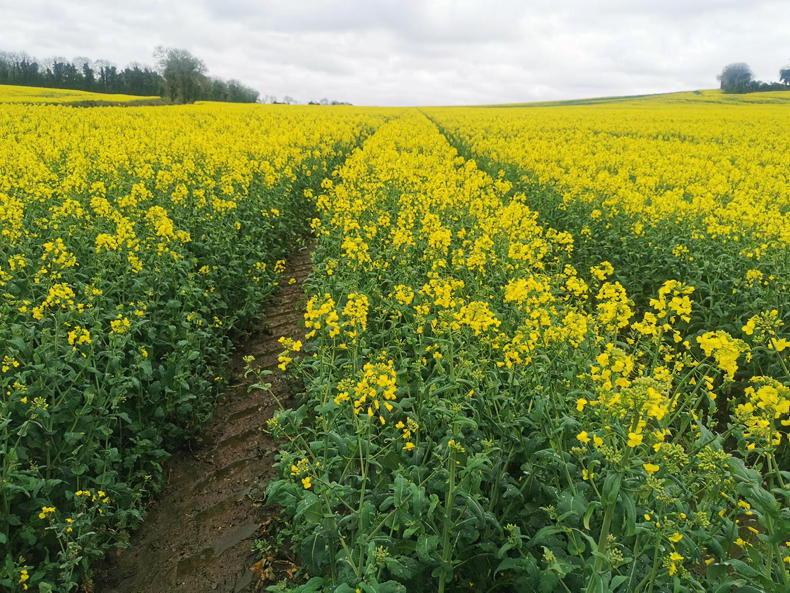
Thiopron is a sulphur-based fungicide and Eamonn sees it as a cheap product which can do some good when he is already applying a growth regulator. Pacifica Plus was also applied recently. Eamonn included SuperFifty Prime, a seaweed biostimulant, and is happy with the result as there is no scorch on the crop.
Eamonn’s winter oats had a decent amount of mildew, but an application of Talius and Midas has cleared this up. It has received 85kg N/ha so far, and another 50kg N/ha will be applied soon.
The spring oats sowed in early March now have four leaves.
There are some patches on headlands, but it’s a very small area, and Eamonn is happy that the crop is sowed. Some 100kg N/ha has been applied. Both winter and spring oats will receive a herbicide of Hurler and Tribe 75WG this week.
Some 20ac of grass has been sprayed off before Geraldine spring barley is established by min-till. Eamonn also plans to apply variable-rate potash to some of his crops next week having taken precision soil samples.
Land is still very wet in Derry, with 65mm recorded on farm in April so far. Alistair says that while his crops wintered well, the prolonged wet weather and standing water has yellowed crops, and patches have emerged. Some 5ac of winter oilseed rape and winter wheat will need to be resowed, and Alistair will do this with spring beans once the ground dries up.
Alistair’s winter oilseed rape has been brought up to 150kg N/ha. After being grazed by sheep, the crop is about two weeks behind other local oilseed rape crops and is just coming into flower.
A total of 3,000 gallons/ac of slurry was applied to winter wheat since last talking to Alistair.
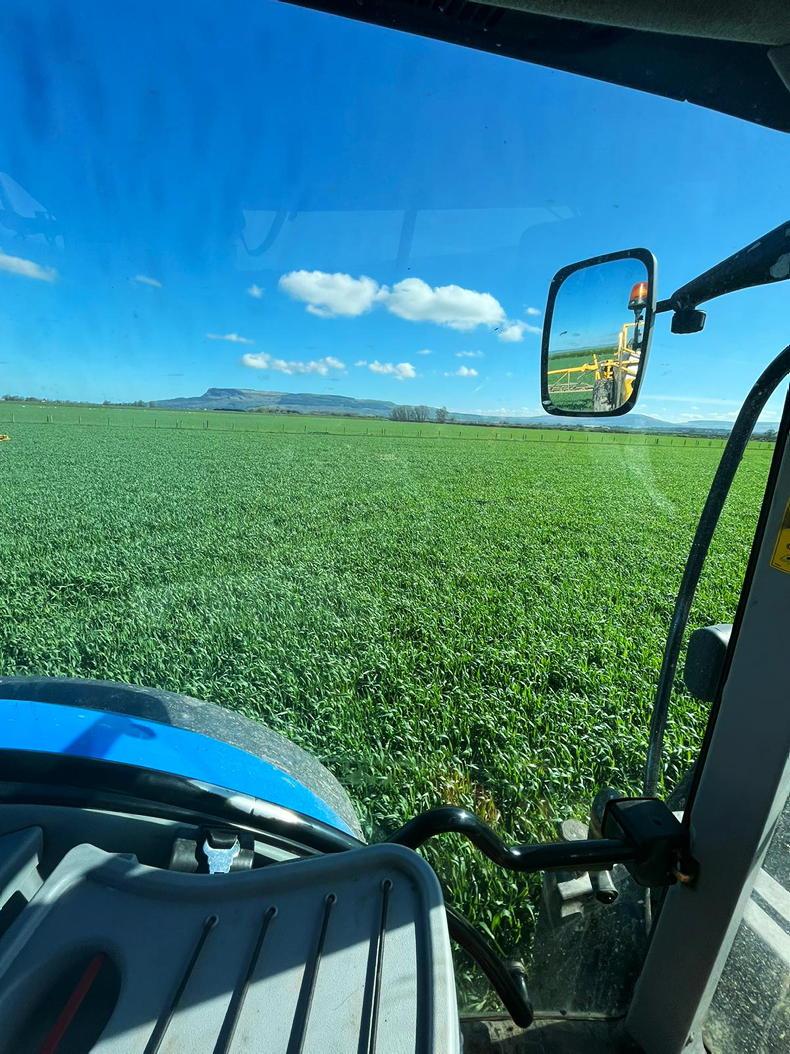
The crop is really starting to green up, since this application. It also received a growth regulator of Chlormequat. It will receive a fungicide and herbicide soon.
The winter rye has received its last fertiliser to bring it up to 160kg N/ha. It will receive a fungicide, growth regulator, and trace elements when conditions allow. This crop is destined for wholecropping and will be used on Alistair’s dairy farm.
Alistair notes that where rye established by plough was driven on twice during slurry spreading (eg on headlands), the rye has done very poorly, and has died in some cases.
It is not an issue in min-till rye fields.
The winter barley received a T0 spray at the end of March. It has received 160kg N/ha so far.
Alistair plans to apply foliar urea at 30kg/ha soon. It will also receive fulvic acid, Medax Max, and epsom salts. A fungicide and herbicide are also planned for this week.
Alistair sees a divide in his barley fields, with some fields showing huge potential, while others are struggling a bit due to the wet weather and waterlogging.
On the dairy side of the farm, Alistair hopes to cut silage as early as next week if the weather allows. Six cuts of high-quality silage are taken every year.



SHARING OPTIONS