



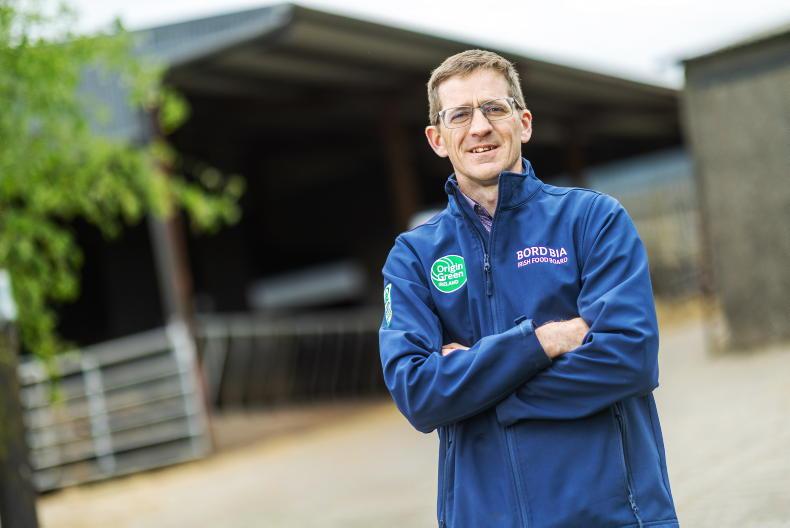
Mick Houlihan comes from a suckler beef farm in Co Kildare, where he still helps out, when time allows, as well as keeping a few cattle of his own. He is an agricultural-science graduate and worked in a number of primarily agri-related jobs prior to joining Bord Bia in 2013.
What do you do in Bord Bia?
My role in Bord Bia is senior manager for agri sustainability. I lead a team that has wide and varied responsibilities within the sustainable assurance and origin green department.
When I joined Bord Bia first, I was responsible for the roll-out and management of the Sustainable Dairy Assurance Scheme, which was a brand-new scheme for Bord Bia and the dairy sector at the time.
I also took on responsibility for managing the Sustainable Beef and Lamb Assurance Scheme as well and, as with any job, the scope of responsibilities grew in line with the ever-increasing emphasis on sustainability driven by policy and the customers for the produce that originates on Irish farms.
Myself and the team are dedicated to meeting the demands in relation to agri sustainability and making sure that these are communicated at all levels to buyers and potential buyers of our produce.
The work varies from working with Bord Bia colleagues engaging with customers in markets around the world, to supporting technical updates to carbon-footprint models that are central to the industry’s sustainability positioning. The agri sustainability team manage the Bord Bia role in the AgNav platform, our partnership project with ICBF and Teagasc.
We work with processors to support their engagement with customers with detailed reporting that supports their quality and sustainability claims.
We represent Bord Bia and the industry in various international sustainability forums, we support our colleagues in standard development and with the integration of farmer-facing initiatives into Origin Green plans set by companies.
I and my colleagues get out regularly to meet farmers at events around the country, which is part of the wider farmer-engagement programme within Bord Bia.
Why is your work important for Irish farmers?
The work is important as there can be a lack of knowledge of Irish agriculture and food production among the customers and consumers of Irish grass-based food production.
We work to bridge that knowledge gap and provide the detail on what makes sourcing from Ireland the sensible approach, and what benefits it offers.
The standards maintained by farmers participating in the Bord Bia schemes and the scale to which they do, along with the depth of information available on sustainability at farm and company level, provide buyers with the important evidence to support a decision to source from Ireland.
How does it add value to the produce coming from Irish farms?
The buyers of Irish agrifood, which starts its journey through the supply chain on Irish farms, have their targets to meet in relation to emissions, responsible sourcing, etc.
Bord Bia’s work, in partnership with Irish farmers, helps them meet those targets due to the infrastructure that exists in the agrifood system in Ireland.
This is where the potential lies. While securing a higher price is always the ambition, it is also about securing market share and building long-term relationships with key customers in key markets.
What would happen if Bord Bia did not do this work?
If Bord Bia wasn’t doing this work, each individual company would need to do it themselves. As well as adding cost to their business, for farmers it would mean the added hassle of multiple factory-organised inspections to do business, instead of one umbrella inspection that covers farmers to trade with any factory that participates in the schemes.
As an organisation, Bord Bia undertakes promotion of the entire industry, which is built on the raw material produced on thousands of Irish farms. We ensure that the produce that begins life on Irish farms before processing in our factories is presented to the top buyers around the entire world.
This is done through promotion of the sustainable-assurance schemes, Origin Green, international marketing campaigns, attendance at trade shows, to name but a few examples.
We make connections and identify opportunities which are passed onto the companies to assess their commercial potential.
The agri-sustainability team plays an important role in making those connections which, ultimately, maximise the value of produce leaving our farms.


SHARING OPTIONS