



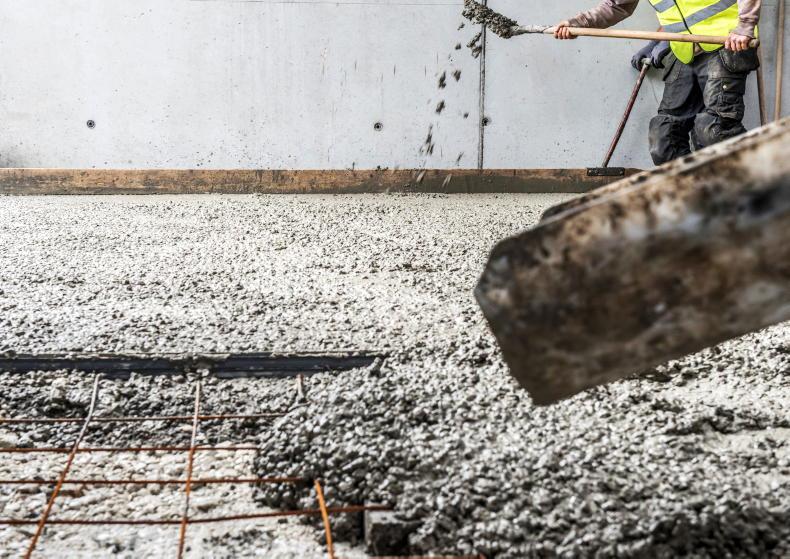
A highly controversial element in Budget 2022 was the addition of a 10% levy on all ready-mix concrete and concrete products from April 2023 onwards.
The levy was to cover the Mica redress scheme, officially known as the “Remediation of Dwellings Damaged by the use of Defective Concrete Blocks Act 2022’’ which puts in place a statutory framework for the provision of grants to homeowners across Ireland whose homes were built using defective products such as concrete blocks that contain excessive amounts of the chemicals known as mica or pyrite.
Revenues raised from the Concrete Levy will finance the provision of grants under this redress scheme.
After much anger from the building and farming industries, the inclusion of the levy was pushed back to September 2023 and the rate dropped to 5%.
Farmers were angry that ultimately the cost of this levy was being passed on to them and the agricultural industry, who had no direct involvement in the manufacture of defective blocks that caused the disaster of houses literally falling apart.
Farm organisations spoke out, and with the rate reduced to 5% and the date pushed back, it went to the back of the minds of many.
With the levy, now known as the Defective Concrete Blocks Levy (DCBL) set to be placed on products in the next three weeks, it has come to the fore again.
How will the rate be collected?
The person who will be liable for the payment of the Concrete Levy is the person who makes “the first supply of a concrete product, where a person:
What the above essentially means is that the person who manufactures a concrete product, such as a cattle slat, is chargeable for the additional 5% levy. The levy is a one-time occurrence.
If the slat manufacturer sells the product to a merchant, the slat manufacturer charges and pays the levy, but if the merchant is selling the slat to a farmer, then the levy is not to be charged or paid again.
A chargeable person (for example, a precast concrete manufacturer or readymix supplier) is required to make a self-assessed return and payment of all amounts of the levy that were due to be charged in an accounting period within 23 days of the end of that accounting period.
For 2023, the period is 1 September to 31 December 2023. The following details are the be included on returns made by chargeable persons: the total of the open market value of all concrete products supplied during the accounting period, and the amount of the levy due for the accounting period.
A return has to be made by a chargeable person for each accounting period even if there is no levy due by that chargeable person (if they sold or purchased no concrete or concrete products).
Returns are to be made electronically. Where an error or omission is discovered on a return, an amended return can be made by the chargeable person.
Where a chargeable person fails to file a return, they will be liable for a maximum penalty of €4,000 for each failure.
Failing to pay any levies incurred may have implications for a business or individual in obtaining a tax clearance cert, Revenue have indicated.
Sourcing from outside the State and non-taxable products
The levy will be applicable to concrete products sourced from outside the State and used within the Republic, and will also be applicable on concrete products made in the Republic and exported elsewhere.
For example, a farmer purchasing precast wall panels from an NI-based company will be the one liable for the 5% levy, while in the case of a quarry supplying readymix concrete to an NI-based farmer, the quarry is responsible for paying the levy.
There is also a grey area surrounding concrete products that are not included as part of the DBCL.
Cost implications
From analysis done by the Irish Farmers Journal the costs will increase overall construction costs by roughly 2%.
The typical concrete costs of a three-bay suckler shed with creep and feed passage, including the costs of slats for the shed, comes to circa €22,000, or roughly 24% of the cost of a project. At a 5% DBCL, the levy will add an additional €1,130 to your standard three-bay suckler shed.
Tanks and collecting yards, which would have a much greater percentage of the project costs associated with concrete, will likely be 3% to 4% higher come 1 September.
The real worry is that this is an additional charge to already inflated concrete costs. Readymix concrete saw inflation of 15-25% across the COVID-19 pandemic, and an additional 5% increase is not welcome. Details regarding how long this levy will remain on concrete have not been openly discussed, with many fearing that the levy will remain similar to the USC after the economic crash.
Accelerated capital allowance
The accelerated capital allowance scheme was seen to be one of the good news stories of Budget 2023, which would allow farmers to depreciate the cost of slurry storage creation across two years as opposed to seven.
In my mind, this was a scheme designed for larger, more profitable farms lacking storage and finding themselves in the higher tax bracket, a problem less affecting the likes of drystock farmers.
It suits smaller farmers to depreciate costs over a longer period, and with the downturn in farmgate milk price, many dairy farmers will find that a seven-year depreciation period makes more sense as well.
Due to the agricultural block exemption rule, the legislation granting accelerated capital allowance could only carry up to June 30 this year, despite it being launched as a three-year scheme.
The Irish Farmers Journal has contacted the Department of Agriculture regarding the extension of this scheme past the June 30 deadline, but did not receive a response.
Opinion
While it is only right that people affected by mica and pyrite receive adequate compensation for their dilapidating house that is due to circumstances outside their control, is it right that farmers looking to increase their slurry storage or housing facilities pay the price?
While TAMS 3 saw an increase in reference costs of 5% to 15%, the old TAMS costs typically ran 20% behind actual costs.
The 2% rise seen in the above suckler shed means costs will still likely be about 7% behind the actual cost to the farmer, and with commodity prices dropping faster than costs and reported increased difficulty in obtaining planning permission for projects, it’s hard to see an uptake in farm building works.
What this will mean is reduced animal welfare, reduced farmer safety and increased pressure on slurry storage which will result negatively on the environment.



SHARING OPTIONS