



Last week I went back to the site and looked at the main varieties with farm owner and Goldcrop employee, John Dunne.
First some general comments. Most or all of the winter barley now seems to be cut in east Cork and many farmers were busy moving bales to clear fields. Winter rape is being harvested and spring barley and oats are also underway.
I reported from a few fields of winter barley from this region in recent weeks and one crop of Cassia in particular caught my attention then. It was cut just recently and did a whopping 5.1t/ac at 21% moisture. The same grower averaged 5.17t/ac from Volume at similar moisture levels. Planting was in the second half of October and the Cassia was sown on 28 October.
I am well aware that reporting individual high yields drives other growers crazy. We all know that it is the average yield that counts because this governs what you have to sell to pay the bills and make the profit. But I report this because it is a line in the sand for the yield potential of winter barley based on current crop genetics.
This is important because the difference between a 3.0-tonne yield and a 4.5-tonne yield is much more likely to be related to the quality and health of the soil than the level of inputs or even the timing of these inputs. While these crops were pushed hard, they were not pet fields, and they point to the need to keep your soil in good condition. There is no substitute for good land that is well minded.
Another thing that caught my eye in this part of the country was the fact that most crops have become black as a result of sooty moulds. This was clearly visible in both wheat and spring barley crops and is a consequence of the muggy weather in this part of the country in recent weeks. But the crops are still good.
||PIC2||
Wheat varieties
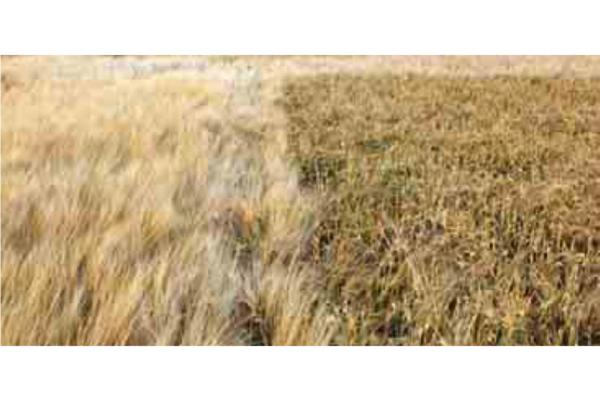
At the Goldcrop site the winter barley and winter oilseed rape trials have been cleared. The winter wheat plots showed the clear variation in maturity between the varieties and this could be seen in the colour of the plots. The early maturers, like Cordiale, were now ripe and getting black as a result of infection by sooty moulds.
KWS Lumos is a progeny of Cordiale with good straw and it is also early maturing. But Lumos has much better septoria resistance. It is up for recommendation this year and it is regarded as being good against mildew with good resistance to sprouting. And it seems to have milling potential.
Another variety of major interest to Goldcrop is Avatar. It is new but already recommended and grown commercially this year. It looks good also but is visibly later than Lumos. At the open day in July the leaves were curled up in an effort to conserve moisture, a characteristic that is attributable to Istabraq, one of its parents. Its other parent, Lion, gave it the big heads but Avatar ears are not as visibly long as Lion.
The other known varieties were very much as expected. Diego was just about ripe and looked well. Cordiale was very ripe and blackened. Lion was nearly ripe. Einstein looked okay but it generally yields above its looks. Evolution is a new wheat with Robigus in its parentage and it looked more interesting last week than a month ago. Epson looked very attractive in July and it still looks very attractive with less blackening than most other varieties.
Grain fill
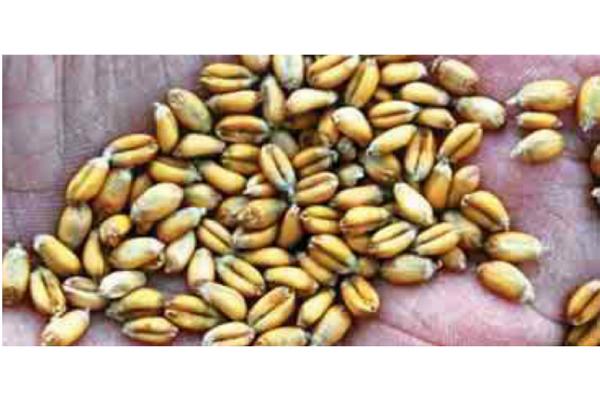
Grain samples from the hand-threshed ears were very interesting. The grains from the individual ears were extremely uniform and well filled. Of the few ears we threshed from the different varieties, every grain was equally well filled. Normally, one would get a few grains that are poorly filled, but in this case all grains were fully filled. Let’s hope this is repeated in all commercial crops. Initial reports indicate up to 80KPG from our winter wheat.
Seeds from one of the new hybrid varieties being tested had a peculiar dent on the grains. This looked like midge damage and when we went to the spring wheat, which is still green and filling, the first thing we noticed was the orange midge larvae with some of the grains. So this could well have been the cause of the problem on the winter variety also.
Spring wheat
Sparrow was still green and growing, and looked well. There was no sign of disease but there was some leaf death, possibly a result of recent drought stress. Sparrow has a strong green colour while Trappe, beside it, was taller with a blue-grey waxy colour. Raffles is earlier and is starting to turn.
Spring barley
There is still a good bit of life in the Goldcrop spring barley plots. These were not sown until late April because the ground was just not good enough before this, John said. As a result, the plots are still lively with quite a bit of green leaf and stem.
All the main varieties were present but the two of most interest are up for recommendation for next year – Crooner and Soldo. These two new feeding barley varieties are regarded as being very similar in yield potential with the former being French and the latter German bred. But they are very different in appearance.
Crooner, like a few others, looks a ‘hairy’ variety as the ears are very slow to bend over thus keeping the awns on top. This happens because the ears do not grow clear of the flag leaf leaf-sheath. It is a Wicket cross but without the net blotch susceptibility. It is good to tiller with very consistent yield performance in recent years. Straw is strong and short and it has high specific weight.
Soldo has Tipple in its parentage and is a bit earlier than Crooner. Quality is good on this variety also and it is said to be quite good against brackling. It is also proving to be very consistent in yield from year to year and is up for recommendation for the coming season. It has a good package of disease resistance but it is only moderately resistant to rhyncho.




SHARING OPTIONS