Oilseed rape remains a popular choice with Irish farmers as it offers a good non-cereal break in the rotation. However, it can also be a costly crop to grow, with similar costs of production to a winter cereal crop.
There are numerous potential pests and diseases to control which can lead to a large spray bill. But in many cases spraying is not economically worthwhile, particularly if it means late passes through the crop which can directly reduce yield.
Ongoing monitoring of crops is essential and if the thresholds are reached again before stem extension, a second spray should be applied
Yield loss from an end-of-flowering spray using a conventional tractor-mounted sprayer has been shown to be 3.4% on 24m tramlines and would be doubled to 6.8% on 12m tramlines. Using a high clearance (90cm) self-propelled 24m sprayer only reduced the yield loss slightly to 2.8%.
Fortunately, there are reasonably well established thresholds for most pests and diseases that, if followed, can reduce significantly the number of passes through the crop and the cost of production.
Slugs
Slugs are an obvious risk but the normal control measures hold true. Good consolidation of the seedbed should be the starting point, followed by the use of pellets where slug populations are high.
Autumn diseases
As well as pest control, disease control will often need to start pre-Christmas and regular monitoring for Light Leaf Spot (LLS) and Phoma is needed. When more than 25% of plants are infected with LLS, or 20% of plants (10% if plants are small) infected with Phoma, a spray should be applied immediately. A half-rate fungicide is usually all that is needed to achieve good control.
For phoma, Prosaro and Proline will give very good control while Magnello and Caramba both give useful levels of control. For LLS control there are a wide range of products that will give good levels of control, including Proline and Prosaro, while Caramba will also provide useful suppression.
Ongoing monitoring of crops is essential and if the thresholds are reached again before stem extension, a second spray should be applied. Once the crop reaches green-bud stage it is no longer worthwhile trying to control either disease.
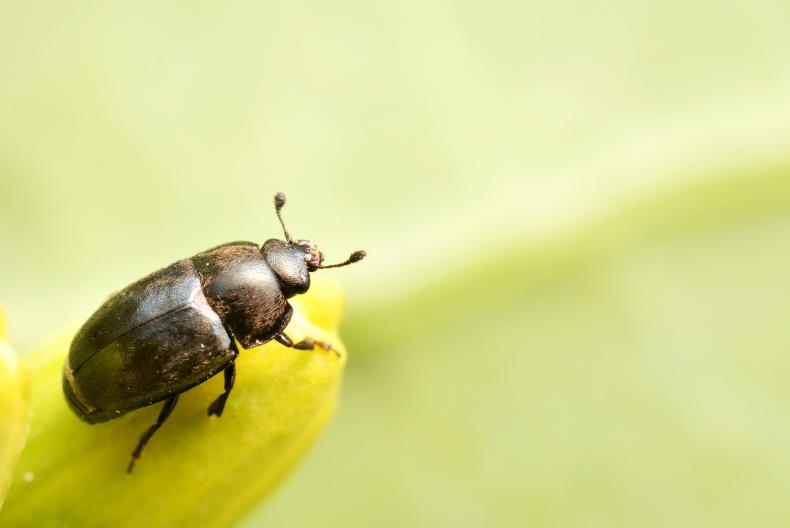
Once there are sufficient open flowers, the adult pollen beetle will feed on the pollen from them and contribute to helping the pollination of the crop, so spraying too late could be detrimental.Once there are sufficient open flowers, the adult pollen beetle will feed on the pollen from them and contribute to helping the pollination of the crop, so spraying too late could be detrimental.
Pollen beetles
In the spring, pollen beetle receives a lot of attention, but rarely causes any economic damage in Britain or Ireland on winter oilseed rape crops. The crop is susceptible to damage during the green to yellow bud stages, when the adults will eat into the buds to get to the pollen and, by doing so, will kill the bud. Once there are sufficient open flowers, the adults will feed on the pollen from them and contribute to helping the pollination of the crop, so spraying too late could be detrimental.
Because each adult can damage relatively few buds, and each plant produces a large number of buds, a large number of beetles need to be present before spraying is worthwhile. In light of this, the British thresholds have just been revised.
Where there are less than 30 plants/m2, the threshold is an average of 25 beetles per plant. However, where there are 70 or more plants/m2, this is reduced to seven beetles per plant. This seems counterintuitive but there are far more buds per plant on low population crops, and the beetle numbers per square metre would work out to be similar in the two situations.
The revised British thresholds do not take account of backward crops which may struggle to produce sufficient pods. However, I would be inclined to revise these thresholds down by roughly 40% to 15 and five beetles per plant on the badly pigeon-grazed crops we have this year, which are struggling in the cold spring.
A pyrethroid insecticide will give good control but avoid spraying unnecessarily to avoid resistance development, which has been found elsewhere in Europe.
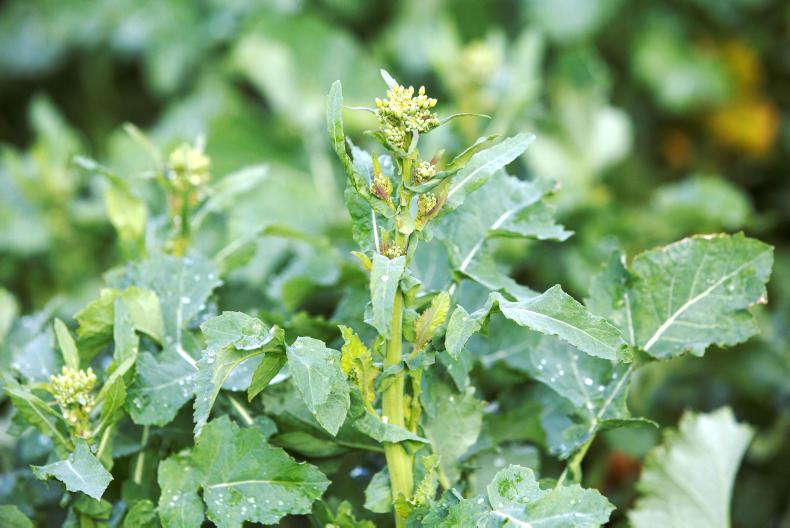
Forward crops will require a growth regulator to avoid the crop developing too dense a flower and pod canopy.Forward crops will require a growth regulator to avoid the crop developing too dense a flower and pod canopy.
Canopy growth regulation
Forward crops will require a growth regulator to avoid the crop developing too dense a flower and pod canopy. These are best delayed until at least green bud, which is too late for the second spray for phoma or LLS, but growth regulatory responses can be achieved up until early flowering.
Carmaba and Folicur are the strongest growth regulators and need to be applied at a minimum of a ¾ rate to get a good response. Because of their strong growth-regulatory properties they should be avoided for winter or early spring disease control on backward crops, but may be beneficial on very forward crops at these earlier timings.
Threat of sclerotinia
Sclerotinia is potentially the most damaging disease of oilseed rape, with yield losses of 2t/ha or more, and it is also the hardest to predict. The first requirement for disease development is inoculum from a previously infected susceptible (including oilseed rape, peas, spring beans, potatoes, carrots) crop in the area.
The disease survives in the soil for 10 years or more as resting bodies or sclerotia. Warm (above 10°C) moist soil is required for the sclerotia to germinate and produce fruiting bodies or apothecia, which are light brown, saucer shaped, and 5-15mm in diameter. These are most easily found in local fields where oilseed rape has been grown in the last one-to-two years.
A period of dry weather is then required for ascospore release. These ascospores land on oilseed rape flower parts and if this is followed by light rain the infected petals stick to the stems of the crop. Once there, the disease grows through the petals and into the stem.
Control with fungicides is entirely protectant and spray must coat the petals or stems before they stick on to the stems. In low to moderate disease pressure sites, a single spray is generally sufficient, with the optimum timing usually just before mid-flowering on the main raceme.
Products need to be applied close to or at full rate and should then give about three weeks protection. In high-risk sites (one where oilseed rape has been grown recently or next to such a field) when weather during flowering is very changeable two sprays may be required to give protection for the whole flowering period.
A wide range of products will give good protectant control of sclerotinia, including Filan, Amistar, Proline, and Prosaro, but if two sprays are to be applied, a single active ingredient product should not be used more than once on the same crop to avoid the risk of resistance development.
Yield loss from an end of flowering spray using a conventional tractor mounted sprayer has been shown to be 3.4% on 24m tramlines and would be doubled to 6.8% on 12m tramlines. Yield loss from an end of flowering spray using a conventional tractor mounted sprayer has been shown to be 3.4% on 24m tramlines and would be doubled to 6.8% on 12m tramlines.
Pod pests
An insecticide may be needed, but very rarely, during flowering and before petal fall if more than one cabbage seed weevil is found per plant. Brassica pod midge can enter the pods through the seed weevil larvae exit hole and feed on the pod wall, causing splitting and seed loss. Damage is generally worst on the headland and looks worse than the yield loss incurred.
Alternaria
Dark pod spot, or alternaria, used to be a significant problem in the 1980s but is rarely a problem these days as sprays used earlier in the season for phoma, LLS and sclerotinia give adequate control. An additional late spray for alternaria is therefore rarely required.
Key Points
If oilseed rape is to provide a profitable break crop then production costs must be kept to an optimum level.Certain frequently used inputs are seldom justified and just represent cost without potential return.When costs are being incurred ensure that the timing of the input is optimum to maximise the potential to generate return.Thresholds exists for a number of pests and diseases and these should be used to help justify costs. Read more
Irish cereal production up despite drop in area planted
Break crops show big bottom-line differences
Oilseed rape remains a popular choice with Irish farmers as it offers a good non-cereal break in the rotation. However, it can also be a costly crop to grow, with similar costs of production to a winter cereal crop.
There are numerous potential pests and diseases to control which can lead to a large spray bill. But in many cases spraying is not economically worthwhile, particularly if it means late passes through the crop which can directly reduce yield.
Ongoing monitoring of crops is essential and if the thresholds are reached again before stem extension, a second spray should be applied
Yield loss from an end-of-flowering spray using a conventional tractor-mounted sprayer has been shown to be 3.4% on 24m tramlines and would be doubled to 6.8% on 12m tramlines. Using a high clearance (90cm) self-propelled 24m sprayer only reduced the yield loss slightly to 2.8%.
Fortunately, there are reasonably well established thresholds for most pests and diseases that, if followed, can reduce significantly the number of passes through the crop and the cost of production.
Slugs
Slugs are an obvious risk but the normal control measures hold true. Good consolidation of the seedbed should be the starting point, followed by the use of pellets where slug populations are high.
Autumn diseases
As well as pest control, disease control will often need to start pre-Christmas and regular monitoring for Light Leaf Spot (LLS) and Phoma is needed. When more than 25% of plants are infected with LLS, or 20% of plants (10% if plants are small) infected with Phoma, a spray should be applied immediately. A half-rate fungicide is usually all that is needed to achieve good control.
For phoma, Prosaro and Proline will give very good control while Magnello and Caramba both give useful levels of control. For LLS control there are a wide range of products that will give good levels of control, including Proline and Prosaro, while Caramba will also provide useful suppression.
Ongoing monitoring of crops is essential and if the thresholds are reached again before stem extension, a second spray should be applied. Once the crop reaches green-bud stage it is no longer worthwhile trying to control either disease.
Once there are sufficient open flowers, the adult pollen beetle will feed on the pollen from them and contribute to helping the pollination of the crop, so spraying too late could be detrimental.Once there are sufficient open flowers, the adult pollen beetle will feed on the pollen from them and contribute to helping the pollination of the crop, so spraying too late could be detrimental.
Pollen beetles
In the spring, pollen beetle receives a lot of attention, but rarely causes any economic damage in Britain or Ireland on winter oilseed rape crops. The crop is susceptible to damage during the green to yellow bud stages, when the adults will eat into the buds to get to the pollen and, by doing so, will kill the bud. Once there are sufficient open flowers, the adults will feed on the pollen from them and contribute to helping the pollination of the crop, so spraying too late could be detrimental.
Because each adult can damage relatively few buds, and each plant produces a large number of buds, a large number of beetles need to be present before spraying is worthwhile. In light of this, the British thresholds have just been revised.
Where there are less than 30 plants/m2, the threshold is an average of 25 beetles per plant. However, where there are 70 or more plants/m2, this is reduced to seven beetles per plant. This seems counterintuitive but there are far more buds per plant on low population crops, and the beetle numbers per square metre would work out to be similar in the two situations.
The revised British thresholds do not take account of backward crops which may struggle to produce sufficient pods. However, I would be inclined to revise these thresholds down by roughly 40% to 15 and five beetles per plant on the badly pigeon-grazed crops we have this year, which are struggling in the cold spring.
A pyrethroid insecticide will give good control but avoid spraying unnecessarily to avoid resistance development, which has been found elsewhere in Europe.
Forward crops will require a growth regulator to avoid the crop developing too dense a flower and pod canopy.Forward crops will require a growth regulator to avoid the crop developing too dense a flower and pod canopy.
Canopy growth regulation
Forward crops will require a growth regulator to avoid the crop developing too dense a flower and pod canopy. These are best delayed until at least green bud, which is too late for the second spray for phoma or LLS, but growth regulatory responses can be achieved up until early flowering.
Carmaba and Folicur are the strongest growth regulators and need to be applied at a minimum of a ¾ rate to get a good response. Because of their strong growth-regulatory properties they should be avoided for winter or early spring disease control on backward crops, but may be beneficial on very forward crops at these earlier timings.
Threat of sclerotinia
Sclerotinia is potentially the most damaging disease of oilseed rape, with yield losses of 2t/ha or more, and it is also the hardest to predict. The first requirement for disease development is inoculum from a previously infected susceptible (including oilseed rape, peas, spring beans, potatoes, carrots) crop in the area.
The disease survives in the soil for 10 years or more as resting bodies or sclerotia. Warm (above 10°C) moist soil is required for the sclerotia to germinate and produce fruiting bodies or apothecia, which are light brown, saucer shaped, and 5-15mm in diameter. These are most easily found in local fields where oilseed rape has been grown in the last one-to-two years.
A period of dry weather is then required for ascospore release. These ascospores land on oilseed rape flower parts and if this is followed by light rain the infected petals stick to the stems of the crop. Once there, the disease grows through the petals and into the stem.
Control with fungicides is entirely protectant and spray must coat the petals or stems before they stick on to the stems. In low to moderate disease pressure sites, a single spray is generally sufficient, with the optimum timing usually just before mid-flowering on the main raceme.
Products need to be applied close to or at full rate and should then give about three weeks protection. In high-risk sites (one where oilseed rape has been grown recently or next to such a field) when weather during flowering is very changeable two sprays may be required to give protection for the whole flowering period.
A wide range of products will give good protectant control of sclerotinia, including Filan, Amistar, Proline, and Prosaro, but if two sprays are to be applied, a single active ingredient product should not be used more than once on the same crop to avoid the risk of resistance development.
Yield loss from an end of flowering spray using a conventional tractor mounted sprayer has been shown to be 3.4% on 24m tramlines and would be doubled to 6.8% on 12m tramlines. Yield loss from an end of flowering spray using a conventional tractor mounted sprayer has been shown to be 3.4% on 24m tramlines and would be doubled to 6.8% on 12m tramlines.
Pod pests
An insecticide may be needed, but very rarely, during flowering and before petal fall if more than one cabbage seed weevil is found per plant. Brassica pod midge can enter the pods through the seed weevil larvae exit hole and feed on the pod wall, causing splitting and seed loss. Damage is generally worst on the headland and looks worse than the yield loss incurred.
Alternaria
Dark pod spot, or alternaria, used to be a significant problem in the 1980s but is rarely a problem these days as sprays used earlier in the season for phoma, LLS and sclerotinia give adequate control. An additional late spray for alternaria is therefore rarely required.
Key Points
If oilseed rape is to provide a profitable break crop then production costs must be kept to an optimum level.Certain frequently used inputs are seldom justified and just represent cost without potential return.When costs are being incurred ensure that the timing of the input is optimum to maximise the potential to generate return.Thresholds exists for a number of pests and diseases and these should be used to help justify costs. Read more
Irish cereal production up despite drop in area planted
Break crops show big bottom-line differences







SHARING OPTIONS