


Hard in terms of having knocked many earlier sown crops backwards and in terms of the lack of growth to help drive backward crops on. Some need rain while others have far too much; 48mm was recorded in parts of Donegal last Saturday while other areas that could benefit from rain received none.
This week’s report comes from many different parts of the country and it is not untrue to suggest that many spring crops have gone backwards.
Tracks everywhere
In north Wexford last weekend I was disappointed to see so many spring crops going backwards relative to the week before, with both colour and leaf volume falling out of crops. Perhaps the most obvious comment that should be made is the degree to which tracking is visible in fields of both winter and spring crops.
In many fields the most obvious tracks appear to be associated with planting machinery but there are many fields where tracks run at different angles, thus suggesting that they may have originated from field operations last autumn. Indeed, the random occurrence of tracks in some fields would point to straw removal as being the likely cause. Much of the poor growth in tracks is associated with compaction somewhere in the last 12 months.
But some spring crops on lighter ground show the opposite effect. In these fields, the planting wheel tracks were growing well and the area beneath the tractor, which was less well firmed, was going backwards as plant roots struggle for nutrients in these stripes.
Nutrient availability
Regardless of tracking, many spring crops have dropped in colour due to lack of nutrient availability. This is most striking in some spring wheat crops that are yellow when they should be green. This problem is worst on later crops with a less developed root system. The newly emerged leaves are carrying this yellow colour with a symptom that is more akin to magnesium deficiency than manganese deficiency, with yellow beading visible up along the length of a narrow leaf.
As a general rule, manganese deficiency symptoms tend to appear after the leaf has grown wider and longer. The plant does this in an effort to capture more light as it recognises that the rate of photosynthesis is lower than the available light level and it makes the leaves bigger to try and capture this light. This happens because manganese can be a limiting factor in photosynthesis.
After the leaf expansion comes yellow blotches between the veins and these give way to dead tissue, which is a disease called grey speck when it occurs on oats.
Both manganese and magnesium deficiencies can be transitory, especially when the soil around the roots is dry. It is also worse in fluffy seedbeds where there is sufficient root soil contact. In both of these instances, the crop can recover following rain; i.e. the new foliage looks healthy and carries a green colour to mask the preceding ‘yellow’ leaf as the symptoms, once present on a leaf, never go away.
In terms of susceptibility to manganese deficiency all crops will show symptoms, but oats, then barley, then wheat, are most susceptible to foliage destruction. Deficiency will initially result in leaf death, then tiller death and then, possibly, plant death. Most crops will not be let get to this critical stage but the longer deficiency is allowed to remain, the bigger impact it can have on yield potential.
This is most evident in spring barley where any restriction on early season growth will result in fewer tillers being produced to reduce yield potential. Early treatment with the necessary elements is important and seed and fertilizer treatment should be showing benefit this year.
Mildew?
Earlier this week a man told me that mildew had marched into his spring oats. While I did not see the crop it seems an unlikely disease, given recent weather patterns and the virtual absence of the disease in other crops. But it is certainly possible given the susceptibility of the crop to mildew.
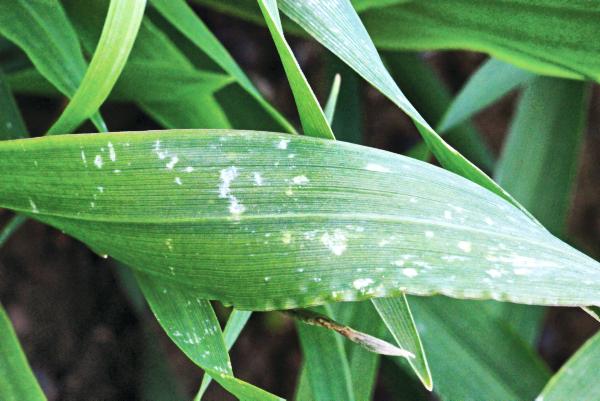
While this means that crops should be watched, one other possible cause of these white spots could be recent hail damage (see picture). This can also result in white spots on leaves and stems, so check if the blotch is in the leaf surface or on the leaf surface. You can verify mildew by bending the leaf over on your finger to see whether or not the ‘blotch’ is raised on the surface of the leaf. Mildew only grows on the surface.
Rape flowering
Winter rape is extremely late flowering this year and is also very uneven. The lateness is the year effect but the unevenness is due to a range of factors like uneven pigeon grazing, low plant populations or even no plant population, damage by sprays, etc.
There was also a lot of weather damage to the main raceme, which throws out the first visible flowers. Indeed, the main raceme in many crops appears to have been killed by weather, leaving many plants with no central dominant stem.
I was in a crop of winter rape last week at a Teagasc field walk in Kildare where a semi-dwarf variety was grown. This was certainly low in biomass and was finding compensatory growth difficult compared with the standard hybrids.
The main racemes were mainly gone and there seemed to be far fewer flowers in the flower heads than in the more typical varieties.
However, flowers do not make yield and so the weighbridge is the only real arbiter in time.
Winter barley
The more advanced crops now show strong crops of awns with some ears present. Crops are generally good. Rhyncho still appears to be the main threat and it certainly came into some crops in recent weeks. There is also some visible black speckling in crops with an occasional one showing yellow blotches on older leaves, possibly as a result of previous hail damage. The presence of speckling reinforces the need to add a contact fungicide in the final main spray to help prevent ramularia.
Winter wheat
Crops are quite variable with the flag leaf emerging in some and the third last leaf not yet emerged in others. Septoria is on the move but I did not see any amount of the disease in any of the crops I visited in the past week. However, that could change very quickly.
While many crops have a proportion of low plant stand, tillering appears to have been good if they can survive to maturity. So while there may not be much straw in these patches, grain yield may not be as bad as feared.


SHARING OPTIONS