With virtually all of the details of greening now available, or in the hands of the Department, it is time for all farmers to have a basic understanding of what is involved and if it concerns them or not.
All farmers are subject to greening, but the availability of a number of derogations means that many grassland farmers are exempt from the specific requirements that apply to tillage farmers.
But things can change on grass farms too, so all farmers need to have an understanding of what the rules are.
Basically, 30% of the final new payment, or almost 48% of the new basic payment system entitlement value, is dependent on being greening-compliant.
For those who must comply, greening has three basic provisions:
Retention of permanent pasture – this is a matter for the State rather than the individual farmer.Crop diversification – this is commonly referred to as the three-crop rule, which sets out the number of crops required by different sized applicants and maximum percentages for the primary and primary plus secondary crops. But there are provisions in place which provide derogations for this requirement.Ecological Focus Areas (EFAs) – this obliges individuals with more than 15ha in tillage crops to have areas of land or crop that are deemed to be beneficial to the environment. These are notional areas, which do not have to be subtracted from the area of the parcel growing the crop. Some derogations also apply.Areas and derogations
The first provision above is not a matter for the individual, so this article will deal with the specifics relating to crop diversification, with a focus on EFAs next week.
Crop diversification means having more than one crop (excluding permanent pasture) if more than 10ha of crops are grown in any year. Three crops, or more, are needed where more than 30ha of crops are grown.
Remember that greening applies to all farmers, but there are a series of derogations that can apply. In fact, there are six derogations and if one of these does not apply to you, then you may need to take actions to comply with greening so as to secure the balance of your new basic payment.
The six different derogations for crop diversification requirements are:
Less than 10ha in crops.Farmers who have 75%, or more, of their application area in grassland and who have less than 30ha of crops. (In this instance, the temporary grass is counted with the grassland.)Areas converted to organic farming.Where 50% of the area farmed is new to an applicant and where all of the land is sown to a different crop than in the previous year.Where 75% or more of the arable land is in temporary grass and where a farmer has more than 30ha in tillage, only two crops are required (rather than three). Where growers use a GLAS equivalence measure using winter crop cover.While a farmer must comply with crop diversification, the number of crops needed will depend on the area sown to arable crops, which includes the area in temporary grass.
The basic requirements for crop diversification mean farmers with 10ha or more of crops must have more than one crop, as shown in Table 1.
As well as the number of crops, crop diversification also places a requirement on the crop mix. Where a minimum of two crops is required, the biggest crop cannot exceed 75% of the arable crop area. So the second and subsequent crops areas must be 25% or greater.
Where three or more crops are required, the biggest crop cannot be greater than 75% of the arable area and the two biggest crops together cannot exceed 95% of the total arable area.
Online help at application
It is important to point out that the online application system being developed by the Department will do these calculations automatically during the 2015 application process.
It will tell you initially if (based on last year’s application) you are likely to be obliged by greening requirements or not. But it is really the information and areas submitted for 2015 that actually matter and this information needs to be inputted before proceeding with the online application process.
So, once you have your parcel and crop details entered on the online application system, the programme will do all the necessary calculations to tell you if you are compliant for crop diversification or not.
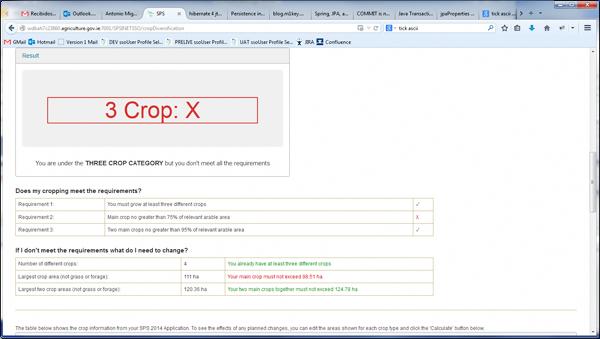
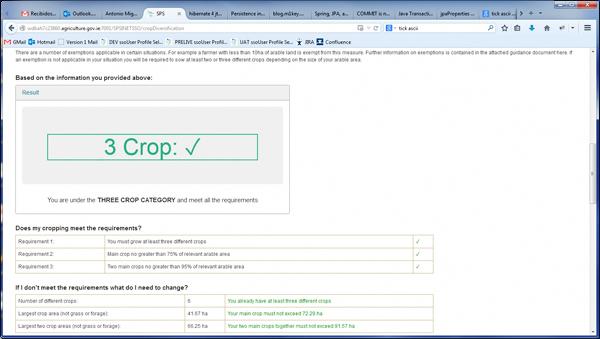
A red screen box means you are not currently compliant and this will turn to green when the crop mix entered is crop diversification-compliant (see pictures on P51).
However, the application process should only be a verification process. As you are likely to have all of your crops sown at the time of application, you must have already done these calculations to have your percentages correct.
If your application details still give you a red box, then you will have to change part of the crop area, opt for an equivalence measure or take the hit on the greening payment.
A similar process will apply when the EFA is being calculated on the parcels submitted, but more about this next week.
So, when you begin to enter your crop area details for 2015, the system will tot up the different crops being grown, do the requisite calculations and tell you if your details are compliant with crop diversification or not.
Reference areas
From 2015 onwards, the crop area of any parcel must be the reference area. This may be different to the declared areas submitted in previous years, as it will be the digitised area of the parcel minus any ineligible features, such as a roadway or area that cannot be sown.
But for many parcels, the digitised area and reference area should be the same, where no ineligible features are present. So, from 2015 onwards, the area under hedges and open drains must be included in the area of the parcel. This may leave many growers with slightly more applied area than in previous years, when the sown area was the declared area.
These new reference areas are important, because they will provide the numbers for the calculation of crop percentages and EFA requirement. If you have been using sown acres in the past, then use the new reference areas to get a better picture of your requirements for greening.
The area of a crop will be the sum of the new parcel reference areas, rather than the sown area previously used, so there has to be a continuous warning about being too tight on any of the percentage thresholds. If you are very close to a threshold and you get an adjustment to a parcel area following an inspection, you could be pushed the wrong side of a threshold with consequential penalties.
The arable area on which the calculations are made will include the areas sown to cereals, root crops, oilseeds, protein crops, vegetables, fallow and temporary grassland.
Once you have a crop diversification obligation, then temporary grass forms part of the arable area, but it also provides a crop option. Temporary grass can also be submitted as fallow, which can be used to provide both a crop option and EFA. The total arable area is also primarily the area on which the 5% EFA calculation is based.
What crops are allowed?
All the main crops are deemed to be individual crops, so cereals include wheat, barley, oats, triticale and maize, with winter- and spring-sown being two different crops.
Winter and spring sowings are deemed different because spring planting leaves the stubble in situ over winter, which provides for a different spectrum of ecological activity compared with a winter-sown crop, which is also harvested earlier.
A crop is basically any land use which relies on annual replanting of that crop. So your standard cereals, oilseed rape, protein crops, roots, maize, etc, are straightforward. Winter and spring plantings of the same crop are regarded as separate crops, regardless of variety.
Woody and multi-annual crops, like willow and miscanthus, are currently not regarded as a crop for crop diversification purposes. They provide repeated harvests from a single planting. The main exception to the multiannual crop rule is strawberries, which are allowed.
However, many crop groups with a different end use (such as feeding barley versus malting barley; ware, seed, earlies and main crop potatoes; fodder beet versus sugar beet; and a number of the brassica vegetables such as cabbage, broccoli, cauliflower, Brussels sprouts and kale) are regarded as being the same crop for crop diversification purposes. Fodder rape and swedes are also regarded as a single crop.
Fallow land, left without use between 1 January and 30 June, is also regarded as a crop. Temporary grass is also a separate crop, but temporary grass can also be used as fallow at any point during the five years of the temporary grass classification. And declaring temporary grass as fallow in any year effectively freezes its progression to permanent pasture, which would normally happen after five years as temporary grass.
A parcel sown to grass in autumn 2010 would be in its fifth year of temporary grass in 2015 and so could be used as fallow, if necessary, to provide either an additional crop or to provide EFA. And this parcel would continue to provide a fallow option until a year when it is again submitted as temporary grass. When this time comes, it would be regarded as being fifth temporary grass and would become permanent pasture if again submitted as grass in the following year.
Fallow must have a minimum area of 0.1ha. Fallow is still regarded as a crop when sown with wild bird seed.
Definitions
It is important that farmers fully understand the meaning of the different terms used in the definitions for greening. For example, temporary grass is a crop for crop diversification purposes, but it is also grassland and not permanent pasture until after five years of this use have been declared.
Permanent pasture is land that has been in temporary grass for more than five years. It can form all or part of the grassland when using the more than 75% grassland derogation for greening.
Temporary grass is land sown to grass within the past five years on land previously used to grow crops. It is technically an arable crop for crop diversification purposes, but it also adds to the grassland area for the purpose of the 75% grassland derogation.
Farms that have more than 75% temporary grass need only have two crops, even if they have more than 30ha of crops by virtue of a recently agreed derogation.
This has become an important category because temporary grassland can now also be declared as fallow for greening purposes to provide either another crop or to provide EFA. So, a farm with a substantial area of temporary grass could use this area to provide two crops – temporary grass and fallow.
Where temporary grass is declared as fallow, its progression to permanent pasture is frozen at that point in time. In the initial proposal on fallow a few weeks ago, fallow land could only be planted to grass during the fallow period and the proposal was that it had to revert to temporary grass one in the following year. The final agreement on this provides a useful option for some mixed farmers.
So, a field sown to temporary grass in the autumn of 2010 can now be used as fallow for EFA purposes on a continuous basis. But fallow means that no crop can be removed between 1 January and 30 June. Bare fallow can still be planted to grass during the fallow period and continue to be used as fallow in subsequent years.
Arable land is land that grows any of the allowed crops, temporary grass or fallow.
Reference area is effectively the digitised area of a land parcel minus any ineligible features present. This is the area on which all area and percentage calculations will be based, such as the crop percentages and the EFA area.
In recent years, many farmers used the traditional sown area of fields, which will be lower than the new reference area and so caution is needed when working on areas and calculations for 2015 onwards.
GLAS green winter cover
Farmers intending to opt for the GLAS green cover equivalence measure to enable them to comply with crop diversification while having only one crop will begin that process during the online application. Parcels must be earmarked for planting with green cover following the main crop use.
Ticking this box for a parcel will enable the Department application to put the relevant area into the EFA calculator to allow the application to be submitted.
Where an application does not meet the crop diversification and EFA requirements, strong warning signals (see above) will alert the applicant to alter the composition of the application.
As a crop diversification measure, this green cover must be planted by 15 September and left in situ until 15 January. This could make it difficult to use this option following later maturing crops such as spring wheat, as the equivalence option is not just confined to malting barley.
Tillage farmers who opt for the equivalence measure for crop diversification will be given priority access into GLAS.
There is still some uncertainty as to the amount of land that will have to be sown to green cover for equivalence. It seems that it will not be a percentage issue, but rather a fixed amount. And a GLAS payment will also accrue. The fixed payment is set at €155/ha, but it is reckoned that equivalence participants will receive about €100/ha to cover establishment costs.
The green cover can be rotated around the farm over the five-year period of the scheme to help improve the soil texture.
With virtually all of the details of greening now available, or in the hands of the Department, it is time for all farmers to have a basic understanding of what is involved and if it concerns them or not.
All farmers are subject to greening, but the availability of a number of derogations means that many grassland farmers are exempt from the specific requirements that apply to tillage farmers.
But things can change on grass farms too, so all farmers need to have an understanding of what the rules are.
Basically, 30% of the final new payment, or almost 48% of the new basic payment system entitlement value, is dependent on being greening-compliant.
For those who must comply, greening has three basic provisions:
Retention of permanent pasture – this is a matter for the State rather than the individual farmer.Crop diversification – this is commonly referred to as the three-crop rule, which sets out the number of crops required by different sized applicants and maximum percentages for the primary and primary plus secondary crops. But there are provisions in place which provide derogations for this requirement.Ecological Focus Areas (EFAs) – this obliges individuals with more than 15ha in tillage crops to have areas of land or crop that are deemed to be beneficial to the environment. These are notional areas, which do not have to be subtracted from the area of the parcel growing the crop. Some derogations also apply.Areas and derogations
The first provision above is not a matter for the individual, so this article will deal with the specifics relating to crop diversification, with a focus on EFAs next week.
Crop diversification means having more than one crop (excluding permanent pasture) if more than 10ha of crops are grown in any year. Three crops, or more, are needed where more than 30ha of crops are grown.
Remember that greening applies to all farmers, but there are a series of derogations that can apply. In fact, there are six derogations and if one of these does not apply to you, then you may need to take actions to comply with greening so as to secure the balance of your new basic payment.
The six different derogations for crop diversification requirements are:
Less than 10ha in crops.Farmers who have 75%, or more, of their application area in grassland and who have less than 30ha of crops. (In this instance, the temporary grass is counted with the grassland.)Areas converted to organic farming.Where 50% of the area farmed is new to an applicant and where all of the land is sown to a different crop than in the previous year.Where 75% or more of the arable land is in temporary grass and where a farmer has more than 30ha in tillage, only two crops are required (rather than three). Where growers use a GLAS equivalence measure using winter crop cover.While a farmer must comply with crop diversification, the number of crops needed will depend on the area sown to arable crops, which includes the area in temporary grass.
The basic requirements for crop diversification mean farmers with 10ha or more of crops must have more than one crop, as shown in Table 1.
As well as the number of crops, crop diversification also places a requirement on the crop mix. Where a minimum of two crops is required, the biggest crop cannot exceed 75% of the arable crop area. So the second and subsequent crops areas must be 25% or greater.
Where three or more crops are required, the biggest crop cannot be greater than 75% of the arable area and the two biggest crops together cannot exceed 95% of the total arable area.
Online help at application
It is important to point out that the online application system being developed by the Department will do these calculations automatically during the 2015 application process.
It will tell you initially if (based on last year’s application) you are likely to be obliged by greening requirements or not. But it is really the information and areas submitted for 2015 that actually matter and this information needs to be inputted before proceeding with the online application process.
So, once you have your parcel and crop details entered on the online application system, the programme will do all the necessary calculations to tell you if you are compliant for crop diversification or not.
A red screen box means you are not currently compliant and this will turn to green when the crop mix entered is crop diversification-compliant (see pictures on P51).
However, the application process should only be a verification process. As you are likely to have all of your crops sown at the time of application, you must have already done these calculations to have your percentages correct.
If your application details still give you a red box, then you will have to change part of the crop area, opt for an equivalence measure or take the hit on the greening payment.
A similar process will apply when the EFA is being calculated on the parcels submitted, but more about this next week.
So, when you begin to enter your crop area details for 2015, the system will tot up the different crops being grown, do the requisite calculations and tell you if your details are compliant with crop diversification or not.
Reference areas
From 2015 onwards, the crop area of any parcel must be the reference area. This may be different to the declared areas submitted in previous years, as it will be the digitised area of the parcel minus any ineligible features, such as a roadway or area that cannot be sown.
But for many parcels, the digitised area and reference area should be the same, where no ineligible features are present. So, from 2015 onwards, the area under hedges and open drains must be included in the area of the parcel. This may leave many growers with slightly more applied area than in previous years, when the sown area was the declared area.
These new reference areas are important, because they will provide the numbers for the calculation of crop percentages and EFA requirement. If you have been using sown acres in the past, then use the new reference areas to get a better picture of your requirements for greening.
The area of a crop will be the sum of the new parcel reference areas, rather than the sown area previously used, so there has to be a continuous warning about being too tight on any of the percentage thresholds. If you are very close to a threshold and you get an adjustment to a parcel area following an inspection, you could be pushed the wrong side of a threshold with consequential penalties.
The arable area on which the calculations are made will include the areas sown to cereals, root crops, oilseeds, protein crops, vegetables, fallow and temporary grassland.
Once you have a crop diversification obligation, then temporary grass forms part of the arable area, but it also provides a crop option. Temporary grass can also be submitted as fallow, which can be used to provide both a crop option and EFA. The total arable area is also primarily the area on which the 5% EFA calculation is based.
What crops are allowed?
All the main crops are deemed to be individual crops, so cereals include wheat, barley, oats, triticale and maize, with winter- and spring-sown being two different crops.
Winter and spring sowings are deemed different because spring planting leaves the stubble in situ over winter, which provides for a different spectrum of ecological activity compared with a winter-sown crop, which is also harvested earlier.
A crop is basically any land use which relies on annual replanting of that crop. So your standard cereals, oilseed rape, protein crops, roots, maize, etc, are straightforward. Winter and spring plantings of the same crop are regarded as separate crops, regardless of variety.
Woody and multi-annual crops, like willow and miscanthus, are currently not regarded as a crop for crop diversification purposes. They provide repeated harvests from a single planting. The main exception to the multiannual crop rule is strawberries, which are allowed.
However, many crop groups with a different end use (such as feeding barley versus malting barley; ware, seed, earlies and main crop potatoes; fodder beet versus sugar beet; and a number of the brassica vegetables such as cabbage, broccoli, cauliflower, Brussels sprouts and kale) are regarded as being the same crop for crop diversification purposes. Fodder rape and swedes are also regarded as a single crop.
Fallow land, left without use between 1 January and 30 June, is also regarded as a crop. Temporary grass is also a separate crop, but temporary grass can also be used as fallow at any point during the five years of the temporary grass classification. And declaring temporary grass as fallow in any year effectively freezes its progression to permanent pasture, which would normally happen after five years as temporary grass.
A parcel sown to grass in autumn 2010 would be in its fifth year of temporary grass in 2015 and so could be used as fallow, if necessary, to provide either an additional crop or to provide EFA. And this parcel would continue to provide a fallow option until a year when it is again submitted as temporary grass. When this time comes, it would be regarded as being fifth temporary grass and would become permanent pasture if again submitted as grass in the following year.
Fallow must have a minimum area of 0.1ha. Fallow is still regarded as a crop when sown with wild bird seed.
Definitions
It is important that farmers fully understand the meaning of the different terms used in the definitions for greening. For example, temporary grass is a crop for crop diversification purposes, but it is also grassland and not permanent pasture until after five years of this use have been declared.
Permanent pasture is land that has been in temporary grass for more than five years. It can form all or part of the grassland when using the more than 75% grassland derogation for greening.
Temporary grass is land sown to grass within the past five years on land previously used to grow crops. It is technically an arable crop for crop diversification purposes, but it also adds to the grassland area for the purpose of the 75% grassland derogation.
Farms that have more than 75% temporary grass need only have two crops, even if they have more than 30ha of crops by virtue of a recently agreed derogation.
This has become an important category because temporary grassland can now also be declared as fallow for greening purposes to provide either another crop or to provide EFA. So, a farm with a substantial area of temporary grass could use this area to provide two crops – temporary grass and fallow.
Where temporary grass is declared as fallow, its progression to permanent pasture is frozen at that point in time. In the initial proposal on fallow a few weeks ago, fallow land could only be planted to grass during the fallow period and the proposal was that it had to revert to temporary grass one in the following year. The final agreement on this provides a useful option for some mixed farmers.
So, a field sown to temporary grass in the autumn of 2010 can now be used as fallow for EFA purposes on a continuous basis. But fallow means that no crop can be removed between 1 January and 30 June. Bare fallow can still be planted to grass during the fallow period and continue to be used as fallow in subsequent years.
Arable land is land that grows any of the allowed crops, temporary grass or fallow.
Reference area is effectively the digitised area of a land parcel minus any ineligible features present. This is the area on which all area and percentage calculations will be based, such as the crop percentages and the EFA area.
In recent years, many farmers used the traditional sown area of fields, which will be lower than the new reference area and so caution is needed when working on areas and calculations for 2015 onwards.
GLAS green winter cover
Farmers intending to opt for the GLAS green cover equivalence measure to enable them to comply with crop diversification while having only one crop will begin that process during the online application. Parcels must be earmarked for planting with green cover following the main crop use.
Ticking this box for a parcel will enable the Department application to put the relevant area into the EFA calculator to allow the application to be submitted.
Where an application does not meet the crop diversification and EFA requirements, strong warning signals (see above) will alert the applicant to alter the composition of the application.
As a crop diversification measure, this green cover must be planted by 15 September and left in situ until 15 January. This could make it difficult to use this option following later maturing crops such as spring wheat, as the equivalence option is not just confined to malting barley.
Tillage farmers who opt for the equivalence measure for crop diversification will be given priority access into GLAS.
There is still some uncertainty as to the amount of land that will have to be sown to green cover for equivalence. It seems that it will not be a percentage issue, but rather a fixed amount. And a GLAS payment will also accrue. The fixed payment is set at €155/ha, but it is reckoned that equivalence participants will receive about €100/ha to cover establishment costs.
The green cover can be rotated around the farm over the five-year period of the scheme to help improve the soil texture.





SHARING OPTIONS