



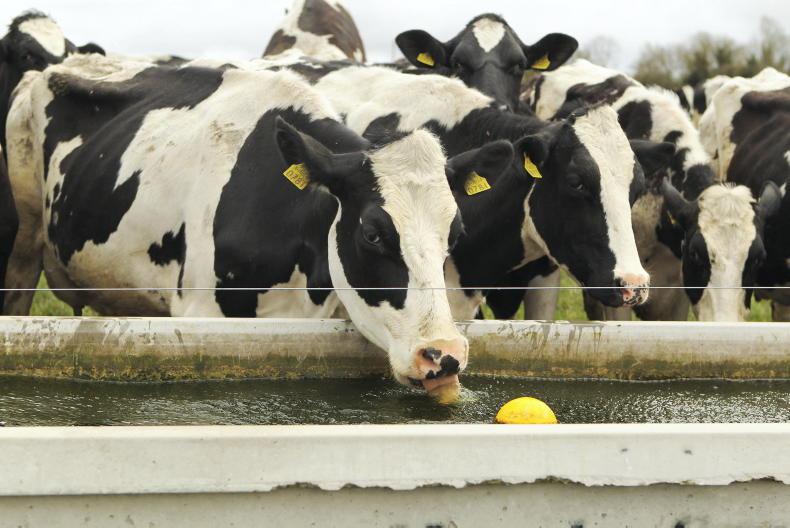
As first reported by the Irish Farmers Journal in October, the Department of Agriculture is now set to classify all dairy farmers who do not submit their milk production to the Department as being in the high band for nitrates.
This approach has now been signed into law and will be seen by farmers as a means of forcing them to share their milk production information with the Department of Agriculture.
Heretofore, the Department of Agriculture did not have access to milk yield data and therefore could not determine what milk yield band a farmer was in for the nitrates banding of organic nitrogen per cow.
What band a herd is placed in will have big implications for dairy farmers.
Band rates
Higher-yielding herds, those producing more than 6,500kg of milk per cow per year, are deemed to produce 106kg N/cow.
Low-yielding cows, those producing less than 4,500kg of milk per year, are deemed to produce 80kg N/cow. Those herds producing milk volumes between 4,500kg and 6,500kg are deemed to produce 92kg N/cow.
The Irish Farmers Journal understands that the Irish Cattle Breeding Federation (ICBF) has a pre-populated template available with milk yield and average cow numbers which farmers can share with the Department of Agriculture before 14 February each year or else it will be presumed by the Department that they are in the high band.
Being in the high band will mean that farmers are more likely to hit the derogation threshold of 170kg N/ha quicker or are more likely to reach the maximum of 250kg N/ha within derogation.
Milk production years
Separately, the rules around which milk production years can be used to determine the band are also changing.
Initially, the milk production band was set to be a three-year rolling average, but the new laws now state that farmers can use the year before the new rule was introduced (2022) as their benchmark.
The Irish Farmers Journal has requested clarity from the Department of Agriculture as to whether or not farmers can continue to use 2022 as the reference year in subsequent years, as the wording used in the statutory instrument signed by Minister Darragh O’Brien on 20 December 2022 is not clear.



SHARING OPTIONS