


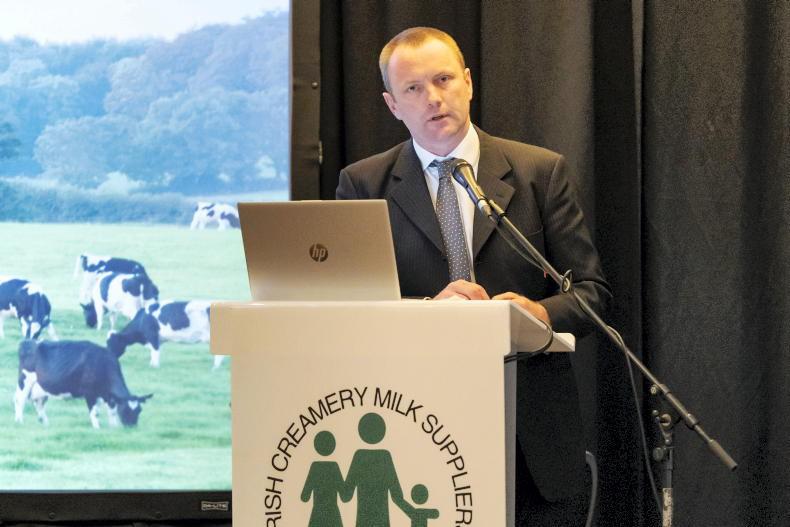
A voluntary volume reduction scheme for dairy farmers should be considered by the European Commission if the collapse in milk prices continued into the peak milk supply months of 2026, the Irish Creamery Milk Suppliers Association (ICMSA) has claimed.
ICMSA president Denis Drennan said milk prices had fallen “like a stone for the last three months” and were now at the “cost of production”.
“That ‘low’ is predicted to continue into 2026 and the real danger is that it continues up to ‘peak’ production in May. If that disaster looks even possible then the case for a voluntary volume reduction scheme at EU level becomes paramount,” Drennan said.
A voluntary volume reduction scheme would essentially pay farmers a price per litre for cutting the level of milk output.
The ICMSA leader’s comments follow a call by the European Milk Board (EMB) – of which the ICMSA is a member – for agriculture commissioner Christophe Hansen to activate such a scheme in the dairy sector.
In a letter to Commissioner Hansen, the EMB claimed that Europe was on the cusp of another “potentially devastating crisis in the dairy sector”.
“Numerous farms – especially family-run farms – now face immediate threats to their existence,” the EMB claimed.
“Another price collapse would endanger a producer base that is already close to breaking point,” the letter added.
The EMB predicted that milk prices “will continue to drop rapidly without intervention”.
The voluntary volume reduction scheme is an “existing, proven and effective instrument”, the EMB pointed out.
“Not using it now would be a serious political mistake,” the letter warned.
The introduction of a voluntary reduction scheme in 2016, during a similar collapse in milk prices, proved extremely popular with farmers across Europe and helped stabilise markets.
Meanwhile, the ICMSA has called on the Government to look again at the Farm Deposit Scheme that it has proposed to tackle income volatility.
This system would allow farmers to set aside a percentage of profits from a very good year, and reintroduce these profits in a subsequent low-income year when they would then be taxed.
ICMSA president Denis Drennan said 2025 and the bleak outlook for 2026 illustrated the extent of the volatility that was now commonplace in farm incomes – and particularly dairy sector incomes.
All measures which helped tackle the peaks and troughs in dairy incomes needed to be considered by the agriculture industry and Government, Drennan maintained.
“It is on all of us in the industry to ‘flatten these curves’ and to build a less erratic and more sustainable model of income from farming,” he said.


SHARING OPTIONS