


The Irish dairy industry has continued its strong global performance in the first eight months of 2018 despite difficult international trading conditions.
The industry is currently exporting to 123 countries across the world and Irish dairy products are prominent throughout the EU, USA, Canada, China and many other Asian and African markets. Exports for the first eight months of the year are valued at €2.67bn which is similar for the same period in 2017 (Central Statistics Office).
Butter
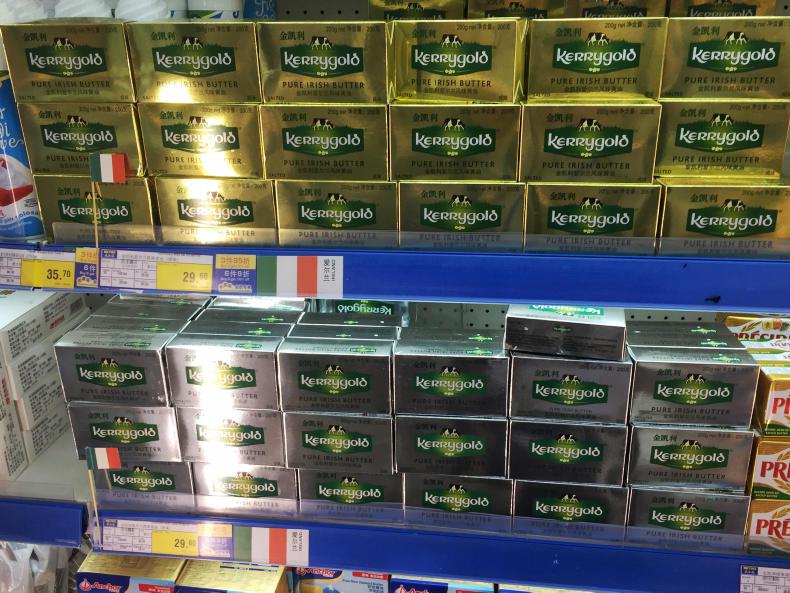
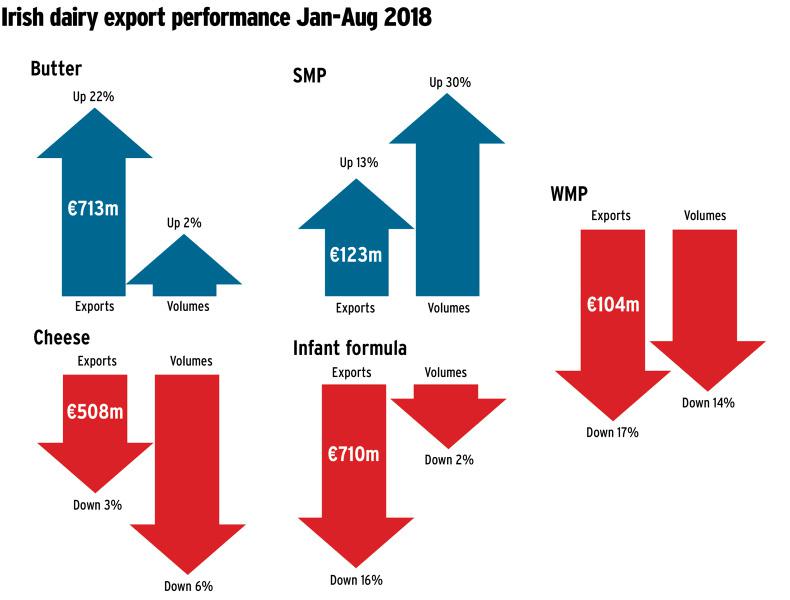
Butter exports were up by 22% at €713m, while volumes were 2% higher, reflecting higher butter prices earlier in the year.
The key markets for butter continue to be the UK at €137m, up 12%, followed by Germany at €104m, up 26%, and the USA at €103m, an increase of 70% in value and 16% in volume.
Cheese
Cheese exports were down 3% at €508m but volumes were 6% lower than the same period in 2017. Cheese exports to the UK were €256m, down 3%, followed by France at €45m, down 9%, the Netherlands at €35m, up 28% and Germany at €32m (the same as 2017).
Exports of cheese to Japan grew by 43% to August 2018 to almost €22m. The EU-Japan trade agreement, which is due to come into effect in 2019, will encourage further development of the Japanese market for Irish cheese. Currently it is subject to a tariff of 29.8% which will be eliminated making Irish cheese more competitive.
SMP
Exports of skim milk powder (SMP) were up by 13% at €123m. In volume terms, SMP exports were ahead by 30%.
Infant formula and WMP
Infant formula and whole milk powder (WMP) exports are showing a decrease of 16% and 17% at €710m and €104m respectively in value and although the value of infant formula exports fell by 16% they were only 2% lower in volume, while WMP was 14% lower.
China remains the biggest importer of infant formula at almost €370m for the eight months to August 2018 followed by Hong Kong at €99m, Great Britain at €77m and Saudi Arabia at €52m. Overall infant formula exports were down 16% in value but only 2% in volume. This reflects a change in the transfer prices between the subsidiaries of multinational infant formula producers exporting from Ireland.
Casein
Casein exports fell by about 5% in value. Exports of enriched or fat-filled milk powder were marginally down by 1.4% on the same period last year at €478m. Whey exports at €68m were stable.
New potential markets
Japan along with the other key markets of China, South Korea, Indonesia and Malaysia represent new potential markets for growth and Bord Bia will be prioritising them in terms of our activities over the coming years. They are dairy deficit markets that have large and growing populations that are increasingly consuming more western style foods which presents an opportunity for Irish dairy exporters. Trade missions to Japan and South Korea in 2017 and the recent mission to Indonesia and Malaysia reflect the importance of these markets in diversifying Irish dairy exports in the short and medium term.
Origin Green
These trade missions are often to countries where little is known about Ireland so it is critical that we leave a strong message with them about what sets Irish dairy product apart from the mainstream.
The Origin Green programme on the sustainable production of quality dairy produce does just that. Food buyers can see for themselves that almost all of our dairy farmers are committed to the programme and 90% of our dairy exports are covered by the Origin Green promise on sustainable production.
Our inward buyer visits allow international buyers see for themselves on farms and in plants the efforts of the industry here around the environment, animal welfare, animal health and full traceability through our independently audited SDAS programme.
Lifestyle and drought driving Scandinavian dairy industry
The hot summer in 2018 and drought wasn’t just an Irish experience. It impacted on much of northern Europe and has resulted in rising Swedish milk prices, which in turn will lead to higher prices for cheese made with Swedish milk.
Similarly, Danish butter prices are increasing as a result of multiple economic effects both domestically and internationally, alongside decreasing milk production.
Interestingly, the fear of fats is also decreasing and indeed the positive health benefits of dairy produce are being talked about in the media.
There is also a growing appreciation of taste which along with health benefits are driving sales growth of cheese.
Cheese consumption is also a feature of the flexitarian lifestyle, a further driver in consumption growth.




SHARING OPTIONS