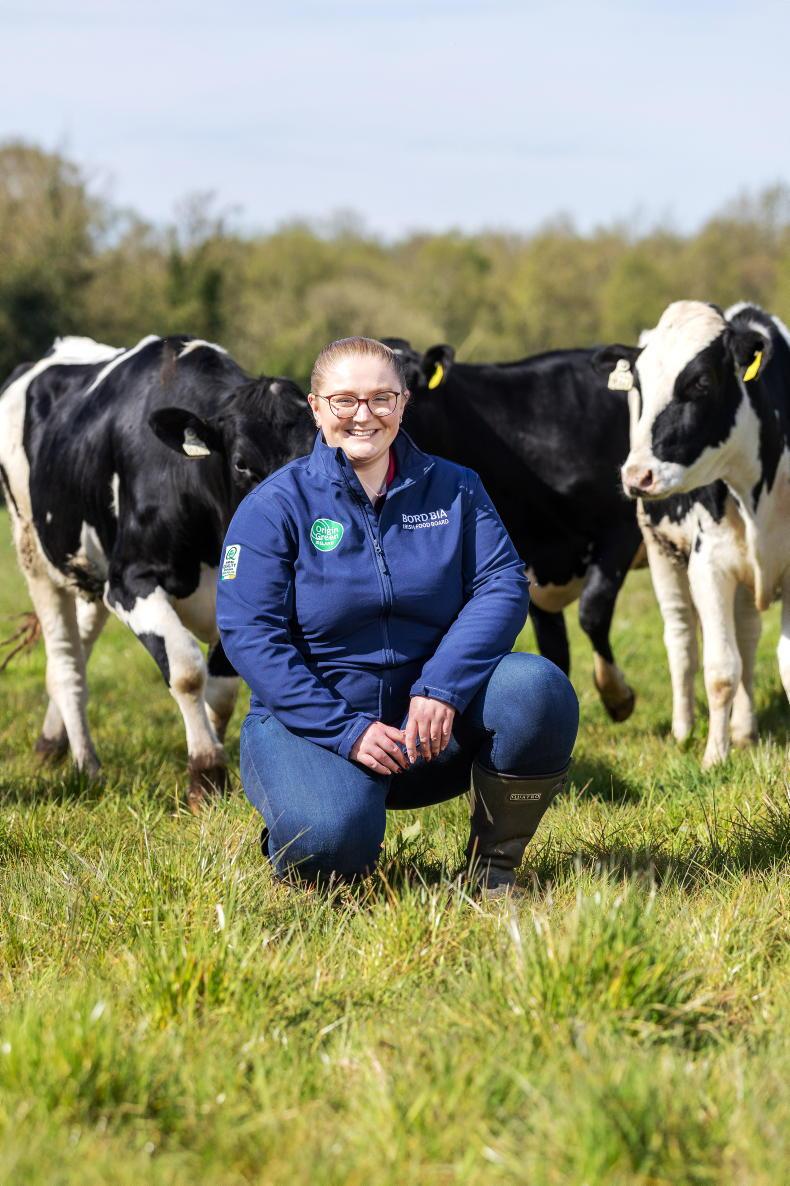
Rebecca O’Halleran is from, and remains actively involved in, the family dairy and poultry farm in Co Longford that markets all its own eggs under the O’Halleran Family Farm brand, supplying both the retail and catering sectors. She holds a Business Management degree from Maynooth University and has worked in Bord Bia since 2022.
What do you do in Bord Bia?
When I joined Bord Bia, I was working on the Food Processor Standard before taking up my current role as Farm Schemes Development Executive managing the pig, poultry and egg quality assurance schemes at farm level. Essentially, this means overseeing the day-to-day operation of the schemes and supporting farmers and the wider industry in understanding and meeting the requirements for Quality Assurance certification.
Within my role, I also work with packing centres, poultry processors and hatcheries because of the integrated relationship they have with farmers. I also represent Bord Bia on a number of stakeholder groups within these sectors. That gives me valuable insight into what’s happening across the industry, while also allowing me to bring the operational experience we see through the schemes into those discussions.
Why is your work on schemes important for Irish pig and poultry producers?
The operation of the Quality Assurance schemes is an essential part of pig, poultry and egg production within Ireland. These schemes provide independently verified proof of the excellent work that is being done at farm level on traceability, food safety and animal/bird care. These proof points provide credible evidence that can then support the promotion of Irish pigmeat, poultry meat and eggs in home and export markets.
How does it add value to the pigs/poultry coming off Irish farms and the pig and poultry meat we sell at home and in export markets?
From an assurance and operations perspective, the value we provide is about proof and trust. We give producers and processors an independently verified way of demonstrating how the product has been produced, including its traceability, food safety and animal care credentials. That proof can then be used further along the supply chain in promotions and marketing material. At home, consumers recognise the Bord Bia Quality Mark.
For trade customers and export markets, the assurance system gives customers confidence that there is a robust standard and an independently audited process behind Irish products. Where it adds value operationally is by giving the sector credible evidence to support the claims being made about Irish food, helping meet customer requirements and supporting access to markets. It’s also important to recognise that these schemes aren’t developed by Bord Bia in isolation. The standards are developed through Technical Advisory Committees that bring together expertise from across the sector, including farmers, industry, regulators and technical experts. That helps ensure the standards strike a balance between reflecting what happens on farms and responding to the requirements of customers and the wider marketplace.
What would happen if Bord Bia didn’t run pig and poultry meat schemes?
If Bord Bia’s Quality Assurance schemes disappeared in the morning, the sector would lose its nationally recognised, independently audited framework that provides evidence of how Irish pigmeat, poultry and eggs are produced. Farmers and processors would of course continue to operate within regulatory requirements, but we would lose that common framework for demonstrating areas such as traceability, food safety and animal care to customers and consumers.
The sector would then have to find alternative ways of providing that assurance, potentially through different customer or market-specific schemes. Having one recognised national system gives us a consistent evidence base that can be used to support Irish produce both at home and internationally.
Do you understand farmer frustration with Quality Assurance?
One of the most interesting things about my job is that I get to see Quality Assurance from both sides. At work in Bord Bia, I’m involved in operating and developing the schemes, but at home on the farm where we are scheme members ourselves. I also know what it’s like when the auditor comes through the farm gate.
That keeps you grounded. Quality Assurance must provide credible evidence for customers and consumers, but it also has to be practical and workable on real farms. Having that farming perspective is something I bring with me into the job every day.