


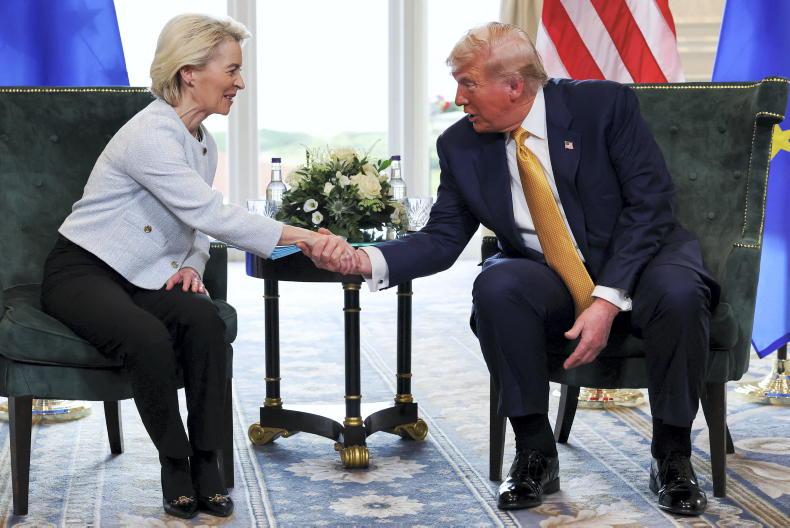
The headline tariff numbers published by the White House on Thursday show that the EU level will be the agreed 15% rate, while those on the UK will be at 10%.
While that might seem like a win for the UK, there is an important difference between how those duties will be implemented. The EU 15% is an all-in tariff, while the UK 10% is an additional tariff.
The details contained in annex II of the White House release states that goods shipped to the US will pay a tariff equal to their long-standing rate under World Trade Organisation commitments or 15%, whichever is higher.
That duty for butter, a key Irish dairy export to the US, has stood at $1,541/tonne. This is roughly equivalent to a tariff rate of 16%.
Under the details published by the White House, this implies that Irish butter will face no additional tariff when being sold to the US.
Not the same
Butter exported from the UK faces the same $1,541/tonne charge. But the UK does not get the same treatment as the EU does for the 10% rate announced on Thursday night.
This effectively means that butter exported from the UK to the US will pay $1,541/tonne plus an additional tariff of 10% of the value of the shipment, effectively putting the all-in tariff at around 25%, depending on the value of the butter.
New Zealand, whose dairy companies compete with Irish companies for US market share, is in a position similar to the UK, only their additional tariffs are even higher at 15%.
While everything to do with trade deals with the US seems to be constantly subject to change, the details released by the White House put Irish butter exports in a strong position relative to exports of the product to the US from non-EU countries.




SHARING OPTIONS