


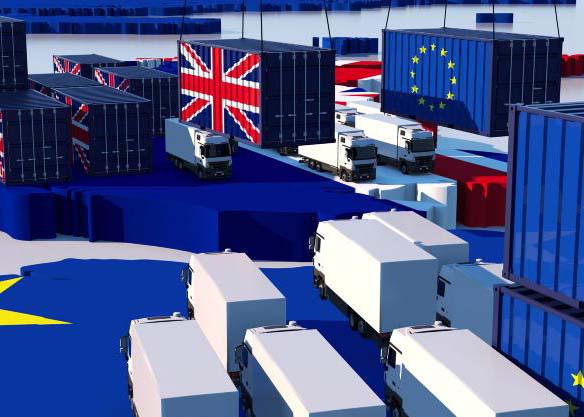
It is now almost 10 years since the UK voted to leave the European Union. After the shock result in the referendum there was a prolonged debate as to what exactly this would mean.
One school of thought suggested that although outside the EU, it could remain in the single market on the same basis as Norway and/or the customs union as is the case with Turkey.
If it had done both, it would have been almost like remaining in the EU without participating in the decision making or having the same membership costs. Being in the customs union would have meant being in the same tariff and trade orbit as EU members.
In the end, the UK decided that it wouldn’t be part of either and left with a trade agreement that provided for tariff-free and quota-free trade between the UK and EU countries.
This addressed one major concern for Irish farmers and exporters in the aftermath of the Brexit vote. Tariffs on agri-food exports, which are particularly high under the World Trade Organisations (WTO) governed most favoured nations (MFN) system.
A no-deal Brexit would have triggered these penal tariffs with horrendous consequences for Irish exports, but that was avoided by the trade deal.
While Irish and EU trade was sorted by the trade deal, it still meant that the UK was now in a position to negotiate trade deals with any other country it choose to as well. This has indirect consequences for Ireland; beef, sheepmeat and dairy in particular.
The first two trade deals agreed by the UK were with Australia and New Zealand. Between them they export over 70% of lamb that is traded globally as well as exporting 2m tonnes of beef (product weight) in 2025.
Their trade deal with the UK came into effect at the end of May 2023 and both countries have been building market share in the UK since then.
Figure 1 and Figure 2 shows New Zealand beef and sheepmeat exports to the UK, Figure 3 and Figure 4 shows Australia’s.
New Zealand had an already large 114,000t tariff-free sheepmeat quota carried over from the UK leaving the EU which was never fully used. Therefore additional quota in the New Zealand – UK deal had little practical impact on trade but it has been the opposite on beef as there was negligible quota prior to the trade deal.
Given that Irish lamb has always competed with New Zealand on the UK market, the UK trade deal with New Zealand will have little additional impact.
It is different with Australia as it had very little access to the UK before their trade deal and since it came into effect it has grown to have a substantial place in that market.
Consistently
Regarding beef, Ireland has consistently supplied between 75% and 80% of UK beef import requirements, but over the past year that seems to be changing.
In 2024, AHDB data shows that Irish beef accounted for 77% of the UK’s beef import demand. Fast forward to the end of 2025 and the Irish share of UK beef imports had fallen to 67%.
Most of the decline occurred in the latter part of the year and indeed looking at the data for December, the Irish share that month fell below 60%.
What is interesting is that Poland’s share also fell, with New Zealand, Australia and Poland all supplying more of the UK beef imports that month though Poland remained the largest supplier for 2025 overall after Ireland.
Cattle supply
Last year was different from previous years in that the amount of beef that Ireland had available for export declined because over 200,000 fewer cattle were processed compared with the year before.
This no doubt contributed to the Irish loss of market share in the UK, but what is interesting is that any deficit wasn’t picked up by other EU countries but by countries that had negotiated a tariff free quota with the UK after Brexit.
Last year looks like the year when real competition for Irish beef in the UK market arrived. Reduced availability of Irish beef no doubt played a part but forecasts suggest that there will be no additional supply this year.
That means that Australia and New Zealand can consolidate their presence in the imported beef market alongside sheepmeat.
It was also interesting to note that Brazil built significant market share last year without a specific trade deal. Its beef has a preferential 20% tariff (for a limited quantity) under the Hilton quota.
Since the present UK government came into office in July last year, there has been a greater focus on rebuilding relations with the EU than pursuing external trade deals.
That said, deals have been done with India and the USA in a limited sense but it includes a reciprocal 13,000t tariff-free beef quota.
What would be of concern to Irish beef producers and exporters is the possibility of the UK following the EU’s footsteps and concluding a deal with the big beef exporters that make up the Mercosur countries in South America.
If it were to secure a substantial quota similar to what Australia and New Zealand secured, then the UK market would have numerous choices to supply their imported beef demand.
The bottom line is that trade deals already done by the UK, never mind ones that they may do in future, are making the UK market for imported beef more competitive than it has beef since the UK joined the then EEC back in 1973.
This means more competition for Irish beef even though Ireland’s geographical location means that we will always have that competitive advantage.



SHARING OPTIONS