


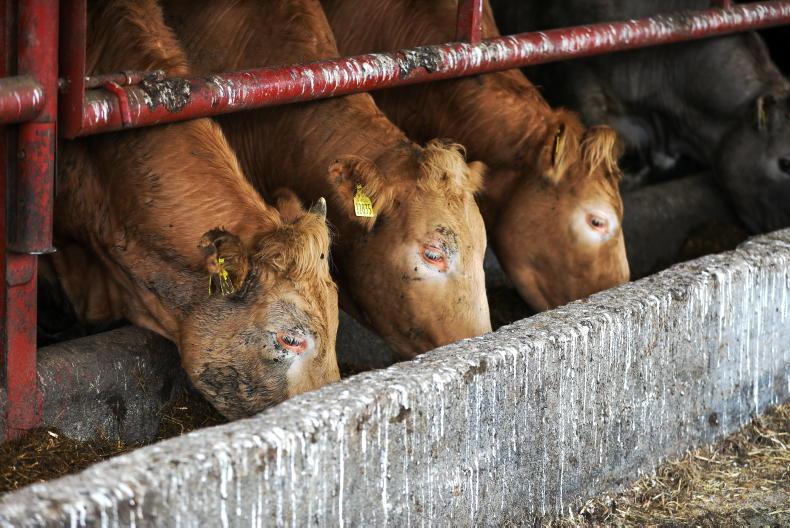
Stock bulls
If stock bulls are neglected during the winter period, this can have a negative impact on fertility and functionality. Take care where bulls are housed on straw bedded pens with no access to concrete areas, as feet can become overgrown and tender.
It’s also important that the bull does not lose too much condition over the winter months, that they are fit and not fat either. In most cases ad-lib access to good quality silage plus 3-4 kg of a balanced ration is adequate.
Avoid feeding rolled barley on its own, as this could increase the incidence of feet problems.
Make sure the bull receives all doses and vaccinations that the herd gets. If outwintered or housed separately, they can often be forgotten about. This goes for all outwintered animals.
It’s really important that fluke doses are kept up-to-date for outwintered animals, as these animals pose a greater risk to parasite infection during the winter months.
CAP Series
The Irish Farmers Journal, supported by AIB and the Department of Agriculture Food and the Marine will hold our next CAP Information Meeting on Tuesday 17 January in the Great National Hotel in Ballina, Co Mayo at 7.30pm.
There are huge changes coming to payment rates and schemes, and at the meeting farmers can hear how the new CAP will affect farm schemes and income, with presentations and a Q&A session.
It’s a great chance to become familiar with schemes that are available for all farmers. The event is free to attend and you can register now at www.ifj.ie/register. I’ll be there on the night to answer any questions on the beef related schemes.
Survey Response
Thanks to everybody who responded to my survey last weekend. It’s great to get readers’ views on changes in policy and how they will adapt to meet new challenges.
While the minister has taken the reduction and exit schemes off the table for now, it’s interesting to see that 50% of respondents would opt not to join any such scheme.
The second question highlighted the fact that 90% of farmers who were thinking of reducing suckler cows were going to wait to see if a reduction scheme would come in to pay them to do it.
The fact that no scheme will be introduced brings a little more certainty to the situation.
The final question on participation in the new Suckler Cow Efficiency Programme (SCEP) and the future replacement for the BEEP scheme showed a massive 75% of respondents intend on joining the two schemes which will pay €240/cow on the first 10 cows and €190/cow on each cow thereafter.
As a side note to this, the schemes are expected to open in March. One of the requirements of the new SCEP is that you must be a member of the Bord Bia Quality Assurance scheme at the time of application.
With thousands of farmers expected to apply in the coming weeks it’s important that you get your application in on time and also have everything in order to pass the Bord Bia inspection.




SHARING OPTIONS