


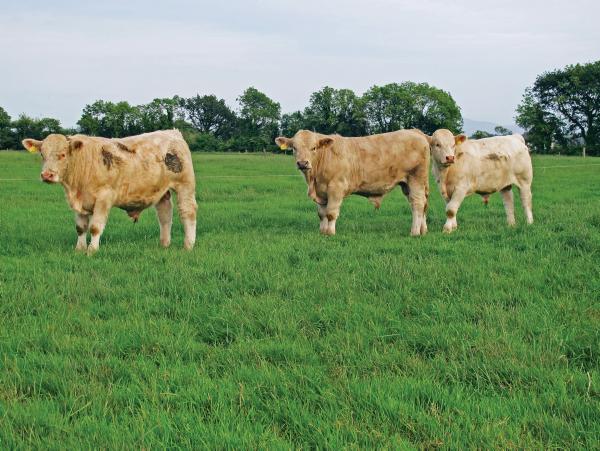
Donie Ahern farms near Kilteely in east Limerick and runs a suckler to finishing system on his 68ha farm. The focus is on achieving high weight gain from grass prior to housing for an 80 to 100-day finishing period on ad-lib concentrates.
The farm consists of 28ha of owned land with the remainder rented. Land quality varies from good, free draining limestone-based soil on the rented farm to a slightly heavier clay type soil on the home block.
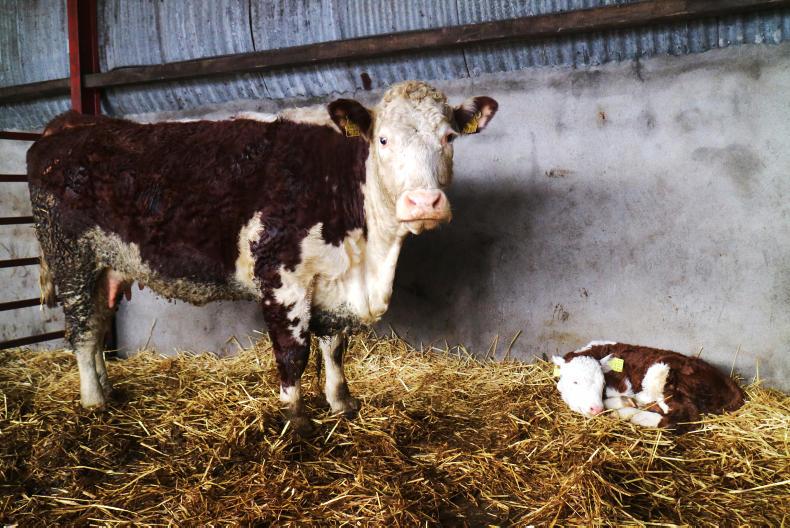
Donie runs 60 spring calving suckler cows, calving from mid-January to the end of March, and 25 autumn calving cows calving from September to December.
Heifers are finished at 18 to 19 months of age with bulls finished at 20 months of age. All are slaughtered through the Keenan Kepak Beef Club. As a new participant in the BETTER farm programme, a farm plan was drawn up by the BETTER farm management team in conjunction with local Teagasc advisers Derek O’Donoghue and Pat Blackwell. The main focus of the plan is to reduce the ration bill by making better use of early spring grass and increasing output.
Breeding Stock
Cow type consists mainly of Limousin cross cows sourced from the dairy herd, along with a small amount of homebred Limousin and Simmental cows. Cows were bred this year to Charolais and Limousin stock bulls.
Next year, only Limousin bulls will be used on the farm. With pressure coming on slaughter weights of bulls, Donie aims to finish earlier, with a maximum carcase weight of bulls of 440kg. To source good quality replacements from a reliable source, Donie has an agreement in place with his brother, who is a dairy farmer, to purchase 20 Limousin cross heifers in November of each year. This eliminated the need for Donie to have a maternal sire on the farm or use AI to breed replacements allowing him to focus on terminal traits on bulls to produce stock for finishing.
||PIC2||
Increasing Output
As part of Donie’s farm plan, a number of changes are to be made to his farm. The first change was to purchase stock for finishing, increasing farm output.
In February, 10 yearling Limousin bulls weighing roughly 360kg were purchased with the aim of finishing them before the end of the year. In addition, 10 yearling heifers have also been purchased with the intention of finishing before the end of this year.
These stock, in addition to the progeny being finished from Donie’s 85-cow suckler herd, leads to a high stocking rate on the farm at 2.45 LU/ha. The demand for grass can be very high at certain times of the year. This means that Donie needs to have a high level of grassland management. Donie measures grass on a weekly basis throughout the main growing season. This lets him make informed decisions on spreading fertilizer or taking out grass surpluses as baled silage.
Calving Spread
One area that needs improvement on the farm is the calving spread, which lasts for almost 6.5 months between autumn and spring. This leads to a long, drawn out workload. Farmers in general are better off with a shorter calving spread. Less time is spent observing cows which should result in fewer losses and less fatigue from the farmer’s perspective. This will lead to a more uniform group of stock for finishing and easier grouping of stock for the winter.
The plan is to reduce the calving spread to a maximum of two 10-week periods through a strict culling regime and having plenty of quality replacement heifers.
Grass
While improving Donie’s output was one of the main aims of the farm plan, improving his grassland management was key to making a profit from this extra output.
Donie has started to turn stock out much earlier than normal to make maximum use of grass to cut production costs. Yearling heifers were turned out to grass in late February this year, along with the purchased yearling bulls.
Cows were also turned out to grass as they calved in the spring with the autumn-born calves creep grazing the land around the sheds over winter, while the cows remained indoors. This allowed Donie to stretch the limited silage supply over the long winter and late spring this year.
It was decided this year to install a paddock system on the rented land to improve grassland management and utilisation. This meant installing a number of water troughs at central locations in the fields and dividing these fields in two with a permanent electric fence. The position of the troughs allows the fields to be divided by temporary strip wires into four or eight divisions, depending on the field size and the number of stock being grazed.
Extra water troughs were installed along farm roadways on the home farm to allow a similar system to operate. This job was not overly expensive to undertake and, so far, Donie is seeing real benefits from the investment.
Further reseeding was carried out on the home farm, and the rented out-farm, by Donie this year. He reseeded silage fields in 2011 and noticed a definite increase in the amount of grass grown, along with a marked improvement in the thrive of stock that were grazing these fields due to the higher feeding value of the new grasses.
Weight Gain in cattle
Donie weighs his cattle regularly to assess their performance. Over the winter, his finishing bulls gained 1.6kg/day while the finishing heifers gained 1.2kg/day.
Donie attributes this to a more balanced diet fed to both the growing and finishing stock. Performance at grass has been exceptional this year, with spring-born yearling bulls gaining 1.8kg/day and yearling heifers gaining 1kg/day between May and July.
This performance is significantly higher than last year and is attributed to Donie’s improved grassland management, ensuring growing stock have access to top quality leafy swards of ryegrass at all times.
Donie fed extra soya bean meal at a rate of 0.5kg/head/day to balance out the low protein (8%) in the 2012 silage and noticed an immediate improvement in performance.
Finishing bulls are normally built up to 14kg of meal, along with 1kg straw and 10kg silage. Finishing heifers are built to a similar diet of 10kg meal, 1kg straw and 10kg silage. Weanlings were fed 2kg of meal along with silage, minerals and 0.5kg/day of soya over the winter.
Challenges so far
Last spring was as much of a challenge for this farm as it was for any farm in the country. Silage supplies ran out due to the late spring, grass supplies were very tight and extra meal had to be purchased. This was in addition to all the changes taking place in accordance with the farm plan and it led to a considerable workload and cash in expenditure for Donie. Thankfully, most of the required farm work has been completed and Donie is almost fully up and running. The good summer weather that followed allowed Donie to recoup some of the extra costs incurred by achieving large weight gain on cattle at grass. Bulls and heifers have been thriving extremely well, with bulls gaining up to 1.8kg/day prior to housing for finishing in September.
Planning ahead
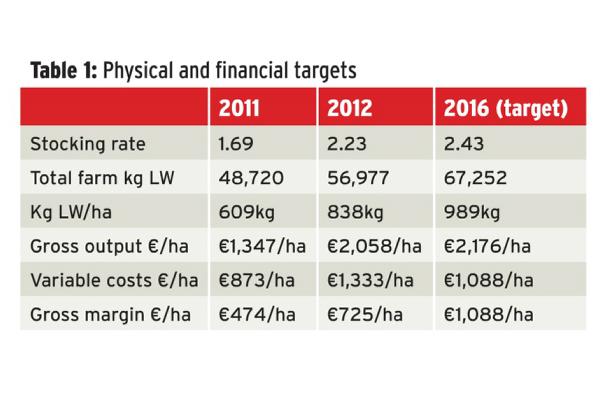
Donie plans to continue pushing his stocking rate to increase output, while monitoring his costs. Donie completed a Profit Monitor for 2012 and saw how increased focus on output led to an increase in gross margin. This has more than covered all of his fixed costs and left a positive net margin, excluding all subsidies.
It had been anticipated that increased meal and silage costs, along with a lack of grass growth this spring, would Donie’s plans and profitability this year. But the favourable grass growth over the summer, along with an improvement in silage quality may balance out the expensive spring somewhat.
The main thing to remember with any plan is to be flexible and open to making small changes should the need/opportunity arise. Donie is well positioned to make major strides in increasing the profitability of his farm in the future.



SHARING OPTIONS