



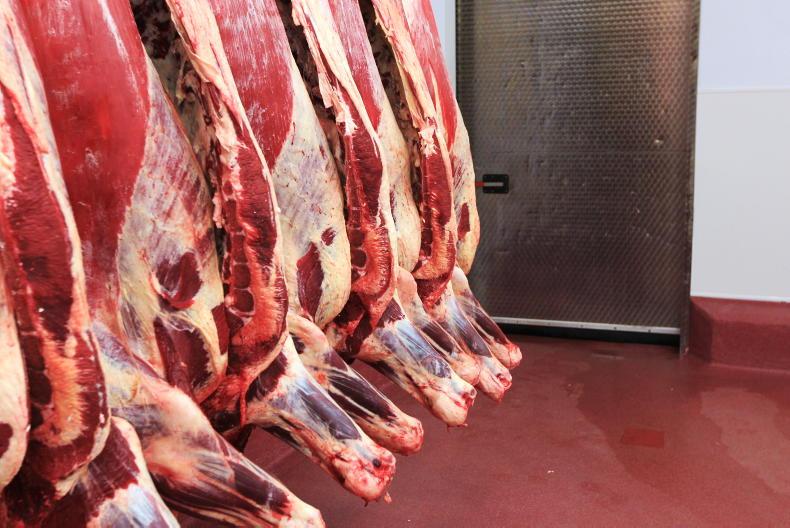
There are some mixed messages coming out of processors this week, with some of the larger groups trying to reduce prices, while some of the smaller independent factories haven’t been able to reduce quotes as they continue to struggle to get cattle.
Some of the larger factories are actively trying to apply pressure to the beef trade this week, with some dropping quotes by 10c/kg.
More cattle available, a shorter week and reducing grass supplies in the south are both being put down as some of the reasons the pressure has come on the trade.
Base quotes for bullocks are working off €6.40/kg, while base quotes for heifers are working off €6.50/kg.
There are some factories trying to quote lower, but are getting very little if any cattle at the lower quotes.
Base prices of as high as €6.60/kg for heifers remain in some of the smaller establishments.
Breed bonuses continue to be paid out between 10c and 20c/kg for in-spec Aberdeen Angus and Hereford bullocks and heifers.
The cow trade has also taken a hit, with P+3 cows working off base quotes of €5.80/kg to €5.90/kg.
O grading cows are working off €5.90/kg to €6/kg, while R grading cows are being quoted anywhere from €6.10/kg to €6.20/kg.
There continues to be higher numbers than normal of dairy cows coming to the market, especially in the south of the country where grass supplies continue to be under pressure and dairy farmers offload.
The bull trade hasn’t escaped the cuts, with prices generally trending 10c/kg behind where they were this time last week.
U grading bulls are working off a price of €6.50/kg, while R grading bulls are being bought at €6.40/kg this week.
Under-16-month bulls are working off base prices of between €6.20/kg and €6.30/kg, but numbers of these younger bulls are in short supply at the moment.
Last week’s kill saw a slight rise to 30,585 head, up about 1,000 head on the previous week. Last week’s kill was 5,000 head over the same week in 2025.
The biggest lift came in the bullock category, up almost 1,500 head. The cow kill came in at 7,044 head, a drop of just over 500 for the week, but still one of the biggest weekly kills for 2026 and almost 2,000 head over the same week in 2025.
The latest UK retail data from Worldpanel by Numerator for the 12-week period up to 12 July 2026 shows beef markets relatively steady, despite increases in price.
Primary beef volumes were back 1%, with mince seeing a 4.5% decline in sales year on year. This was primarily driven by a 12% increase in price.
Steak cuts and diced beef saw good growth in the 12-week period, with steak cut sales up 9% and diced beef sales up 10%.
Burgers and grilling meat also saw an increase of 5.2% with warm weather and the World Cup effect being put down as reasons for this growth.
The latest import data from the UK for the first five months of 2026 shows beef imports steady, trending down just 0.3% on 2025 import levels.
Delving a little deeper, Ireland remains the largest exporter of beef to the UK with 64,681 tonnes exported between January and May this year. This figure is down 14% on 2025 levels.
New Zealand beef has seen record growth in the UK, with volumes up to 12,174t for the first five months, up 339%.
Australian beef has also seen huge growth in the UK, with 7,852t of Australian beef imported to the UK between January and May 2026, up 139% on 2025 levels.
Prices across the water in Britain have generally been trading upwards in recent weeks, with R4L bullocks this week working off base prices of between 610p and 615p/kg (€7.09/kg and €7.15/kg) in many cases.



SHARING OPTIONS