



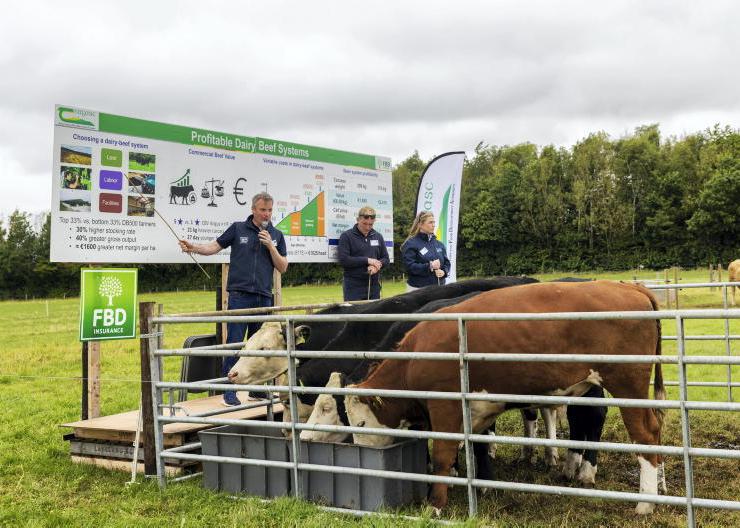
There is potential for efficient dairy-beef systems to deliver a net margin of upwards of €500 per head. This statement was one of many positive messages delivered on the prospects for dairy calf-to-beef production systems at Beef2026.
Teagasc adviser Jamie O’Driscoll presented two scenarios of early maturing bullocks slaughtered at 22 months of age at a carcase weight of 290kg and 310kg.
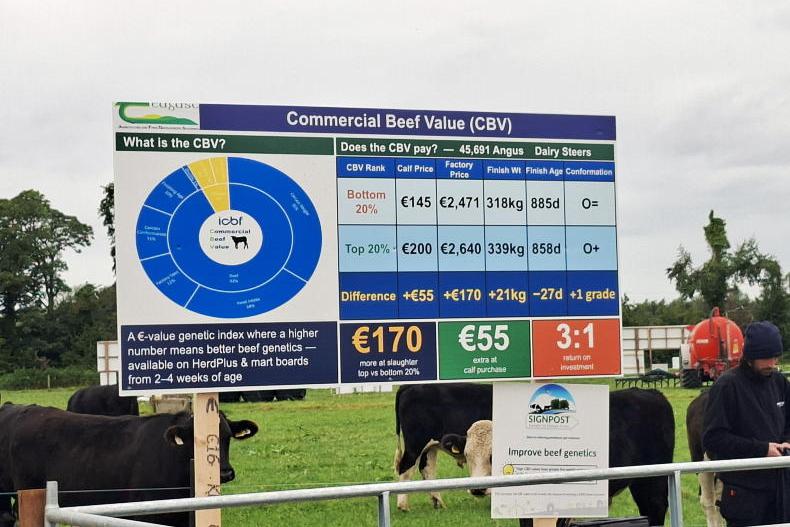
He outlined that the difference in carcase weight could be used to demonstrate the difference in margin from selecting animals on the basis of the commercial beef value (CBV) and on a five-star and one-star basis.
Alternatively, the difference could be used to demonstrate different levels of performance.
The beef price used in the analysis was €6.50/kg – this was based on a base price of €6.40/kg and animals priced on the quality payment system (QPS) grid.
At a calf price of €350 per head the lower carcase weight figure returned a net margin of €510 per head while the higher carcase weight figure generated a gross margin of €640 per head.
If the calf price increased to €450 per head, the net margin per head figure reduced to €410/hd and €540/hd respectively.
System costs
The net margin figure is based on costs in the system of €1,025 to bring an animal from purchase to slaughter.
This can be broken down into variable costs of €850/hd and fixed costs of €175/hd.
A breakdown of the variable costs that can be expected in an efficient dairy calf-to-beef system were presented by Teagasc researcher Ellen Fitzpatrick and are summarised in Figure 1.
She outlined that the first step is for a farmer to identify the most suitable system for their farm in terms of ability to grow grass, labour availability etc, followed by sourcing the best-performing genetics for that system.
The calf-rearing system is one of the most demanding in terms of labour, with direct production costs at €160/head.
This is composed of a bag and a half of milk replacer, 100kg of concentrates and veterinary costs including vaccination.
Maintaining performance through the weaning transition phase is critical and Ellen says that concentrate supplementation is continued for three weeks after weaning before transferring to a grass-only diet until concentrates are reintroduced in the middle of September.
She highlights that hitting performance targets of 0.8kg daily liveweight gain (DLWG) during the first grazing season can be one of the most challenging periods in the animal’s life.
First winter
A cost of €160 is allocated for the first winter period and Ellen outlines that keeping costs to such a level is reliant on having high-quality, high dry matter digestible (DMD) silage.
This allows a minimal level of concentrate supplementation over the first winter, but if silage quality is poor, concentrate costs can quickly increase.
The aim here is for a moderate level of growth, in the region of 0.65kg DLWG so that animals are primed to avail of compensatory growth once released to grass in the second season.
Ellen says that it costs around €180 for the 200-day period at grass in the second grazing season.
A target of 1kg DLWG is the target performance here and requires high levels of grassland management.
Animals are then housed for a period of about 60 to 70 days and finished on a conventional finishing system of 5kg concentrates and ad lib high-quality silage. This is costing around €250/head – bringing total costs to €850/head.
Fixed costs
Fixed costs are taken as €175/hd and Ellen says this is for a well-established system that has roadways, good grazing infrastructure, housing etc in place.
She cautioned that this figure could rise to €300/head where the farm is in a phase of high investment with farmers encouraged to look at their own figures and to take realistic production figures to identify the best fit for their farm.
DairyBeef 500 performance
Figures collated by Alan Dillon, DairyBeef 500 co-ordinator were also presented at Beef2026 on the performance of farms in the Teagasc-led programme.
The increase in beef price underpinned a doubling in net margin as outlined in Table 1.
Alan outlines that the rise in output in 2025 reflects the sharp jump in beef price along with improved animal performance and more efficient production systems.
He said that variable costs remained constant allowing the increase in output to translate directly in to higher gross margins.
It was highlighted that farms that maximised production through higher stocking rates and improved liveweight gain were better positioned to capitalise on the beef price increase.
The top third of farms achieved 592kg liveweight output per hectare compared to 562kg for the bottom third of farms in terms of profitability.
The stocking rate on the top third farms was 2.36LU/ha or 188kg organic nitrogen/ha (N/ha) compared to 1.85LU/ha or 148kg N/ha for the bottom third farms.
Excellent grassland management is required to operate at such a stocking rate and obviously the continuation of the nitrates derogation is vital to operate at such levels.
The top third farms had lower variable costs of €1.38/kg liveweight compared to €1.62/kg on lower performing farms. It was noted that Teagasc has identified calf price as a key concern for future years with rising calf prices having the potential to reduce profitability if beef prices do not increase correspondingly.



SHARING OPTIONS