



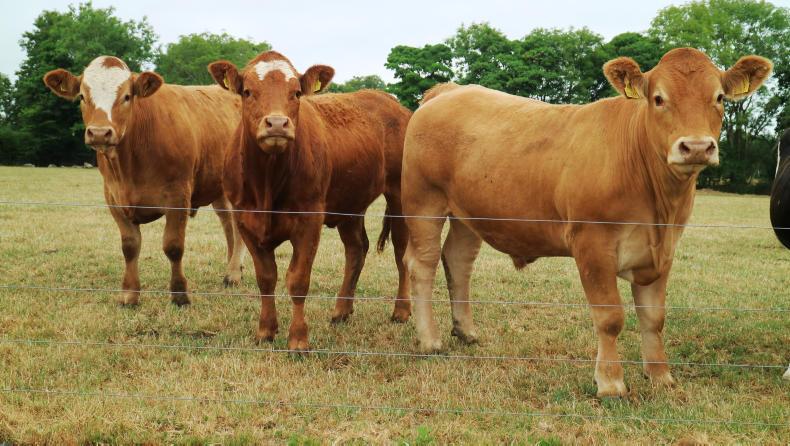
Tom Bolger farms 43ha outside Borris in Co Carlow alongside his son Ian. Similar to most farms across the country it has been an extremely challenging summer on the Bolger’s farm as a result of the extreme drought conditions falling on the back of a torturous spring. However, given the free-draining, light nature of the region’s soils, the farm has been struggling worse than most in recent weeks, with Tom likening the farm’s appearance to being more “like the Sahara”, rather than the green Carlow land.

Changes afoot
Despite these difficulties, the farm is continuing its progression. This year, the Bolger’s farm is set to experience a big change, as the farm’s sheep flock will be completely phased-out. According to Tom, the discontinuation of the sheep flock was something he had been considering for a number of years and when the BETTER farm management team, along with Tom’s local B&T advisor Hugh Mahon, approached him to join the programme he said it was one of the changes he wanted to make. “As soon as I was asked to join the programme I told the team that the sheep flock would probably have to go. I wanted to concentrate more on the cattle and as well as that, my son Ian has work off-farm so calving cows and lambing ewes wasn’t practical. I think I won’t know myself next spring without them.”
This spring only 80 sheep were lambed, a reduction on previous years, and next spring there will be no sheep on the farm. That said, Tom always got on well with the sheep flock. With a highly-prolific flock of Belclare ewes, he acknowledged that “there was definitely profit in the sheep”, however he also pointed out that the full potential of the cow herd couldn’t be unleashed – “you would find that the sheep would have all of the grass gone in the spring – the place would be bare. It meant early grazing for cattle wasn’t an option.” Tom is not afraid of making changes. Two years ago, the farm moved from a split calving herd to a wholly spring calving herd. “I remember coming home one time and having nearly ten groups of stock to move – the split calving was leaving me with far too many groups. This year was the second time I calved all my cows in the spring and I find that the management of the herd is far more straight-forward,” Tom said.
Dairy calves in
With the loss of the sheep flock, a dairy calf-to-beef system is being introduced in its place. This year, 55 dairy calves were purchased from five different herds, with a mix of breeds within the group. “There are seven Limousin crosses, eight Angus crosses, eight Simmental crosses and the rest are Hereford crosses,” explained Tom. “I plan to keep the Simmentals as replacements for myself.” The calves were purchased between the middle of February and the start of April. Each calf was treated for cryptosporidium and given vaccinations for pneumonia and clostridia diseases. For rearing, each calf got 1.75 bags of milk replacer on average according to Tom, although some got more than this and some got significantly less - “some of the calves I purchased were half-reared and they cost me €360/head. The rest were baby calves which I paid €230/head for.”
What will be of great interest to Tom is whether the €130/head difference in purchase price will be smaller or greater than the price difference at sale – “fair enough, the calves are different breeds and the €230/head calves are almost a month younger, however, they are all on the farm for roughly the same amount of time and I would be inclined to think that there will be more than a €130/head in the difference when it comes to selling them.” When asked why he didn’t opt for extra suckler cows instead of rearing dairy calves he replied: “I could run a lot more calves where I could have only 10 extra cows. It also goes back to the labour and I should have an easier time rearing the calves than calving a higher number of cows.”
Incorporating AI
This year, 38 cows and five heifers were bred for calving next spring. “By right, we should have more heifers in for breeding, but for various reasons we just let five in. We were considering buying in replacements and didn’t. To be honest, it’s for the best because the less stock we have to feed this autumn and winter, the better.” AI has become a big part of the breeding strategy on the farm. Tom explained that he had concern over the lack of milk in his herd. His cows are predominantly Charolais crosses and he felt that an introduction of maternal cross-breeding would help to generate more milk in his cows. In the past, Limousin AI sire CWI was used to breed replacements. For his heifers, another Limousin bull EBY is the preferred choice with Tom saying he has had little or no trouble with this bull’s calvings. Salers sires were also used last year to further incorporate maternal traits and Tom has four impressive Salers calves on the ground at present. A Charolais stock bull is used to serve remaining cows after the AI period.
Tackling the drought
With growth non-existent in recent weeks, Tom has been forced into taking measures to alleviate the problem. While some of these measures may not be applicable to all drystock farms in the country, many of them can be considered as options to compensate for the lack of grass growth at this key time of the year.
Cull cows:
When I visited Tom last week, his son Ian had just returned after bringing eight cull cows to the factory. Up until slaughter, these cows had been suckling calves, but Tom explained that the calves had been on creep for a long time prior to the cows being sold. As a result it meant that the calves’ dependence on their mothers had been significantly reduced and that concentrates were making up a large part of their diet. The calves were extremely settled without their mothers and barely panicked at their absence.
Steers:
The farm is operating a steer and heifer beef system. After weighing all of these stores last week, 13 animals were picked out to start finishing on concentrates (Table 1). At present, these are getting 2kg/3kg of concentrates and high-quality wrapped silage, with the aim being to build them up to 8kg of concentrates before selling them in the middle of October. Tom pointed out that this process is happening a month earlier than usual but he had little option but to do so.
Dairy calves:
Tom would have expected that his dairy calves would be grazing on his best quality grass with little-or-no meal in the diet. As it stands, the calves are on 2kg of meal to supplement for almost no grass on their grazing block. It is vital to sustain these animals’ performance at all times of the year and the introduction of concentrates was seen as a must.
Fodder purchases:
Given the farms’ location is in the heart of tillage country, Tom has been able to access straw and barley. Maize crops are also doing extremely well this year due to the high temperatures and Tom has agreed on the purchase of 200t of maize to boost his fodder reserves.



SHARING OPTIONS