


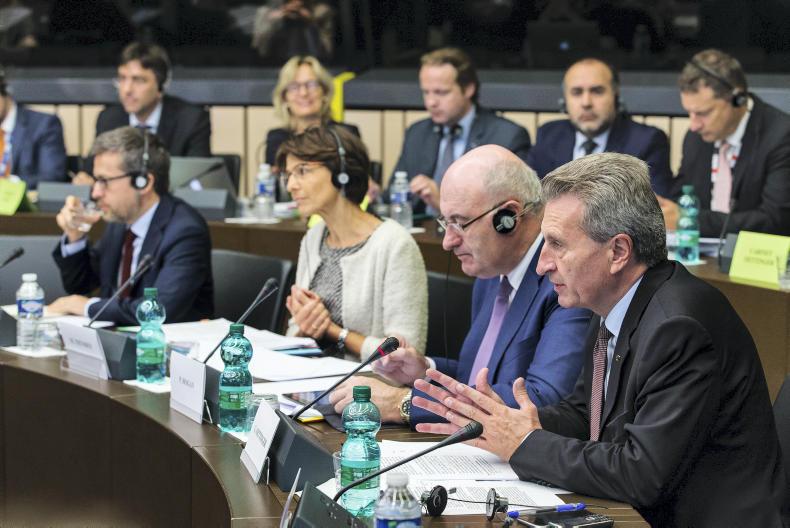
Although there is a dedicated budget commissioner, preparing a budget for the EU involves the entire European Commission, with each member fighting their corner. How well the next CAP is funded very much falls on the shoulders of Phil Hogan. In a recent Reflection Paper on the Future of EU Finances, Budget Commissioner Günther Oettinger set out five scenarios. This formal starting point for discussions on the EU’s budget after 2020 reflects the €10bn shortfall created by Brexit, and increased ambitions on defence and migration. This suggests a €20bn gap.
1 Carrying on:
work within the current contributions of the EU 27 but reallocate some of the CAP to finance new priorities.
2 Doing less:
reduce the EU’s overall activity and budget, with serious implications for CAP. Only farmers under special constraints would receive direct assistance with risk management tools suggested for other farmers.
3 Some do more:
increase expenditure in some areas, funded by participating countries through greater contributions or a new revenue stream such as a financial transaction tax. This could enable agriculture funding by those members most committed to it, but CAP would become less common.
4 Radical redesign:
end all rebates to members and review VAT so that the EU generates its own resources. This would also lead to a cutting of direct payments to farmers with a focus on areas of natural constraint and agri-environmental schemes, with risk management tools offered to other farmers.
5 Doing more together:
increase budget contributions and expand EU activity in all areas, including agriculture.
Higher contributions by member states under the fifth scenario would maintain the CAP budget. The other four would mean less money for the CAP. Agriculture certainly has a tough fight on its hands to retain its budget. One positive note is that all scenarios continue to provide some subsidies to farmers.





SHARING OPTIONS