



Ireland’s most inspiring young environmental change makers were celebrated on 12 May as Eco-Unesco announced the winners of the Young Environmentalist Awards (YEA) 2026 at a national showcase event in Dublin.
The programme is one of Ireland’s largest youth environmental initiatives, which celebrates young people aged 10-18 who have developed projects addressing major environmental and social challenges, including biodiversity loss, climate change, waste reduction, sustainable transport and food sustainability.
This year’s programme saw 340 environmental action projects submitted from 29 counties, with 110 finalist groups shortlisted following regional Eco-Dens semi-final events held across Ireland.
According to Elaine Nevin, national director of Eco-Unesco, the sense of optimism and purpose in the room made this year’s showcase special.
“These young people are not waiting for change to happen around them but they are actively leading it within their schools, communities and everyday lives. From sustainability and biodiversity to climate action and waste reduction, the level of thought, creativity and commitment on display was genuinely remarkable,” she says.
GoWild
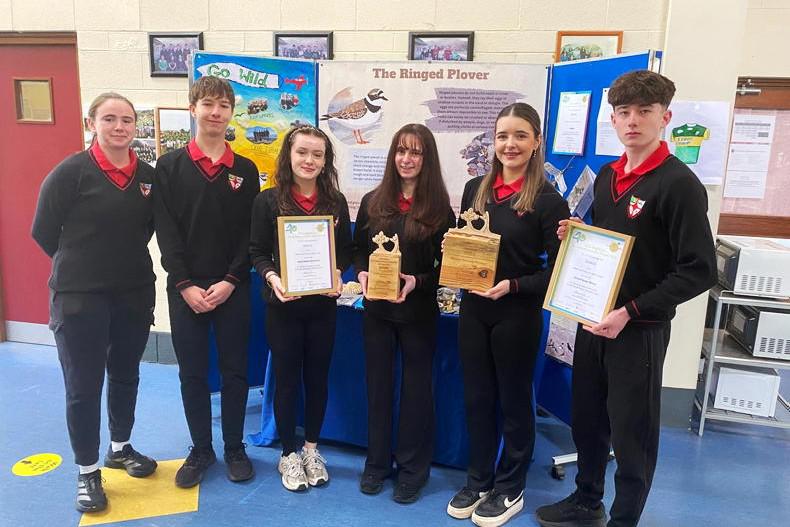
The overall senior prize was given to the GoWild project from Mean Scoil Nua An Leith Triuigh, Castlegregory, Co Kerry. The rural school which only has 106 students focused on protecting the ringed plover, an endangered coastal bird in their local area, which is now on the amber list of endangered species.
Teacher and principal Karen Blennerhassett says the project grew organically.
“It started off as an environmental studies class with transition-year (TY) students, and it developed from there,” she explains.
“We started entering the Environmental Awards competition maybe four years ago, and I love it because it’s really open and inclusive of everyone, there’s something for everyone in it. No matter what their interests are.”
Living by the sea students Jarlath Malachy Wruck, Aoife Flynn, Grace Boland, Darragh Goodwin, Saoirse Brosnan and Beatrice Dowling were naturally drawn to coastal conservation and the work of the Maharees Conservation Association (MCA), particularly its efforts to protect the ringed plover.
“They’re a really small little bird,” Karen says.“They lay their eggs in the sand in what we call a little scrape, at the high water line mark on the beach, which is not a great place. If the tide is high, the tide will come in and wash the eggs away, and we’ve surfers, jeeps, walkers and dogs – all of which can damage the eggs as well.”
Visiting speaker Martha Farrell from the conservation group, helped ignite the students’ interest and stayed involved throughout the project duration.
“We were very lucky that Martha saw the interest of the students and came back every so often to guide them,” says Karen.
“For me as a teacher, it was lovely as well to hear a new voice, someone else that’s really passionate about it.”
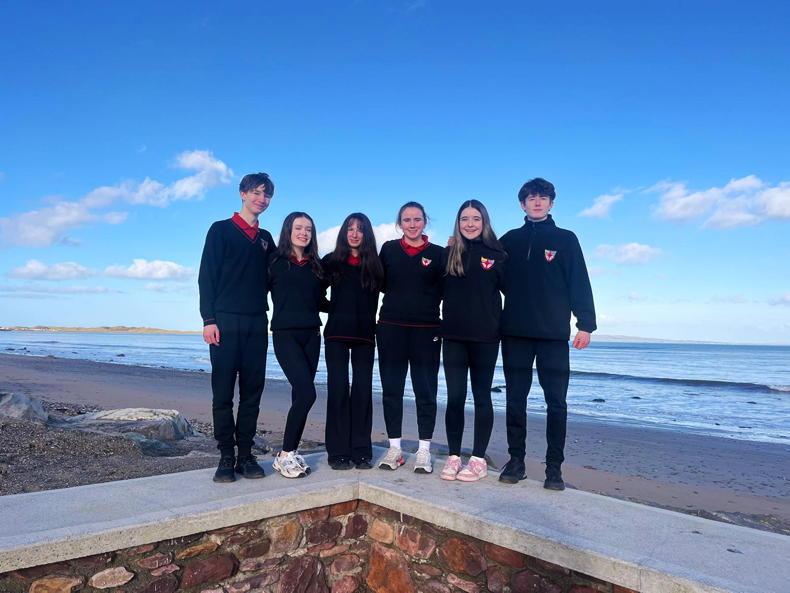
About the project
Each student took on a specific role: one led social media on Instagram and TikTok, while another created a tactile model of the beach, using real sand and grass so children could “learn by touch”.
The TY group then brought workshops into local primary schools and invited students from the Maharees into the secondary school for lunchtime sessions.
“It is just a real proud moment for the school when we’re able to perform on the national stage,” says Karen.
“We’re a small school, and we’re not often the ones that the papers would come out to cover stories of, so we’re so appreciative of the acknowledgement and the recognition.”
With some of the students from the TY group away on a school trip when the final took place in Dublin, the class “passed the baton” to younger third-year students, who travelled to the RDS to present the project.
“I’m really proud of the fourth years, because it just shows that this will live on,” Karen says. “It’s wonderful to show what the students can do when their heart is in it and there’s passion there.”
For Karen, the win underlines the power of small rural schools to nurture talent and confidence.
“A child can go to a small country school and still excel and still win on the national stage,” she says.




SHARING OPTIONS