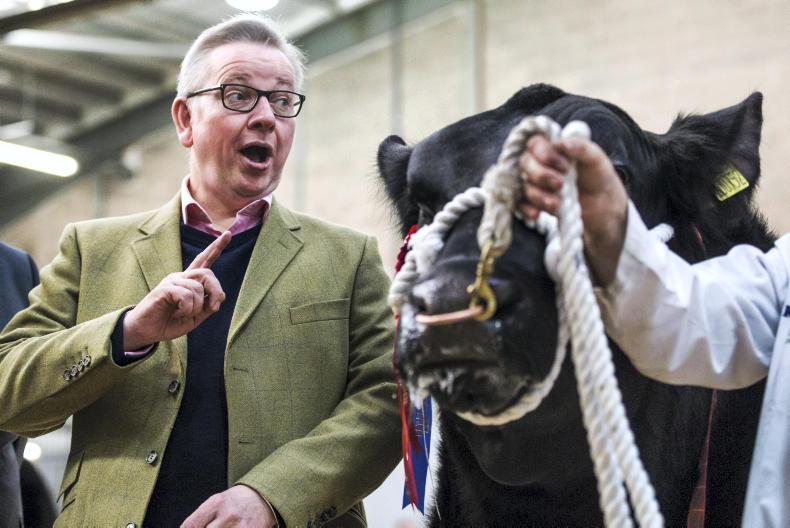
The secretary for the Department for the Environment, Food and Rural Affairs, Michael Gove, attended the Stirling Bull Sales on Sunday 4 February. \ Craig Stephen
ADVERTISEMENT
In many ways, the addition of an education requirement to qualify for payment could be seen as a ‘gold plating’ of EU rules. Adding another set of hoops, if you will. It certainly does not make life easy. But it also helps to tackle the ‘active farmer’ definition problem. Up until now the EU has had a negative list to define the active farmer, a list of what s/he is not. Under the simplification of the Common Agricultural Policy, it was decided to let member states provide their own definition of an active farmer.
The UK will have to find its own solution to this debate post–Brexit, in order to avoid giving payments to ‘slipper farmers’. Putting education criteria in place would test the commitment of those wishing to receive payments. But the benefit is two-fold in the sense that studying agriculture provides you with more tools to manage a farming enterprise and experience on farms away from home. It also gives you a network of people with similar interests to share ideas and pose questions to.
It does not necessarily need to be a paper based exercise, but an apprenticeship scheme which involves experience on other people’s farms or even in food manufacturing could be just as beneficial in broadening horizons.
ADVERTISEMENT
Register for free to read this story and our free stories.
This content is available to digital subscribers and loyalty code users only. Sign in to your account, use the code or subscribe to get unlimited access.
The reader loyalty code gives you full access to the site from when you enter it until the following Wednesday at 9pm. Find your unique code on the back page of Irish Country Living every week.
CODE ACCEPTED
You have full access to the site until next Wednesday at 9pm.
CODE NOT VALID
Please try again or contact support.
In many ways, the addition of an education requirement to qualify for payment could be seen as a ‘gold plating’ of EU rules. Adding another set of hoops, if you will. It certainly does not make life easy. But it also helps to tackle the ‘active farmer’ definition problem. Up until now the EU has had a negative list to define the active farmer, a list of what s/he is not. Under the simplification of the Common Agricultural Policy, it was decided to let member states provide their own definition of an active farmer.
The UK will have to find its own solution to this debate post–Brexit, in order to avoid giving payments to ‘slipper farmers’. Putting education criteria in place would test the commitment of those wishing to receive payments. But the benefit is two-fold in the sense that studying agriculture provides you with more tools to manage a farming enterprise and experience on farms away from home. It also gives you a network of people with similar interests to share ideas and pose questions to.
It does not necessarily need to be a paper based exercise, but an apprenticeship scheme which involves experience on other people’s farms or even in food manufacturing could be just as beneficial in broadening horizons.
If you would like to speak to a member of our team, please call us on 01-4199525.
Link sent to your email address
We have sent an email to your address. Please click on the link in this email to reset your password. If you can't find it in your inbox, please check your spam folder. If you can't find the email, please call us on 01-4199525.
ENTER YOUR LOYALTY CODE:
The reader loyalty code gives you full access to the site from when you enter it until the following Wednesday at 9pm. Find your unique code on the back page of Irish Country Living every week.







SHARING OPTIONS