



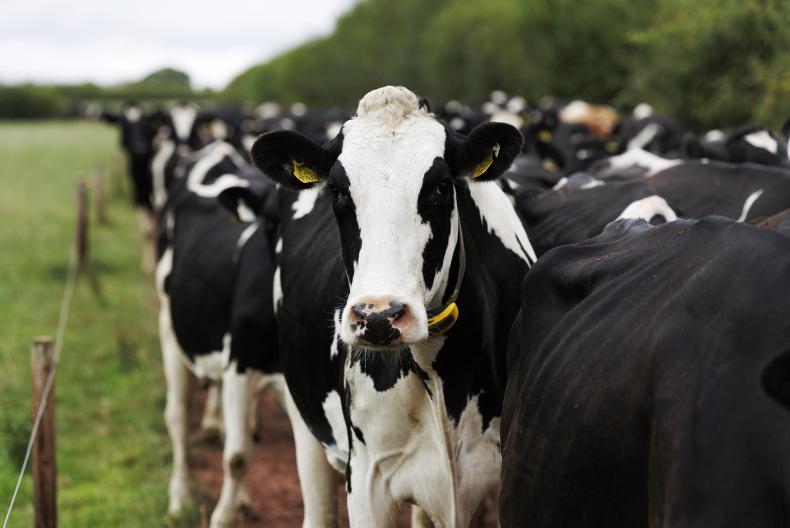
Bull selection: With breeding just weeks away on most farms, it’s time to finalise bull selection for the coming year. The active bull list is available here.
The importance of this list has waned in recent years as farmers now use teams of bulls, rather than focusing on a handful of bulls.
However, every bull in a team needs to be selected.
I’m a big believer in using some Gene Ireland bulls – these are test bulls with no field fertility data, so only use a handful of them in case some don’t get the cow in-calf.
In terms of their genetic reliability, the only difference between these Gene Ireland test bulls and most of the bulls on the active bull list is that the bulls on the list have a calving proof.
Most daughter proven bulls for milk and fertility don’t make the list as their EBI is a bit lower, but as highlighted here many of the most widely used genomic bulls end up with a much lower EBI anyway.
There are some very good EBI daughter proven bulls available in both Holstein Friesian and Jersey or Jersey crossbred.
They might be slightly lower EBI than their genomic counterparts, but at least you know what you are getting.
Multispecies: The Department of Agriculture is offering €50 off the price of a bag of multispecies seed mixture, to encourage more farmers to take it up. The closing date for applications to the scheme is next Monday, so those interested need to act quickly.
Is it worth doing? I would say the research on how best to manage it in an intensive dairy situation is hazy enough.
Even under ideal conditions and good management, plantain and chicory will die out after two or three years.
That’s not to say they won’t have a positive impact on the soil beyond that. It seems that longer rotation lengths at higher pre-grazing yields and higher post grazing heights is important.
Persistent weeds like docks and thistles can be a problem as the standard clover safe sprays cannot be used in a multispecies sward.
Soil pH needs to be high and overall soil fertility needs to be good otherwise clover won’t take. It’s important to remember that the main benefit from multispecies is the high clover content. Speaking of clover, hybrids such as Alsike fix nitrogen in their first year of sowing unlike most other clovers, and so is a good option for those reseeding this year. It should be sown along with white clover.
Feed costs: This week, Teagasc gives a lowdown on feed costs, most of which have increased by about 30% compared to last year.
Even at high nitrogen costs, grazed grass is still the cheapest feed by a long way.
Maize is coming out slightly dearer than first cut silage and slightly cheaper than second cut silage. Added up it works out at about the same cost per tonne dry matter, although maize yields more per hectare than the two cuts of silage.
However, this doesn’t take into account that you could get two or three grazings after grass silage is harvested.
Also, if maize is harvested late and not reseeded until the following spring that field will have much lower total yields in the next year.



SHARING OPTIONS