


Efficient, sustainable and profitable are three words I hope I can use to describe our farm in years to come. Grazed grass has been shown by established Irish farmers to be the key to unlocking all three in a spring-calving grass-based dairy system. Consequently, our goal is to maximise the production and utilization of this green gold on our farm.
Grass production on this farm can be summed up by the phrase ‘a lot done, more to do’. Soil samples show that the majority of the farm is in index 3 and 4 for phosphorus and pH is close to the optimum of 6.3. However potassium levels are a concern. We set about correcting this by spreading one bag to the acre of Muriate of potash (50%), on low index fields, at the end of the 2013 grazing season. At around €450/tonne, its an expensive application but a necessary one if we are to grow enough grass to achieve our target stocking rate in five years. The likelihood is that we will need to repeat this for at least another two grazing seasons. Last year we reseeded 18 acres and another 12 have been earmarked for next year.
A new paddock and water system as well as an improved road network will hopefully increase grass utilization on our farm. Fine weather over the past month has provided ideal conditions to upgrade our grazing infrastructure. Before any work was carried out on the ground, we decided to measure and map our prospective milking platform. A company called Grasstec mapped the farm using GPS for €5/acre. Now we had a blank canvas to work with.
As efficiency goes hand in hand with accuracy, we chose to adopt a paddock grazing system to accurately budget grass on our farm. Fortunately for us, our farm was conducive to creating uniform paddocks as many of our fields are regular and rectangular in shape. Our next step was to calculate the size of paddocks required for our new herd of cows. In order to determine the area, we first needed to determine herd size taking into account future expansion possibilities. Our plan is to milk 60 heifers in year one and build up to 90 cows in five years. Once we made that decision, all we had to do was carry out a few simple calculations.
First of all, we calculated the daily demand for a 60 cow herd (60 cows x 16kg DM/cow = 960kg DM total required). Ideally our pre-grazing height will be 1,400kg DM/ha in mid season. Therefore 960kg DM divided by 1,400 gave us the area 60 cows required for 24 hours (0.69ha). If we multiply this figure by 1.5, it will give the area required for 36 hours (0.69 x 1.5 = 1.04ha or 2.5 acres). Using our new map, we were able to notionally divide the grazing platform into 1 hectare paddocks, giving 60 cows 36hours for grazing or 90 cows 24 hours (60 divided by 90 = 0.67 and 24 divided by 36 = 0.67). For the first few years we will just use temporary wire, but it was important for us to determine paddock size in order to position water troughs in the most suitable locations.
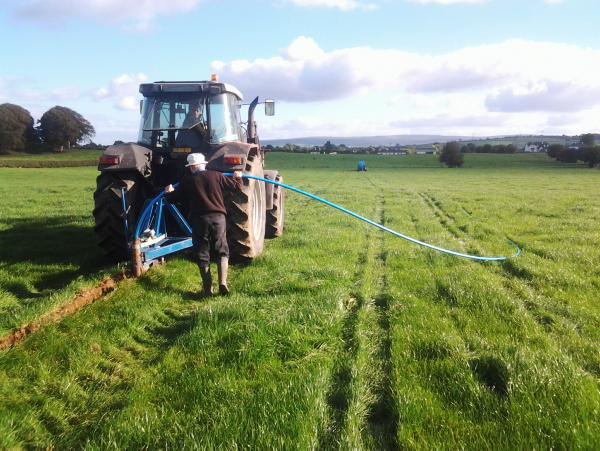
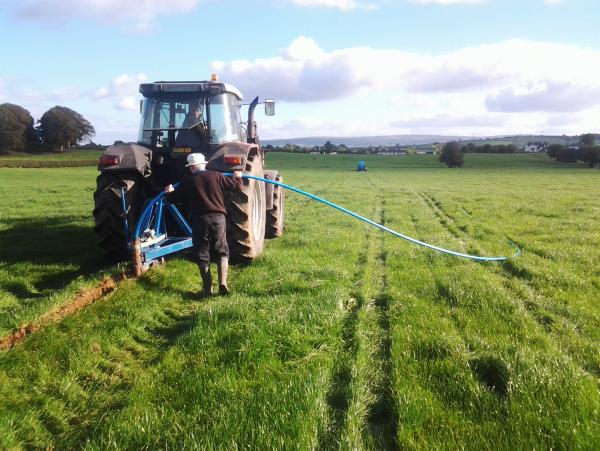
A new water system was next on the agenda. Our old water system consisted of 90 gallon water troughs positioned in the corner of fields and supplied by half inch pipe. Drought conditions during the middle of the year reinforced in our minds the requirement for a new system. We decided to install a loop system because it allows water to travel from both sides of a tee to a trough, supplying 50% more water than the conventional straight line branched system. My cousin, Pádraig Horan, laid the 1 inch MDPE pipe using a mole plough. He attached the leg of an old bale lifter to the back of the plough to act as a feeding mechanism for the pipe. Ground conditions were ideal, allowing the mole plough to bury the pipe 2 feet from the surface. We laid 2 kilometres of pipe in two days.
That was the easy part. Fitting the bottom-fill water troughs was tedious work. We placed them in the driest areas in-between paddocks and in the middle of fence lines where possible. The water pipe (€1.11/meter incl. VAT) and fittings were purchased from Terra Services for €3,900. They gave us the use of their pipe trailer, free of charge, with the pipe coming in a 3 kilometre roll. I would highly recommend getting the pipe this way as it speeds up the job significantly and reduces the number of compression tees required. We bought the 240 gallon water troughs from Murphy Concrete for €275 each incl. VAT, delivery and ballcock.
The total cost of the water system, including hired labour, came to €7,550 (or 4 months wages in my last job). The upfront cost may seem off-putting. However, we feel that this cost will be recouped many times over by increased grass utilization, resulting in improved animal performance, milk production and ultimately profitability.



SHARING OPTIONS