Maintaining grass production while using lower levels of artificial nitrogen and increased clover content on a commercial dairy farm is possible, but not without its challenges.
Last year, the farmers in the Low Carbon Dairy Farms discussion group grew 13.8t DM/ha using 137kg N/ha.
When they started out in 2021 grass production across the group averaged 13.9t DM/ha with a nitrogen usage of 197kg N/ha.
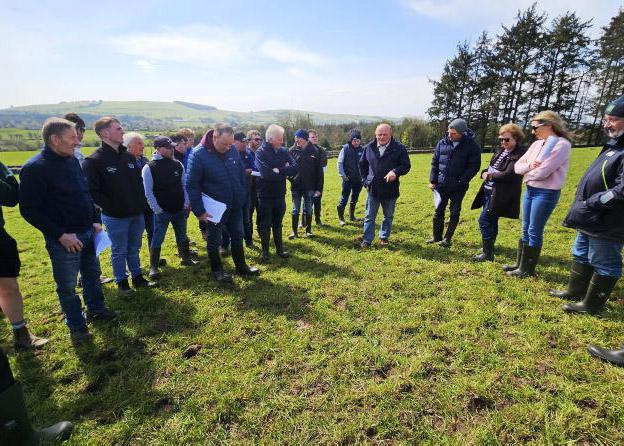
The Irish Farmers Journal recently attended a meeting of the group on the farm of Jimmy and Ann Cotter, Coachford Co Cork where the results of the last five years were disseminated.
The year just gone and 2021 showed what’s possible, but much of the discussion centred on the variability of the weather and how it impacts on grass growth.
In the intervening period, artificial N usage dropped as low as 128 kg/N/ha in 2023 and the farms grew 13.2t DM/ha on average. As proponents of clover have experienced, weather is one of the chief challenges it faces.
When good grass growing conditions prevail, it goes a long way to replace purchased nitrogen. However, it’s a different story when weather is wetter and temperatures are low. This can be seen in the group’s figures from 2024.
Recalled as a challenging year for grass growth whether you were depending on organic or artificial nitrogen, grass grown across the group was the lowest in the five years to date with 12.7t DM/ha grown from an average fertiliser N use of 154kg/N/ha.
For good measure, the same quantity of fertiliser was used in 2022 when the average tonnage of dry matter grown was 12.9t DM/ha. Meal levels fluctuated from a low of 668kg/LU/year in 2021 to a peak of 925kg/LU/year in 2024 while bought in forages were at 52kg DM/LU/year in 2021 and topped out at 322kg DM/LU/year in 2023.
Weather was the principal driver of those fluctuations with drought impacting grass production in some years and cold temperatures impacting in 2024.
Bloat is one of the chief concerns cited by farmers when it comes to increasing clover content on their farms and while it has raised its head on occasion on Cotter’s farm there have been no losses from it to date.
Jimmy doesn’t use bloat oil choosing to regulate the cows intake in order to avoid incidence of bloat. This ensures that cows aren’t hungry going into paddocks with high clover content.
Setting up a strip wire and giving cows a portion of the paddock for a few hours as a breakfast break helped to reduce the risk of bloat.
This enables the cows to fill up rather than gorge themselves on clover and after a few hours grazing, they get their full allocation of grass.
Getting the balance right between grazing out a paddock in full and keeping enough grass in front of the cow to get her to hit a target of 2kg/MS/day is a central part of the daily routine for the Cotters. It’s what enabled them to achieve 570kg milk solids/cow in 2025.
To this end, cows will return to get paddocks to a closing cover that Jimmy is content with, even if it’s only for a few hours before they move on.
The prominence of strip wires and their regular moving kick started a discussion on how sustainable that attention to detail was when it came to labour.
It wasn’t an issue to the Cotters as they did the work themselves, but on a larger farm with hired contracted help that may have a limited work time frame or milking only, it was likely to prove more challenging.
Jimmy felt that more farmers will have to consider clover to mitigate against unexpected shocks occurring in the supply of fertiliser.
“Given the cost of fertiliser and the availability of it, along with ever increasing environmental concerns, I think every farmer will have to look at clover. Every year is different but you need flexibility and you have to trust the clover
“We’ve grown 14t DM/ha on paddocks with good clover content with just slurry and soiled water. If you told me that was possible a few years ago I wouldn’t have believed it but it’s happening.
“Last year, we were disappointed with growth in general but we were impacted by drought twice during the grazing season, once in May and again in late summer."
The group aren’t missionaries for clover by any means but their mindset is flexible and they’re willing to see where clover can help the overall profitability of their farms.
They haven’t gone cold turkey on chemical nitrogen either and flexibility and variability were two words that popped up frequently during the meeting.
Cotters’ farm is a good example of the how conditions vary on farm and decision making needed to be flexible to deal with them.
Their 34ha milking platform is divided into 23 paddocks and last year, six of which received less than 100kg N/ha last year, this includes two that received no artificial nitrogen.
Of those six paddocks, the highest dry matter grown was 13.6t DM/ha while one of the paddocks that got zero chemical N grew 10.4t DM/ha.
At the other end of the spectrum, a paddock that received 259kg N/ha grew 10.9t DM/ha while the paddock that performed best, growing 14.3t /ha received 189kg N/ha.
Variables from the choice of cultivars to the weather conditions at grazing as well as soil fertility were all factors at play in the variety of dry matter production on Cotters’ milking platform.
Chemical N varied from zero to 281kg N/ha with organic N, in the form of slurry and soiled water ranged from zero to 93 kg N/ha.
“You can have the best will in the world but if your pH and P and K aren’t right it becomes very difficult to establish clover. Getting the basics right is very important. The soil fertility, a pH of over 6.5 plus, and high soil indexes of 3 and 4 for P and K are critical.
“Making sure the clover paddocks are grazed out in the last rotation to a cover of 350k g and 400kg is important too as it allows light get in the grow the clover,” Jimmy added.
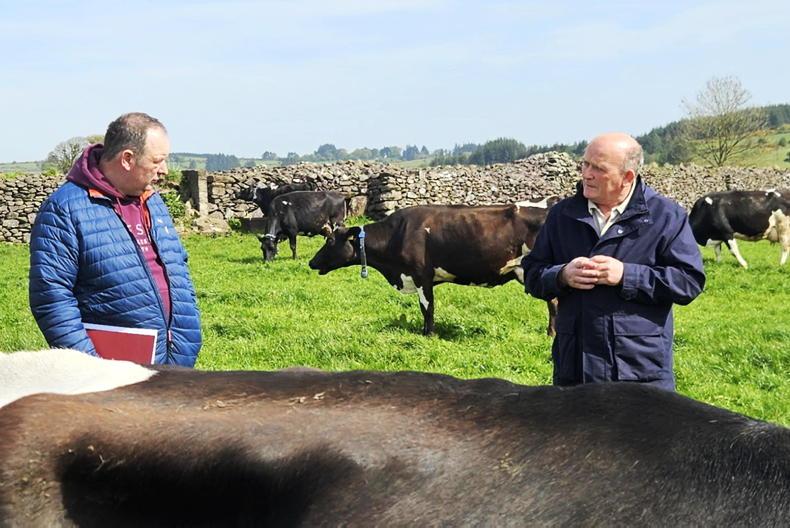
Low Carbon Dairy Farms discussion chairman, Simon Breen with host farmer Jimmy Cotter, Coachford, Co Cork at their recent meeting.
The group was established in 2021 in an effort to see if the low artificial nitrogen, clover-based milk production system that was developed under James Humphries’ watch at Solohead could be replicated on commercial dairy farms.
James, a Principal Research Officer with Teagasc facilitates the group. He said: “There are over 30 farmers in the group with their farms spread across the country.
“Of these, 26 are providing usable data and 20 or so have been successfully adopting clover.
“The other six farms are still at baseline levels of fertiliser nitrogen use.
“At Solohead we developed a
profitable system of clover-based
milk production with very low
reliance on fertiliser N and we
want to identify obstacles to adoption and provide solutions for these obstacles.
“Since 2021 we have been
road-testing this system on 20 commercial dairy farms across the country under a range of soil and climatic conditions.
“Farms are converting to clover by reseeding around 10% of the farm area per year.”
Currently around 50% of the farm areas is under clover; ranging between 30 and 80%.”
James highlighted that this system proved to be highly profitable during 2022 and 2023 when fertiliser prices soared due to the Russian invasion of Ukraine.
Faced with the current uncertainty due to upheaval around the Strait of Hormuz, James said: “It makes sense to diversify and use clover to avoid being solely dependent on fertiliser nitrogen.
“It is a profitable system, which can lower the carbon footprint of a farm by up to 20%.”
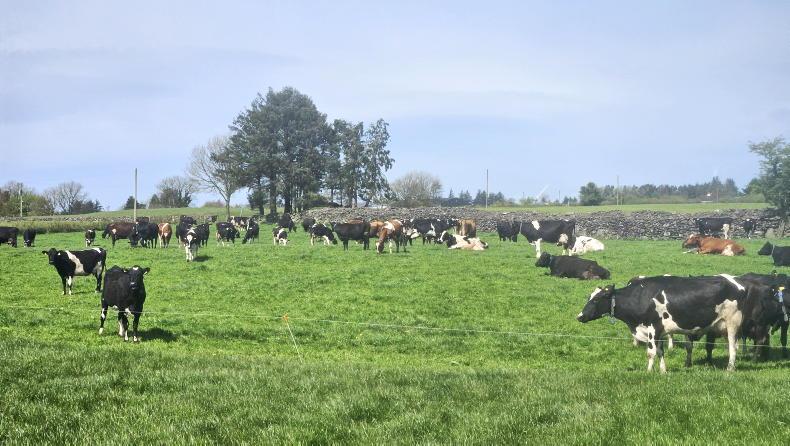
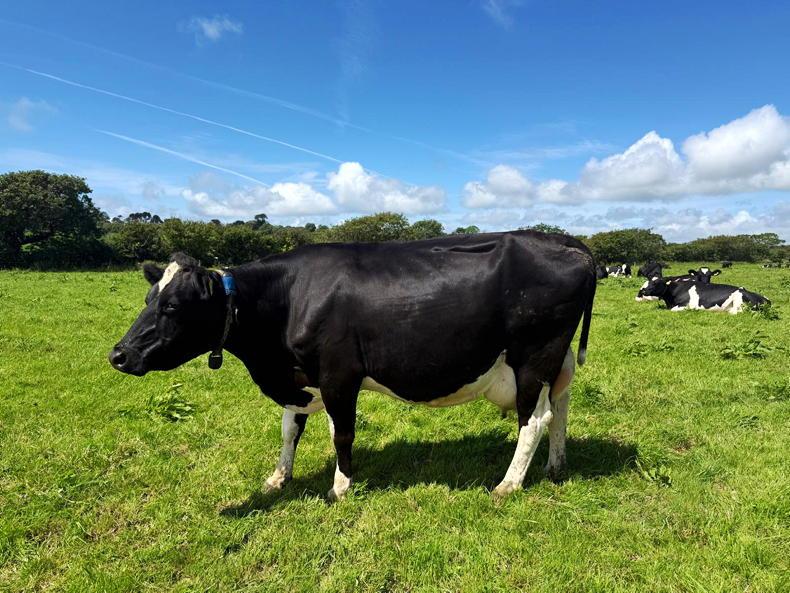
Breeding commenced on 4 May on the farm of Jimmy and Ann Cotter, Coachford, Co Cork.
Maintaining grass production while using lower levels of artificial nitrogen and increased clover content on a commercial dairy farm is possible, but not without its challenges.
Last year, the farmers in the Low Carbon Dairy Farms discussion group grew 13.8t DM/ha using 137kg N/ha.
When they started out in 2021 grass production across the group averaged 13.9t DM/ha with a nitrogen usage of 197kg N/ha.
The Irish Farmers Journal recently attended a meeting of the group on the farm of Jimmy and Ann Cotter, Coachford Co Cork where the results of the last five years were disseminated.
The year just gone and 2021 showed what’s possible, but much of the discussion centred on the variability of the weather and how it impacts on grass growth.
In the intervening period, artificial N usage dropped as low as 128 kg/N/ha in 2023 and the farms grew 13.2t DM/ha on average. As proponents of clover have experienced, weather is one of the chief challenges it faces.
When good grass growing conditions prevail, it goes a long way to replace purchased nitrogen. However, it’s a different story when weather is wetter and temperatures are low. This can be seen in the group’s figures from 2024.
Recalled as a challenging year for grass growth whether you were depending on organic or artificial nitrogen, grass grown across the group was the lowest in the five years to date with 12.7t DM/ha grown from an average fertiliser N use of 154kg/N/ha.
For good measure, the same quantity of fertiliser was used in 2022 when the average tonnage of dry matter grown was 12.9t DM/ha. Meal levels fluctuated from a low of 668kg/LU/year in 2021 to a peak of 925kg/LU/year in 2024 while bought in forages were at 52kg DM/LU/year in 2021 and topped out at 322kg DM/LU/year in 2023.
Weather was the principal driver of those fluctuations with drought impacting grass production in some years and cold temperatures impacting in 2024.
Bloat is one of the chief concerns cited by farmers when it comes to increasing clover content on their farms and while it has raised its head on occasion on Cotter’s farm there have been no losses from it to date.
Jimmy doesn’t use bloat oil choosing to regulate the cows intake in order to avoid incidence of bloat. This ensures that cows aren’t hungry going into paddocks with high clover content.
Setting up a strip wire and giving cows a portion of the paddock for a few hours as a breakfast break helped to reduce the risk of bloat.
This enables the cows to fill up rather than gorge themselves on clover and after a few hours grazing, they get their full allocation of grass.
Getting the balance right between grazing out a paddock in full and keeping enough grass in front of the cow to get her to hit a target of 2kg/MS/day is a central part of the daily routine for the Cotters. It’s what enabled them to achieve 570kg milk solids/cow in 2025.
To this end, cows will return to get paddocks to a closing cover that Jimmy is content with, even if it’s only for a few hours before they move on.
The prominence of strip wires and their regular moving kick started a discussion on how sustainable that attention to detail was when it came to labour.
It wasn’t an issue to the Cotters as they did the work themselves, but on a larger farm with hired contracted help that may have a limited work time frame or milking only, it was likely to prove more challenging.
Jimmy felt that more farmers will have to consider clover to mitigate against unexpected shocks occurring in the supply of fertiliser.
“Given the cost of fertiliser and the availability of it, along with ever increasing environmental concerns, I think every farmer will have to look at clover. Every year is different but you need flexibility and you have to trust the clover
“We’ve grown 14t DM/ha on paddocks with good clover content with just slurry and soiled water. If you told me that was possible a few years ago I wouldn’t have believed it but it’s happening.
“Last year, we were disappointed with growth in general but we were impacted by drought twice during the grazing season, once in May and again in late summer."
The group aren’t missionaries for clover by any means but their mindset is flexible and they’re willing to see where clover can help the overall profitability of their farms.
They haven’t gone cold turkey on chemical nitrogen either and flexibility and variability were two words that popped up frequently during the meeting.
Cotters’ farm is a good example of the how conditions vary on farm and decision making needed to be flexible to deal with them.
Their 34ha milking platform is divided into 23 paddocks and last year, six of which received less than 100kg N/ha last year, this includes two that received no artificial nitrogen.
Of those six paddocks, the highest dry matter grown was 13.6t DM/ha while one of the paddocks that got zero chemical N grew 10.4t DM/ha.
At the other end of the spectrum, a paddock that received 259kg N/ha grew 10.9t DM/ha while the paddock that performed best, growing 14.3t /ha received 189kg N/ha.
Variables from the choice of cultivars to the weather conditions at grazing as well as soil fertility were all factors at play in the variety of dry matter production on Cotters’ milking platform.
Chemical N varied from zero to 281kg N/ha with organic N, in the form of slurry and soiled water ranged from zero to 93 kg N/ha.
“You can have the best will in the world but if your pH and P and K aren’t right it becomes very difficult to establish clover. Getting the basics right is very important. The soil fertility, a pH of over 6.5 plus, and high soil indexes of 3 and 4 for P and K are critical.
“Making sure the clover paddocks are grazed out in the last rotation to a cover of 350k g and 400kg is important too as it allows light get in the grow the clover,” Jimmy added.

Low Carbon Dairy Farms discussion chairman, Simon Breen with host farmer Jimmy Cotter, Coachford, Co Cork at their recent meeting.
The group was established in 2021 in an effort to see if the low artificial nitrogen, clover-based milk production system that was developed under James Humphries’ watch at Solohead could be replicated on commercial dairy farms.
James, a Principal Research Officer with Teagasc facilitates the group. He said: “There are over 30 farmers in the group with their farms spread across the country.
“Of these, 26 are providing usable data and 20 or so have been successfully adopting clover.
“The other six farms are still at baseline levels of fertiliser nitrogen use.
“At Solohead we developed a
profitable system of clover-based
milk production with very low
reliance on fertiliser N and we
want to identify obstacles to adoption and provide solutions for these obstacles.
“Since 2021 we have been
road-testing this system on 20 commercial dairy farms across the country under a range of soil and climatic conditions.
“Farms are converting to clover by reseeding around 10% of the farm area per year.”
Currently around 50% of the farm areas is under clover; ranging between 30 and 80%.”
James highlighted that this system proved to be highly profitable during 2022 and 2023 when fertiliser prices soared due to the Russian invasion of Ukraine.
Faced with the current uncertainty due to upheaval around the Strait of Hormuz, James said: “It makes sense to diversify and use clover to avoid being solely dependent on fertiliser nitrogen.
“It is a profitable system, which can lower the carbon footprint of a farm by up to 20%.”

Breeding commenced on 4 May on the farm of Jimmy and Ann Cotter, Coachford, Co Cork.
SHARING OPTIONS