



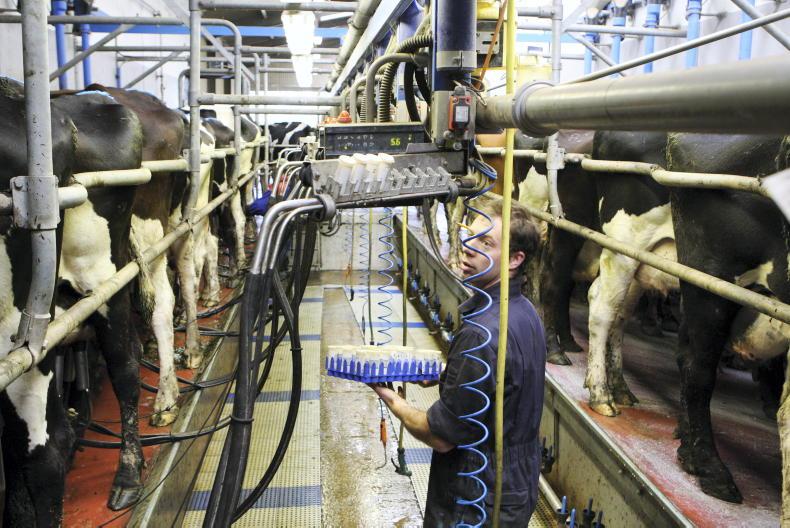
Average somatic cell counts (SCC) across Irish herds are on the rise over the past number of weeks. While slight increases are to be expected for the time of year, it’s important to keep on top of cases.
According to ICBF live statistics the average SCC nationally this week is at 184,000 cells/ml. This is well up from 160,000 cells/ml at the same week last year.
Aside from the penalties as a result of high cell count, there is the issues around reduced milk yields and infection spread.
Now is an ideal time to tackle the issue before it goes too far. Milk recording is the best way to identify the problem cows in the herd. If you haven’t milk recorded in the last number of weeks it might be a good time to consider it now.
Any cows with an SCC over 200,000 cells/ml can be considered a problem cow. If this cow has been consistently over 200,000 cells/ml in the last few milk recordings or over the last couple of seasons, she can be classed as a chronic case.
With strong cull cow prices at the moment, it makes sense to remove these chronic problem cows from the herd now. Milking them on until dry off is increasing the likelihood of infection spreading, putting the rest of the herd at risk.
Culling alone won’t solve problems but it should bring the average SCC back significantly.
The next step is identifying new problem cows. If a cow is showing up with an inflated SCC for the first time she needs to be dealt with now. Identify the problem quarter through a California milk test (CMT) and treat it as soon as possible.
If the cow is exhibiting signs of clinical mastitis she will need an antibiotic treatment. If the case is not clinical it may be the best option to dry off that particular quarter and continue milking her.

Halt the spread
To effectively halt the spread of infection, the goal should be attaching clean clusters to clean cows.
The first non-negotiable is wearing gloves while milking. These gloves should be changed or disinfected when dealing with problem cases.
Post-spraying cows with 15ml per cow is another non-negotiable. Cows should be standing when sprayed to ensure there’s full teat coverage. Cows walking out of the parlour while being sprayed are not being sprayed effectively.
Regularly service the milking machine, once every six months ideally to ensure the machine isn’t causing any problems.
Liners should be replaced every six months or every 2,000 milkings whichever comes first. In a herd milking 10 rows of cows, that’s a liner change every 100 days or so.
Finally, when milking a problem case, unless there is cluster flush on the machine, the cluster should be dipped in disinfectant after milking the cow. The bucket for dipping the cluster should be clean and contain a suitable disinfectant like peracetic acid.
Conclusion
If SCC is high on your farm or starting to rise, get on top of the problem now. Cull cow prices are strong, so waiting until cows are dry is not the right decision.
Reduce the risk of infection being spread through the herd. Milk recording is the best tool to help guide decisions around cell count. Milk record now if you haven’t done one for late August/early September and aim for one more before dry-off.






SHARING OPTIONS