In preparation for the start of the grazing season, Cork farmer Paul Sheehan hosted a spring grazing walk on his farm in Conna.
The walk is the first of a series of spring walks hosted by Teagasc that will take place across the country over the coming weeks, outlining the key management practices that can be implemented to get as much spring grass as possible into cows’ diets.
Paul and his father John are milking 286 cows in total across two units. The home farm is owned and located in Carrignavar, ten minutes outside Cork city while the Conna farm is leased and roughly a half an hour away from the home block.
The 56ha Conna farm acts as a satellite unit. The cows are calved at home and moved to the farm throughout the spring.
To begin with on 15 February, 100 cows are moved to the Conna farm with numbers gradually built up to 160 cows by the 1 April giving a platform stocking rate of 2.88LU/ha in 2025.
The farm cover in Conna was lower than Paul would like at 843kg DM/ha on the 30 January. Good grazing conditions in late November last year, coupled with a lower-than-average over-winter growth has left cover light.
As there will be no cows on this farm until the middle of February, Paul is still confident they will be able to build cover to around 1,000kg DM/ha before grazing starts, all of which will be needed with such a high demand from day one of grazing.
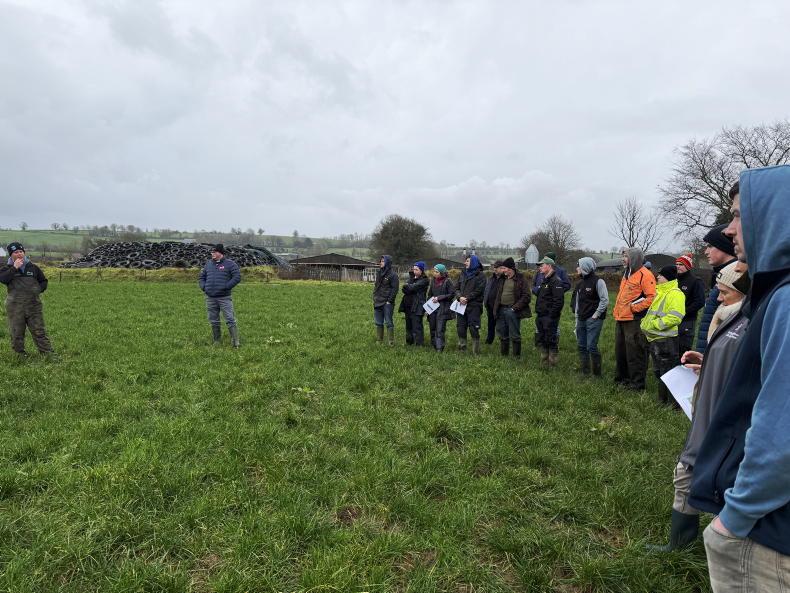
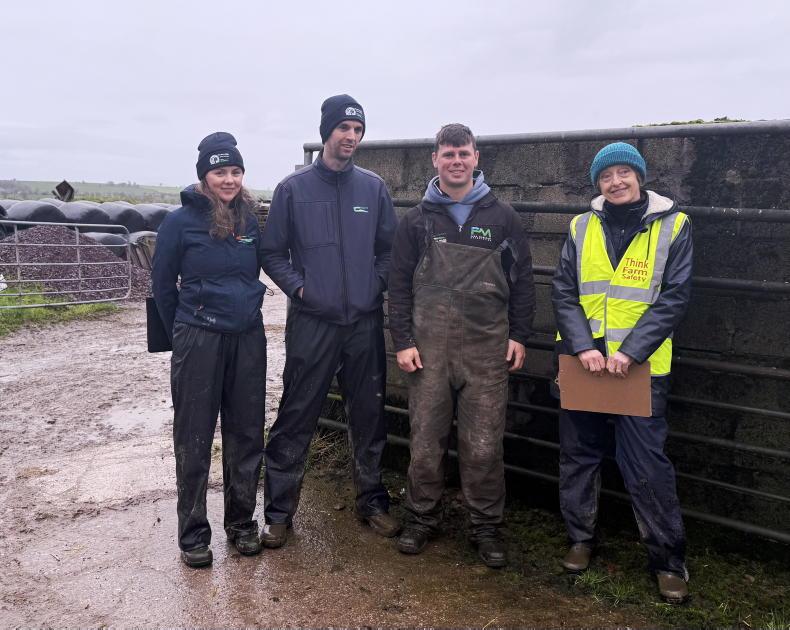
A good crowd turned out to the first spring grazing walk of the year.
The land type is dry and free draining with the exception of ten acres prone to flooding from the local river Bride which runs through the farm.
Cows will be on/off grazing for a number of weeks, until ground conditions have dried enough to allow for full-time turnout.
The grazing infrastructure has been developed on the farm over the years to make on/off grazing work well.
There is more than one trough in each of the paddocks, with several smaller roadways also constructed off the main road, to allow for multiple access points to most of the paddocks.
Spur roads are set up in the longer and more difficult paddocks to allow for back fencing and to prevent cows walking back over grazed ground.
An E-gate has been a big addition to the farm according to Paul. It allows him to open the gap from his phone once the cows have finished their three-hour grazing or if they are starting to poach paddocks.
A non-return gate in the yard means once the cows are in from grazing, they are automatically locked in for the next milking.
These investments have given Paul huge flexibility with no more returning to the farm late in the evening to bring in cows.
This time can be spent on the home farm where all of the work calving cows and rearing calves is taking place.
Grass covers on the farm were ranging from 250kg DM/ha up to 1,400kg DM/ha. Paul is aiming to graze some of the lighter covers between 700-900kg DM/ha first.
He believes that the lighter covers are easier to graze out fully for freshly calved cows in poor weather conditions.
On top of this they will re-grow quicker than heavier covers that were grazed and will help to meet the spring rotation targets.
As the farm is dry, the target for the end of February is to have 30% of the platform grazed, 60% grazed by St Patrick’s Day and 100% grazed by the 5 April.
The level of meal fed on the farm in 2025 was 1.4t/cow. Some of this can be put down to the droughts suffered during the summer months but Paul was quick to admit high milk price had also influenced higher feeding.
The target for 2026 is to drop feeding level to 800kg/cow. A planned reduction in platform stocking rate from 2.88 LU/ha back to 2.7LU/ha should help to achieve this but the real gains can be achieved by utilising more grass in the spring according to Paul.
Meal feeding levels will be limited to a max of four kilos per day throughout the year with silage being used instead if more supplement is required.
The goal for the Sheehan’s is to get 60 units of nitrogen spread before the start of April, in the form of either chemical nitrogen or the nitrogen that goes out in the form of slurry.
Half of the farm gets approximately 2,500 gallons/acre of slurry in early February, with the other half of the farm getting 20 units of protected urea.
Contractors are invaluable for the Sheehans and do all of the fertiliser and slurry work.
“As well as doing a more accurate job, the value of my time driving close to an hour on a tractor to and from the home farm, on top of the time it takes to do the job is not worth the savings,” Paul said.
The remaining 40 units of nitrogen will be split across two fertiliser spreads, one in early March and the other in late March/early April.
In preparation for the start of the grazing season, Cork farmer Paul Sheehan hosted a spring grazing walk on his farm in Conna.
The walk is the first of a series of spring walks hosted by Teagasc that will take place across the country over the coming weeks, outlining the key management practices that can be implemented to get as much spring grass as possible into cows’ diets.
Paul and his father John are milking 286 cows in total across two units. The home farm is owned and located in Carrignavar, ten minutes outside Cork city while the Conna farm is leased and roughly a half an hour away from the home block.
The 56ha Conna farm acts as a satellite unit. The cows are calved at home and moved to the farm throughout the spring.
To begin with on 15 February, 100 cows are moved to the Conna farm with numbers gradually built up to 160 cows by the 1 April giving a platform stocking rate of 2.88LU/ha in 2025.
The farm cover in Conna was lower than Paul would like at 843kg DM/ha on the 30 January. Good grazing conditions in late November last year, coupled with a lower-than-average over-winter growth has left cover light.
As there will be no cows on this farm until the middle of February, Paul is still confident they will be able to build cover to around 1,000kg DM/ha before grazing starts, all of which will be needed with such a high demand from day one of grazing.

A good crowd turned out to the first spring grazing walk of the year.
The land type is dry and free draining with the exception of ten acres prone to flooding from the local river Bride which runs through the farm.
Cows will be on/off grazing for a number of weeks, until ground conditions have dried enough to allow for full-time turnout.
The grazing infrastructure has been developed on the farm over the years to make on/off grazing work well.
There is more than one trough in each of the paddocks, with several smaller roadways also constructed off the main road, to allow for multiple access points to most of the paddocks.
Spur roads are set up in the longer and more difficult paddocks to allow for back fencing and to prevent cows walking back over grazed ground.
An E-gate has been a big addition to the farm according to Paul. It allows him to open the gap from his phone once the cows have finished their three-hour grazing or if they are starting to poach paddocks.
A non-return gate in the yard means once the cows are in from grazing, they are automatically locked in for the next milking.
These investments have given Paul huge flexibility with no more returning to the farm late in the evening to bring in cows.
This time can be spent on the home farm where all of the work calving cows and rearing calves is taking place.
Grass covers on the farm were ranging from 250kg DM/ha up to 1,400kg DM/ha. Paul is aiming to graze some of the lighter covers between 700-900kg DM/ha first.
He believes that the lighter covers are easier to graze out fully for freshly calved cows in poor weather conditions.
On top of this they will re-grow quicker than heavier covers that were grazed and will help to meet the spring rotation targets.
As the farm is dry, the target for the end of February is to have 30% of the platform grazed, 60% grazed by St Patrick’s Day and 100% grazed by the 5 April.
The level of meal fed on the farm in 2025 was 1.4t/cow. Some of this can be put down to the droughts suffered during the summer months but Paul was quick to admit high milk price had also influenced higher feeding.
The target for 2026 is to drop feeding level to 800kg/cow. A planned reduction in platform stocking rate from 2.88 LU/ha back to 2.7LU/ha should help to achieve this but the real gains can be achieved by utilising more grass in the spring according to Paul.
Meal feeding levels will be limited to a max of four kilos per day throughout the year with silage being used instead if more supplement is required.
The goal for the Sheehan’s is to get 60 units of nitrogen spread before the start of April, in the form of either chemical nitrogen or the nitrogen that goes out in the form of slurry.
Half of the farm gets approximately 2,500 gallons/acre of slurry in early February, with the other half of the farm getting 20 units of protected urea.
Contractors are invaluable for the Sheehans and do all of the fertiliser and slurry work.
“As well as doing a more accurate job, the value of my time driving close to an hour on a tractor to and from the home farm, on top of the time it takes to do the job is not worth the savings,” Paul said.
The remaining 40 units of nitrogen will be split across two fertiliser spreads, one in early March and the other in late March/early April.
SHARING OPTIONS