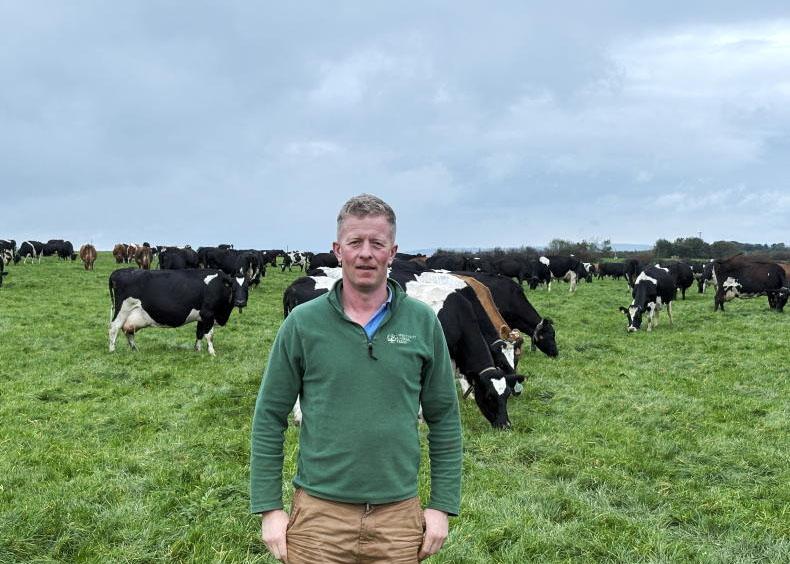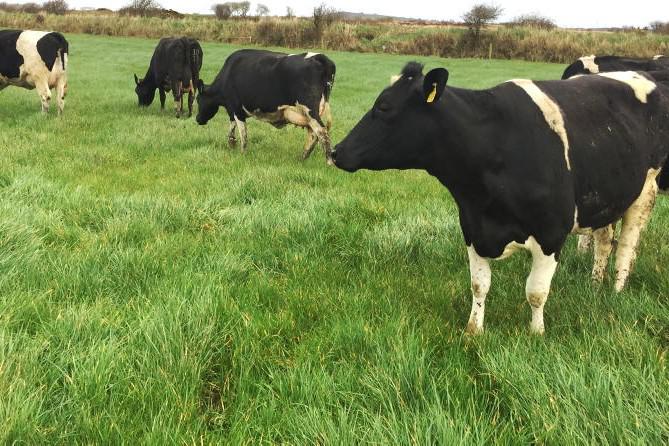
The grazing season has kicked off for a selection of farms this week but for the most part turnout date has been delayed due to the heavy rainfall in Leinster and parts of Munster.
Some areas of Leinster have seen rainfall accumulations close to four times the average for the time of year according to Met Éireann data, with almost double the average for the rest of the country.
While this is significant, the level of consistency with which it has rained throughout the winter months has been the real crux of the problem. Ground is completely saturated in a lot of areas and as a result, the recent deluges have brought about widespread flooding.
Where possible, getting cows out should still be the priority. The fact that full-time grazing is not an option shouldn’t rule out grazing completely.
Any grazing at all will save money on feeding silage and extra meal, cows will be healthier and they’ll perform better in terms of milk and solids production.
It won’t be possible to graze everyday but taking opportunities as they present themselves should be the rule.
Target reasonably dry paddocks with lighter covers and plan to get in and out of them within three hours.
Setting up a number of breaks at a time early in the week, could help to avail of those windows of opportunity later in the week.
Allocations
Intakes will vary depending on cow type and the number of heifers versus the number of mature cows that are calved.
Lighter crossbred cows around 500kg will be eating around 12kg of dry matter in the first week after calving. This will rise by approximately one kilo per week up to a max of 19kg.
Bigger cows around 600kg will be eating slightly more at 13-14kg initially post-calving and their intakes will also rise by approximately a kilo a week up to a max of about 21kg.
Heifers’ intakes will be slightly lower by around 2kg of dry matter per day for all breed types.
Take a crossbred herd with 40 cows calved. There are roughly 20 heifers and 20 cows in the mob. As it’s the first week after calving and there’s an even split of heifers and cows. The farmer should be therefore allocating an average of 11kg per animal of dry matter.
If the cows are getting 2kg of meal per day, the grass demand is 9kg dry matter per animal.
The mob of cows should be allocated 360kg (9kg x 40 cows) of grass per day. Splitting that over two grazing’s means the herd should get 180kg in each grazing.
In a 2ha paddock with a cover of 1,000kg DM/ha, there’s a total cover of 2,000kg DM in the paddock.
In terms of area the cows should be getting 0.18ha for one grazing. This is calculated by dividing the 180kg demand into the paddock cover of 2,000kg DM/ha. This equates to 1/11th of the 2ha paddock area or 0.18ha.
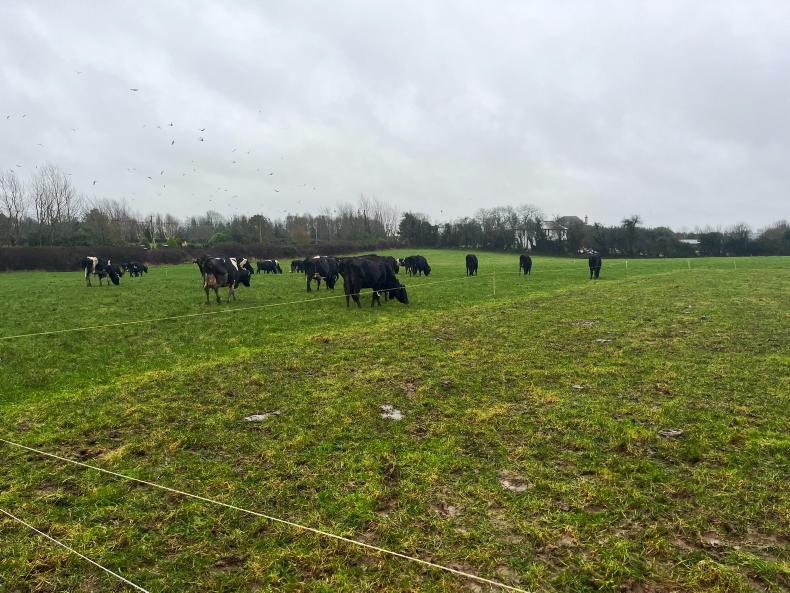
This is a small area and hence the reason paddocks with multiple access points and troughs are better for on/off grazing.
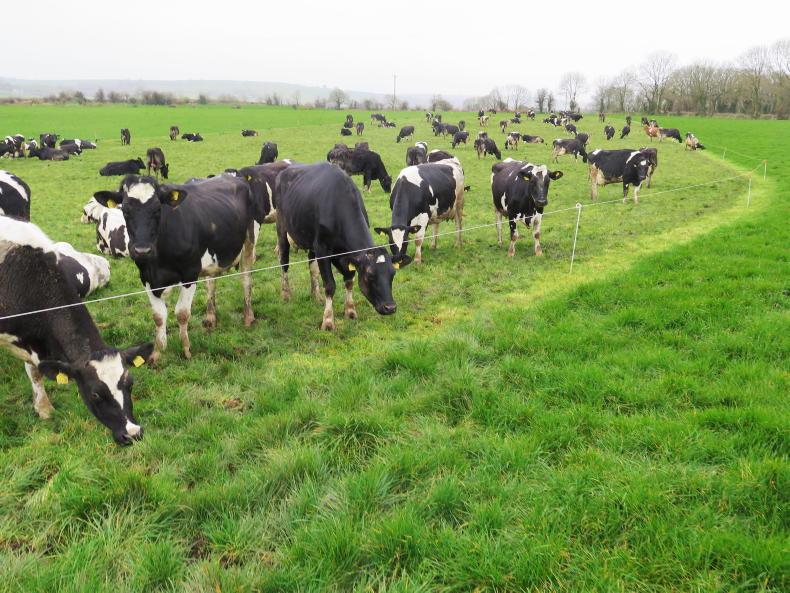
Using a strip wire and back fence is essential to allocate the required area for each grazing, this prevents cows trekking over and back on grazed ground and poaching paddocks.
There are several free apps available for measuring paddock area using the phone and this can show where strip wires should go. Field Area Measure is the most commonly used and the area can be tracked by clicking the field option with GPS mode turned on.
Alternatively, some farmers will step out the area of a strip. The area required is 0.18ha from the earlier calculation and this equates to 1,800m sq, as there are 10,000m sq in a hectare.
If the width of the paddock is 75 metres for example, the length of the strip will need to be 24 metres to give 1,800m sq.
If utilisation rates are low and cows are leaving grass behind, make the paddock smaller for the next grazing. If the paddock is wiped clean after a three-hour grazing, more area should be allocated. This will inevitably take a bit of tinkering with to get right.
While all of the maths may sound complex, it’s actually fairly straightforward when it’s been done once or twice. Most farmers who implement these practices enjoy the challenge of getting grazing areas and allocations correct.
As more cows calve and intakes rise each week, allocations will have to be adjusted accordingly. Best advice is to send cows out with an appetite. Holding cows for an hour or two after milking without silage will help to make grazing efficient.
Offering silage after grazing’s will reduce the cow’s willingness to graze and it should be avoided.