At a time when there has been much discussion around falling sheep numbers, Kerry sheep farmer Michael Fitzgerald is veering in the opposite direction with numbers increasing slightly in recent years.
Michael farms mixed sheep and store-to-beef enterprises on a mixture of upland and lowland ground in Kerry and Limerick.
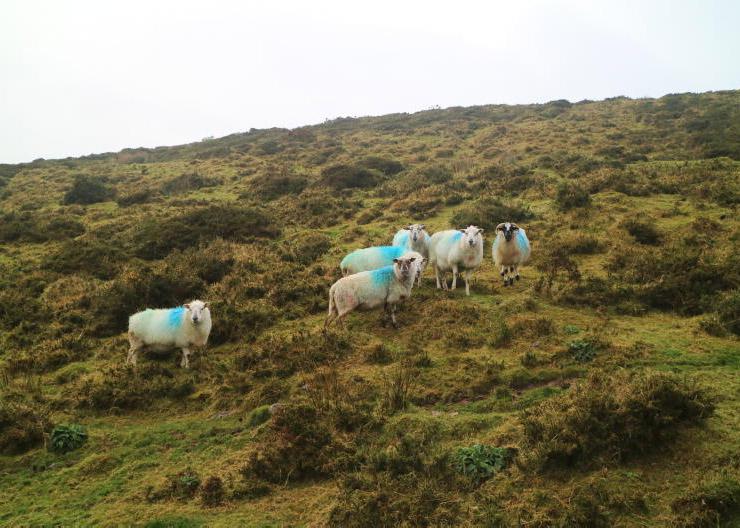
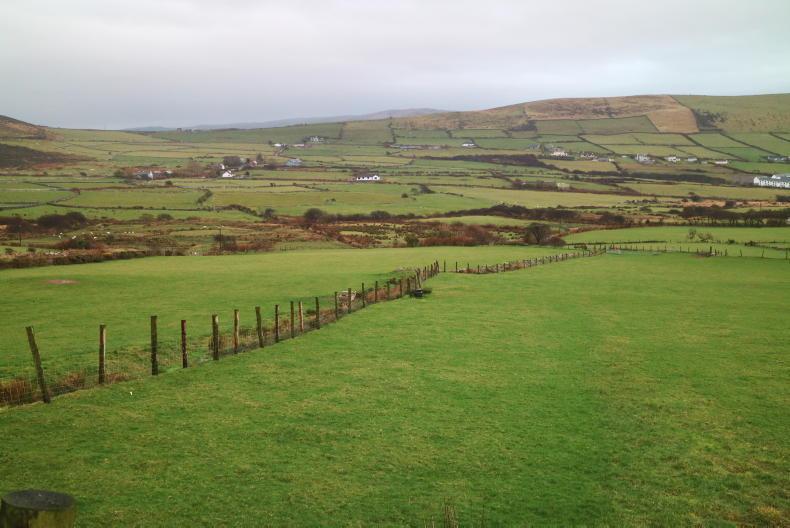
The sheep enterprise is run on the Dingle peninsula across a mixture of upland and hill commonage ground.
Store cattle, generally purchased at store or weanling stage, are kept in Kerry for their first winter and possibly their first grazing season and are then transferred to an out farm in Limerick and brought through to finish or sold as forward stores.
The sheep enterprise has witnessed some growth in recent years with numbers currently standing at about 285 ewes put to the ram along with 20 to 30 ewe lamb replacements.
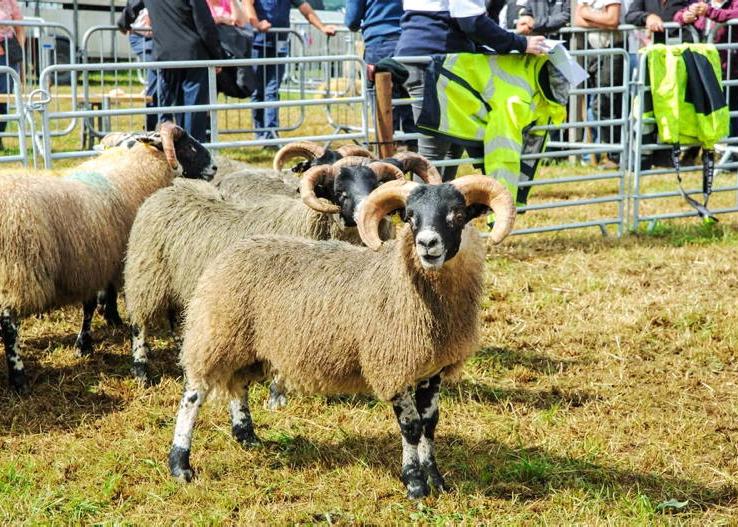
The flock includes about 50 Kerry-type Scottish Blackface ewes which are used as foundation stock for the main flock of Texel x Scottish Blackface, or Hiltex, ewes.
Michael has tried a number of breed types on hill and upland grazing and finds that such a ewe maintains a good mix of hardiness, which he says is vital for harsh weather on the peninsula, while also being capable of producing good-quality lambs.
The only downside, which he is focused on trying to improve, is a litter size of 1.3 lambs per ewe joined to the ram.
The below-target litter size is partly underpinned by a relatively high barren rate of almost 8%.
The scanning breakdown in 2026 is as follows – 132 single bearing ewes, 127 twins, four triplets and 22 dry ewes.
He says that the barren rate has remained roughly at this level in recent years with no readily apparent reason and continued efforts will focus on steps to lower this rate.
Hiltex ewes are generally mated with Charollais rams to lamb from mid-March onwards with all progeny sold off the farm.
A couple of Suffolk rams were bought in 2025 with the aim of producing some quality ewe lambs as an option for the replacement market.

.
Scottish Blackface replacements are purchased as ewe lambs or hoggets in local sales. Michael feels that this is a more straightforward system than running an additional mating group to breed foundation stock.
Lowland and productive upland grazing is the engine of the farm and used for grazing ewes and lambs post-lambing, lambs pre-sale and ewes pre-and-during-breeding.
A 30ha share of commonage is used to graze ewes post-weaning and again post-breeding, along with replacement hoggets in spring/summer.
Sheep are hefted to an area of commonage with yearling replacements returned to the hill in spring along with young dry ewes which are retained following scanning.
Michael explained that supplementing such replacements for a period after turning back on to the hill also helps in getting them accustomed to a certain area of commonage ground.
Michael is a big believer in purchasing high-quality genetics and has been purchasing rams with good €uro-Star figures long before it was included in the Sheep Improvement Scheme.
He thinks that the introduction of an incentive to encourage participation in performance recording programmes in hill sheep flocks is a good development and one that should be supported with backing from the Department of Agriculture and commercial farmers.
He is also a participant in the Agri-Climate Rural Environment Schemes (ACRES) and is supportive of the scheme.
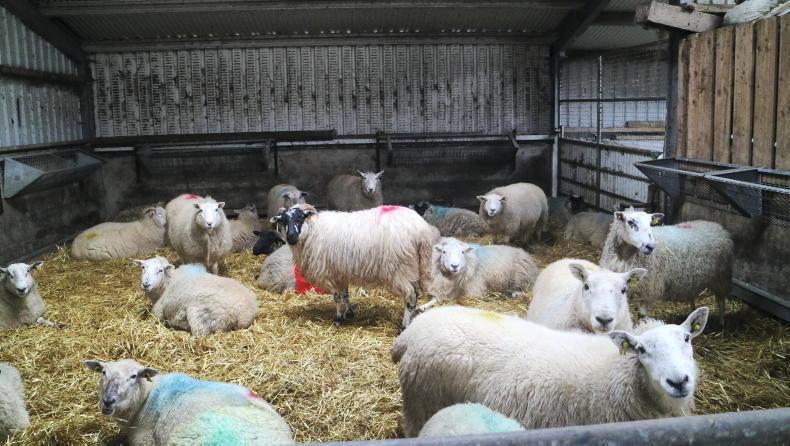
Ewes housed for preferential treatment.
He feels however that more will need to be done to help farmers address invasive species getting a stronger foothold.
The greatest challenge he is facing is with gorse and he comments that without the correct management it will become a fire hazard in the coming years.
A significant percentage of lambs are sold as stores without any concentrate feeding, with feeding commencing to lambs as grass supplies and quality declines.
There is typically a draft of stronger lambs selected at weaning and shortly after which are sold live for slaughter through Dingle Co-operative livestock mart.
After this stores are sold at forward store stage at a target weight of 36kg to 40kg, plus.
The market in 2025 was buoyant for stores with prices trending above €130 per head for well-presented lambs.
Michael says that such a price is needed for progeny with poor returns in recent years failing to cover costs and adding to the decline in numbers and switch to organic production.
The focus at present is late pregnancy feeding. Close attention is placed on ewe condition and ewes falling below optimum condition were segregated at scanning and housed for preferential treatment.
Twin-bearing ewes will be housed on the point of lambing along with any other singles needing preferential treatment while remaining single-bearing ewes and Scotch ewes are generally lambed in a paddock close to the farm yard.
Fields have been strategically closed since autumn to have grass available post-lambing.
The aim is to let ewes and lambs to grass without any need for concentrate feeding.
The preference is to retain twin-born lambs indoors for a few days post-lambing with Michael commenting that losses to predators including foxes are an ongoing challenge.
Housed ewes have access to ad lib hay and have been receiving flat rate concentrate supplementation of about a pound a day (0.45kg) since housing. Ewes on the hill are also supplemented with a similar level of concentrates.
Eamonn Dempsey, Teagasc business and technology adviser says that regular monitoring of ewe body condition and the introduction of supplementary feeding is critical this year given continual inclement weather.
He says that available forage resources have been depleted much quicker on some hill areas and in the absence of supplementary feeding ewe condition will suffer greatly and lead to higher lamb mortality and possibly higher ewe mortality.
Particular attention should be placed on ewes carrying twin lambs, which have a higher nutritional requirement, and aged ewes.

.
Eamonn says that one of the farm’s strengths has been its grassland management.
The foundation to this is addressing any soil fertility deficits with all soils at index three or four for phosphorus and potassium.
Protected urea is used early in the season to kick-start growth with Richland fertiliser (22.7-2.5-5 plus 3% sulphur and minerals) used as a top-up pending P allowances.
Applying lime is helping to retain soils at the optimum pH and in better utilising applied nutrients, along with targeting FYM to low fertility soils.
At a time when there has been much discussion around falling sheep numbers, Kerry sheep farmer Michael Fitzgerald is veering in the opposite direction with numbers increasing slightly in recent years.
Michael farms mixed sheep and store-to-beef enterprises on a mixture of upland and lowland ground in Kerry and Limerick.
The sheep enterprise is run on the Dingle peninsula across a mixture of upland and hill commonage ground.
Store cattle, generally purchased at store or weanling stage, are kept in Kerry for their first winter and possibly their first grazing season and are then transferred to an out farm in Limerick and brought through to finish or sold as forward stores.
The sheep enterprise has witnessed some growth in recent years with numbers currently standing at about 285 ewes put to the ram along with 20 to 30 ewe lamb replacements.
The flock includes about 50 Kerry-type Scottish Blackface ewes which are used as foundation stock for the main flock of Texel x Scottish Blackface, or Hiltex, ewes.
Michael has tried a number of breed types on hill and upland grazing and finds that such a ewe maintains a good mix of hardiness, which he says is vital for harsh weather on the peninsula, while also being capable of producing good-quality lambs.
The only downside, which he is focused on trying to improve, is a litter size of 1.3 lambs per ewe joined to the ram.
The below-target litter size is partly underpinned by a relatively high barren rate of almost 8%.
The scanning breakdown in 2026 is as follows – 132 single bearing ewes, 127 twins, four triplets and 22 dry ewes.
He says that the barren rate has remained roughly at this level in recent years with no readily apparent reason and continued efforts will focus on steps to lower this rate.
Hiltex ewes are generally mated with Charollais rams to lamb from mid-March onwards with all progeny sold off the farm.
A couple of Suffolk rams were bought in 2025 with the aim of producing some quality ewe lambs as an option for the replacement market.

.
Scottish Blackface replacements are purchased as ewe lambs or hoggets in local sales. Michael feels that this is a more straightforward system than running an additional mating group to breed foundation stock.
Lowland and productive upland grazing is the engine of the farm and used for grazing ewes and lambs post-lambing, lambs pre-sale and ewes pre-and-during-breeding.
A 30ha share of commonage is used to graze ewes post-weaning and again post-breeding, along with replacement hoggets in spring/summer.
Sheep are hefted to an area of commonage with yearling replacements returned to the hill in spring along with young dry ewes which are retained following scanning.
Michael explained that supplementing such replacements for a period after turning back on to the hill also helps in getting them accustomed to a certain area of commonage ground.
Michael is a big believer in purchasing high-quality genetics and has been purchasing rams with good €uro-Star figures long before it was included in the Sheep Improvement Scheme.
He thinks that the introduction of an incentive to encourage participation in performance recording programmes in hill sheep flocks is a good development and one that should be supported with backing from the Department of Agriculture and commercial farmers.
He is also a participant in the Agri-Climate Rural Environment Schemes (ACRES) and is supportive of the scheme.

Ewes housed for preferential treatment.
He feels however that more will need to be done to help farmers address invasive species getting a stronger foothold.
The greatest challenge he is facing is with gorse and he comments that without the correct management it will become a fire hazard in the coming years.
A significant percentage of lambs are sold as stores without any concentrate feeding, with feeding commencing to lambs as grass supplies and quality declines.
There is typically a draft of stronger lambs selected at weaning and shortly after which are sold live for slaughter through Dingle Co-operative livestock mart.

After this stores are sold at forward store stage at a target weight of 36kg to 40kg, plus.
The market in 2025 was buoyant for stores with prices trending above €130 per head for well-presented lambs.
Michael says that such a price is needed for progeny with poor returns in recent years failing to cover costs and adding to the decline in numbers and switch to organic production.
The focus at present is late pregnancy feeding. Close attention is placed on ewe condition and ewes falling below optimum condition were segregated at scanning and housed for preferential treatment.
Twin-bearing ewes will be housed on the point of lambing along with any other singles needing preferential treatment while remaining single-bearing ewes and Scotch ewes are generally lambed in a paddock close to the farm yard.
Fields have been strategically closed since autumn to have grass available post-lambing.
The aim is to let ewes and lambs to grass without any need for concentrate feeding.
The preference is to retain twin-born lambs indoors for a few days post-lambing with Michael commenting that losses to predators including foxes are an ongoing challenge.
Housed ewes have access to ad lib hay and have been receiving flat rate concentrate supplementation of about a pound a day (0.45kg) since housing. Ewes on the hill are also supplemented with a similar level of concentrates.
Eamonn Dempsey, Teagasc business and technology adviser says that regular monitoring of ewe body condition and the introduction of supplementary feeding is critical this year given continual inclement weather.
He says that available forage resources have been depleted much quicker on some hill areas and in the absence of supplementary feeding ewe condition will suffer greatly and lead to higher lamb mortality and possibly higher ewe mortality.
Particular attention should be placed on ewes carrying twin lambs, which have a higher nutritional requirement, and aged ewes.

.
Eamonn says that one of the farm’s strengths has been its grassland management.
The foundation to this is addressing any soil fertility deficits with all soils at index three or four for phosphorus and potassium.
Protected urea is used early in the season to kick-start growth with Richland fertiliser (22.7-2.5-5 plus 3% sulphur and minerals) used as a top-up pending P allowances.
Applying lime is helping to retain soils at the optimum pH and in better utilising applied nutrients, along with targeting FYM to low fertility soils.
SHARING OPTIONS