High levels of trust, decent technical performance and stable cow numbers can see share farming offer a viable entry route into dairy farming for those without an existing land base. That was the takeaway message from the share farming families showcased at a recent Dairy Women Ireland event, held in conjunction with the Aurivo Leading Ladies Group.
The event heard from Michael and Sarah Malone, who entered into a partnership with Pat and Elaine Hickey on a 68ha farm in Roscommon that the latter couple purchased in 2019.
The farm was initially run by the Hickeys as a silage and youngstock-rearing block to support an existing dairy unit that they owned close by.
The block was converted to dairy, with the two parties running their first cows through the parlour in early 2022.
The business is structured in a registered farm partnership between the two couples and profits are split 50:50 at the end of the year, but with direct payments going to the farm owners.
There is no pre-profit labour deduction on the Malones’ part, nor any land rental costs on the part of the Hickeys.
Arrangement
The arrangement sees all costs aside from those strictly related to the cows, such as breeding, split between the two parties.
The Malones also bought out the Hickeys’ herd at the beginning of the share farming agreement.
The event heard the two families outline three areas critical to making their share farming work:
Not overpromising on finances, to prevent a share farming agreement from breaking down before it ever gets off the ground.Understanding that the relationship’s technical efficiency and cow numbers can have on ensuring an agreement’s scale is viable.Agreeing contract terms favourable to both parties.On the third point, Pat Hickey told visitors that after reviewing sample contracts drawn up by Dairy NZ, as well as that drafted for the Shinagh Estate share farming demonstration farm in Gurteen, the families felt that a shorter, custom contract was needed in their case.
Pat described these sample contracts as being “80 pages of signatures and penalties” that would have seen “a different problem every day if it was followed to the letter”, whereas he maintained two pages of detail could suffice when there are high levels of trust between the farm owners and share farmers.
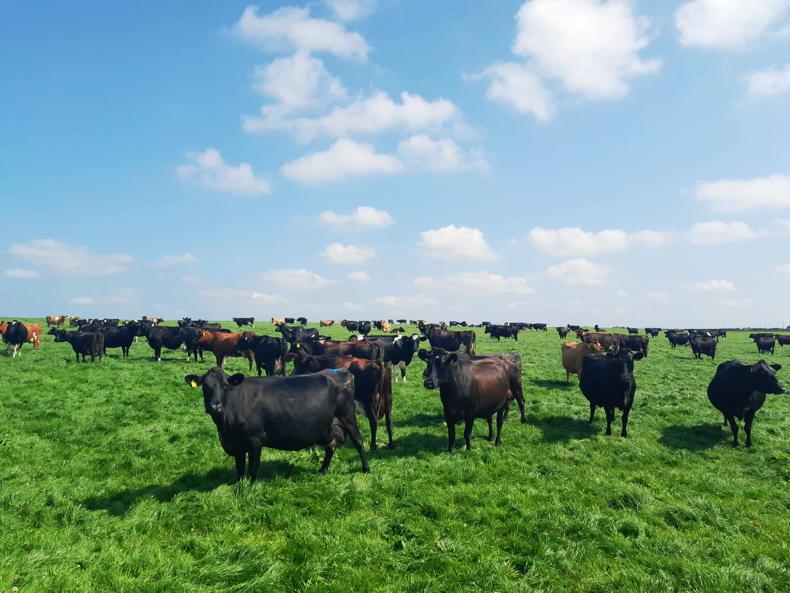
The cows averaged 555kg solids in 2024, including milk fed to calves .
Decent performance makes scale work
All speakers – the Malones, the Hickeys and discussion facilitator John McCabe of Teagasc – were keen to emphasise that the venture’s success is underpinned by strong farm technical and financial performance.
Cows averaged 535kg solids sold last year from 1.4t of concentrate (the equivalent of another 20kg was fed to calves) and milk solids are holding this year with lower levels of meal feeding. The ultimate result of the farm’s management efficiency and productivity was summarised by McCabe: on last year’s profitability, the farm’s 180 cows cleared the equivalent output of 250 cows at national average figures.
Savings and ‘absolute torture’ of finance
“I make no bones about it – it was absolute torture to try and get money at the start to get going. I was lucky I was in a position that we had saved hard so I had a lot going to the table and just needed the banks to top us up,” Michael Malone said about financing the purchase of the Hickeys’ cows.
“My main point is that the initial step with banks is very hard, but once you are on the treadmill and you are doing the job right, they are slightly easier to get going again. That initial step is very difficult.”
In the context of the credit access challenge, Michael emphasised the importance of the younger would-be share farmer not overpromising based on borrowings sought but not yet approved by the lender.
“If you were starting off here today and a farmer approached you, you don’t want to take for granted that you have the finance sorted,” he said.
“That is where I think things can break down. When someone promises something and they do not deliver, you are off on a bad foot straight away.”
Michael said the trust between himself and the Hickeys granted them the time flexibility needed for the funds sought from his bank to buy out the Hickeys’ cows to land in his account.
Credit
Teagasc’s John McCabe stated that he has not seen a young farmer access credit beyond €120,000 without having land to put up as security, with this €120,000 lending threshold only accessible to those with a “very good track record already”.
“There are a couple of unique things here for me. One of them is the relationship and trust that is not everywhere. A lot of these break down because of that,” McCabe noted.
“Another is the control that the Malones have over the farm and their really strong technical ability. The other is that the farm here is a set-up farm.”
McCabe explained further that as the herd was stable in number, there was no drain on cash and profits that exists when similar arrangements are entered during an expansion phase.
If cow numbers were to increase, “the share farmer can suffer” leaving share farming a better option for a “stable farm”, he said.
An output level of 1,400kg milk solids/ha for the farm (equivalent to 1,250kg/ha with supporting land for slurry and silage) in the Malone and Hickeys’ case is also well above the national average, the Teagasc adviser added.
\ Odhran Ducie
Number crunching on leasing costs
Attendees questioned the viability of young farmers setting out to lease a dairy farm, instead of looking at share farming, after hearing the Malones’ experience of the share farming model.
Numbers were crunched on the fringes of the meeting about the levels of finance that would be needed to take on a lease at a scale that would carry 150 cows on a turn-key operation.
Buying 150 cows at a very conservative cost estimate of €1,700/cow would require €255,000, while working capital of €500/cow or €75,000 in total would be needed to run these cows through to next spring when accounting for spending like meal, veterinary costs and land rental costs.
Another €30,000 could be needed to buy out any silage in the leased farm’s yard and a tractor with just the bare essentials machinery-wise for feeding out and scraping could see another €30,000-€50,000 spent when leasing.
Those totting up the figures came to an agreement that a ballpark of €400,000 would be needed to lease a farm, stock it with cows and maintain the stock for six months.
The figures thrashed out cover the costs a farmer would expect to incur to get cows as far as spring and do not cater for any degree of investment in concrete or steel that may be needed to take farms on leasing market up to scratch.
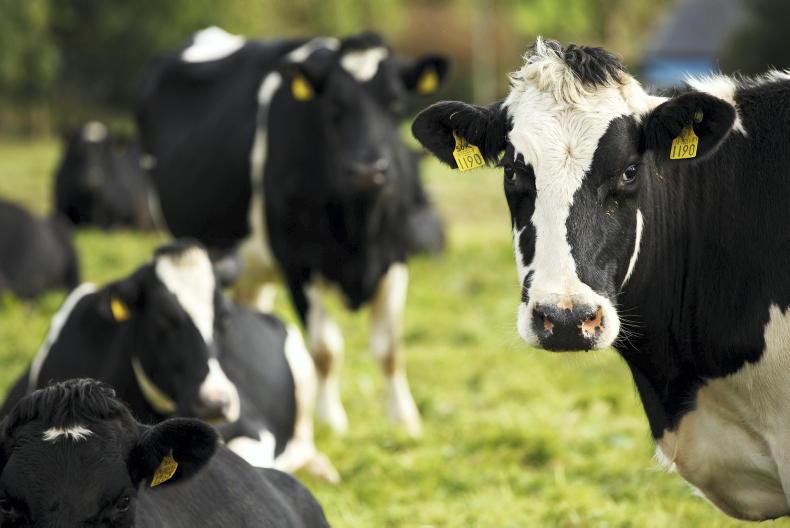
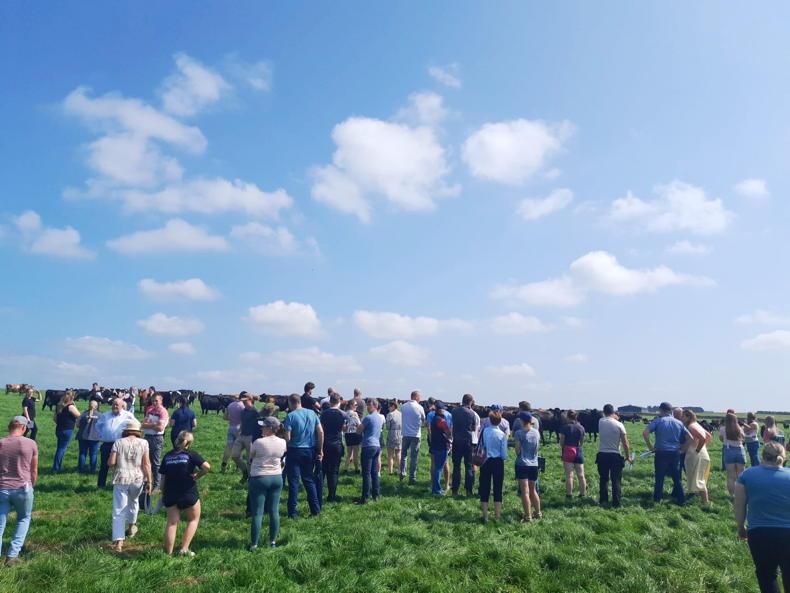
The farm walk heard that share farming works better with stable herds, rather than those going through cash-heavy herd expansions. / Donal O'Leary
Teagasc adviser John McCabe stated that he had come across many share farming outfits in which the owner had not offered “as sweet of a deal” as the Malones are getting.
“Most share farms are set up in a way that before profit is split at the end of the year, there is a big chunk taken out for land rental for the land owner,” he said.
The agreement featured sees neither the Malones receiving a wage to cover their labour before profits are calculated, nor the Hickeys drawing down a land rental or return on investment charge before the end-of-year margin is split.
“We didn’t want anyone coming here and absolutely crippling them, working like slaves and having no living out of it,” Pat Hickey remarked in this regard.
Instead, the Hickeys see the agreement as a means of facilitating their borrowing repayments on the farm.
Their back of an envelope sums at the time of entering into the agreement were that 180 cows could clear “about €1,000/cow profit” before the end-of-year split.
“If we could get €90,000 out of it, we could go a massive way to servicing the loan,” Pat explained.
“We don’t need a massive amount of money out of here. If the farm can wash its face, in 15 years’ time we will own a farm and we will not have had to work for it. That is what we proposed.”
The first year of the agreement was 2022, a “massive year” to start with exceptional milk prices, he noted.
Letting another farmer in the gate
The Hickeys accepted that a share farming agreement may have been more palatable to them than it might be for other farm set-ups, given that the farm was newly purchased and not one that had been passed down generations.
“That’s where we are slightly different. We only bought this farm in 2019,” Pat Hickey conceded. “And I would say that some people would say ‘listen, it’s only a small part of our business and if it went haywire, it didn’t really matter’ and maybe that was a bit of security for us.
“That if it went sideways that we would just scrap it and start again. It wouldn’t be going to put us under financial pressure and I suppose we need to take on board that that is a bit of security we have.
“Maybe for somebody who is on their own 150ac, 200ac farm, maybe it would be a bigger risk and they could have to take more extreme steps to see that they are guaranteed a return on it.”
Pat again reiterated the confidence he had in the Malones and the fact that they were financially invested in the farm’s improvement as a factor in not going down the leasing route.
High levels of trust, decent technical performance and stable cow numbers can see share farming offer a viable entry route into dairy farming for those without an existing land base. That was the takeaway message from the share farming families showcased at a recent Dairy Women Ireland event, held in conjunction with the Aurivo Leading Ladies Group.
The event heard from Michael and Sarah Malone, who entered into a partnership with Pat and Elaine Hickey on a 68ha farm in Roscommon that the latter couple purchased in 2019.
The farm was initially run by the Hickeys as a silage and youngstock-rearing block to support an existing dairy unit that they owned close by.
The block was converted to dairy, with the two parties running their first cows through the parlour in early 2022.
The business is structured in a registered farm partnership between the two couples and profits are split 50:50 at the end of the year, but with direct payments going to the farm owners.
There is no pre-profit labour deduction on the Malones’ part, nor any land rental costs on the part of the Hickeys.
Arrangement
The arrangement sees all costs aside from those strictly related to the cows, such as breeding, split between the two parties.
The Malones also bought out the Hickeys’ herd at the beginning of the share farming agreement.
The event heard the two families outline three areas critical to making their share farming work:
Not overpromising on finances, to prevent a share farming agreement from breaking down before it ever gets off the ground.Understanding that the relationship’s technical efficiency and cow numbers can have on ensuring an agreement’s scale is viable.Agreeing contract terms favourable to both parties.On the third point, Pat Hickey told visitors that after reviewing sample contracts drawn up by Dairy NZ, as well as that drafted for the Shinagh Estate share farming demonstration farm in Gurteen, the families felt that a shorter, custom contract was needed in their case.
Pat described these sample contracts as being “80 pages of signatures and penalties” that would have seen “a different problem every day if it was followed to the letter”, whereas he maintained two pages of detail could suffice when there are high levels of trust between the farm owners and share farmers.

The cows averaged 555kg solids in 2024, including milk fed to calves .
Decent performance makes scale work
All speakers – the Malones, the Hickeys and discussion facilitator John McCabe of Teagasc – were keen to emphasise that the venture’s success is underpinned by strong farm technical and financial performance.
Cows averaged 535kg solids sold last year from 1.4t of concentrate (the equivalent of another 20kg was fed to calves) and milk solids are holding this year with lower levels of meal feeding. The ultimate result of the farm’s management efficiency and productivity was summarised by McCabe: on last year’s profitability, the farm’s 180 cows cleared the equivalent output of 250 cows at national average figures.
Savings and ‘absolute torture’ of finance
“I make no bones about it – it was absolute torture to try and get money at the start to get going. I was lucky I was in a position that we had saved hard so I had a lot going to the table and just needed the banks to top us up,” Michael Malone said about financing the purchase of the Hickeys’ cows.
“My main point is that the initial step with banks is very hard, but once you are on the treadmill and you are doing the job right, they are slightly easier to get going again. That initial step is very difficult.”
In the context of the credit access challenge, Michael emphasised the importance of the younger would-be share farmer not overpromising based on borrowings sought but not yet approved by the lender.
“If you were starting off here today and a farmer approached you, you don’t want to take for granted that you have the finance sorted,” he said.
“That is where I think things can break down. When someone promises something and they do not deliver, you are off on a bad foot straight away.”
Michael said the trust between himself and the Hickeys granted them the time flexibility needed for the funds sought from his bank to buy out the Hickeys’ cows to land in his account.
Credit
Teagasc’s John McCabe stated that he has not seen a young farmer access credit beyond €120,000 without having land to put up as security, with this €120,000 lending threshold only accessible to those with a “very good track record already”.
“There are a couple of unique things here for me. One of them is the relationship and trust that is not everywhere. A lot of these break down because of that,” McCabe noted.
“Another is the control that the Malones have over the farm and their really strong technical ability. The other is that the farm here is a set-up farm.”
McCabe explained further that as the herd was stable in number, there was no drain on cash and profits that exists when similar arrangements are entered during an expansion phase.
If cow numbers were to increase, “the share farmer can suffer” leaving share farming a better option for a “stable farm”, he said.
An output level of 1,400kg milk solids/ha for the farm (equivalent to 1,250kg/ha with supporting land for slurry and silage) in the Malone and Hickeys’ case is also well above the national average, the Teagasc adviser added.

\ Odhran Ducie
Number crunching on leasing costs
Attendees questioned the viability of young farmers setting out to lease a dairy farm, instead of looking at share farming, after hearing the Malones’ experience of the share farming model.
Numbers were crunched on the fringes of the meeting about the levels of finance that would be needed to take on a lease at a scale that would carry 150 cows on a turn-key operation.
Buying 150 cows at a very conservative cost estimate of €1,700/cow would require €255,000, while working capital of €500/cow or €75,000 in total would be needed to run these cows through to next spring when accounting for spending like meal, veterinary costs and land rental costs.
Another €30,000 could be needed to buy out any silage in the leased farm’s yard and a tractor with just the bare essentials machinery-wise for feeding out and scraping could see another €30,000-€50,000 spent when leasing.
Those totting up the figures came to an agreement that a ballpark of €400,000 would be needed to lease a farm, stock it with cows and maintain the stock for six months.
The figures thrashed out cover the costs a farmer would expect to incur to get cows as far as spring and do not cater for any degree of investment in concrete or steel that may be needed to take farms on leasing market up to scratch.

The farm walk heard that share farming works better with stable herds, rather than those going through cash-heavy herd expansions. / Donal O'Leary
Teagasc adviser John McCabe stated that he had come across many share farming outfits in which the owner had not offered “as sweet of a deal” as the Malones are getting.
“Most share farms are set up in a way that before profit is split at the end of the year, there is a big chunk taken out for land rental for the land owner,” he said.
The agreement featured sees neither the Malones receiving a wage to cover their labour before profits are calculated, nor the Hickeys drawing down a land rental or return on investment charge before the end-of-year margin is split.
“We didn’t want anyone coming here and absolutely crippling them, working like slaves and having no living out of it,” Pat Hickey remarked in this regard.
Instead, the Hickeys see the agreement as a means of facilitating their borrowing repayments on the farm.
Their back of an envelope sums at the time of entering into the agreement were that 180 cows could clear “about €1,000/cow profit” before the end-of-year split.
“If we could get €90,000 out of it, we could go a massive way to servicing the loan,” Pat explained.
“We don’t need a massive amount of money out of here. If the farm can wash its face, in 15 years’ time we will own a farm and we will not have had to work for it. That is what we proposed.”
The first year of the agreement was 2022, a “massive year” to start with exceptional milk prices, he noted.
Letting another farmer in the gate
The Hickeys accepted that a share farming agreement may have been more palatable to them than it might be for other farm set-ups, given that the farm was newly purchased and not one that had been passed down generations.
“That’s where we are slightly different. We only bought this farm in 2019,” Pat Hickey conceded. “And I would say that some people would say ‘listen, it’s only a small part of our business and if it went haywire, it didn’t really matter’ and maybe that was a bit of security for us.
“That if it went sideways that we would just scrap it and start again. It wouldn’t be going to put us under financial pressure and I suppose we need to take on board that that is a bit of security we have.
“Maybe for somebody who is on their own 150ac, 200ac farm, maybe it would be a bigger risk and they could have to take more extreme steps to see that they are guaranteed a return on it.”
Pat again reiterated the confidence he had in the Malones and the fact that they were financially invested in the farm’s improvement as a factor in not going down the leasing route.
SHARING OPTIONS