


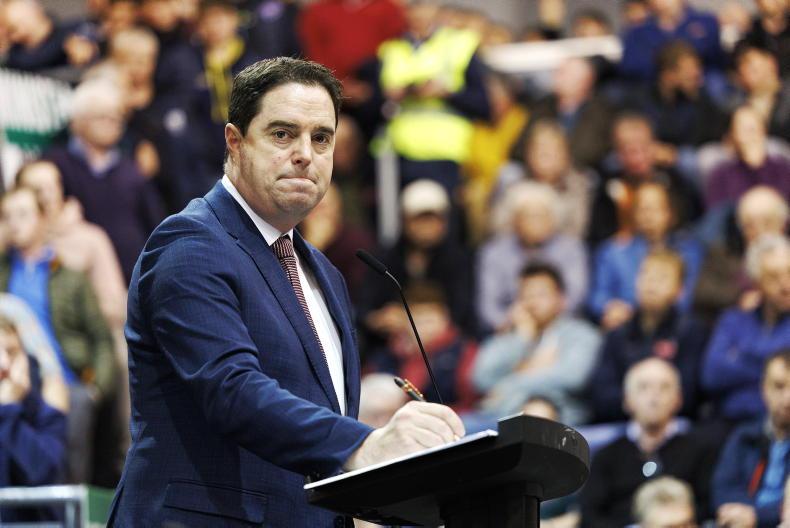
As Minister for Agriculture Martin Heydon faced a wall of 2,000 troubled farmers in Corrin Mart, he could be in no doubt about the depth of feeling among those present.
Farmers, dairy co-op management and representatives of meat processors, feed mills and local politicians packed into Monday’s IFA meeting to press home the urgency of their message.
And their message was clear: to lose Ireland’s nitrates derogation would be to decimate local economies and inflict severe damage on Irish rural jobs and valuable food exports.
Losing the derogation would cost the Irish economy €45bn between 2026 and 2035, and could force one in eight family farms out of dairying, the EY report commissioned by Dairy Industry Ireland found.
Teagasc economists have warned that losing the derogation would cost €1bn per year in export revenue. The figures are staggering.
Meat Industry Ireland chair Philip Carroll warned that uncertainty stifles investment on farms and across the industry.
Tirlán chair John Murphy encapsulated the frustration and incredulity that many farmers feel when he said that they were “begging to produce food – what has gone wrong?”
He also rightly warned about the political danger for the European Commission if farmers, after investing massive time and effort into changing their farm practices and management, were refused the derogation.
The apathy and disillusionment caused by such a decision could irreparably damage farmer buy-in to Europe’s policies for food production and environmental management for years to come.
While there are 7,000 farmers farming under the derogation, Brussels decision-makers and other EU member states must be made aware that derogation changes have much wider implications.
The IFA has calculated that additional land an area the size of Co Kildare would be required to meet lower stocking rates. Land sales and rental prices would inevitably increase and push land access beyond the reach of many young farmers.
Macra president Josephine O’Neill warned about the impact on young farmers.
European leaders have bemoaned the exodus of young farmers from food production, so for European policy to exacerbate that problem in a country that is in a prime position to produce high-quality and environmentally sustainable food would be reckless.
Commitment
The Irish Government’s commitment to improving water quality is clear. In the last decade, it has granted farmers €153m for slurry storage and low emissions equipment.
In October, €42m was announced as part of Budget 2026 for water quality initiatives.
This includes the Farming for Water European Innovation Partnership (EIP), to which over 4,300 farmers have enthusiastically applied. They are planting thousands of acres of cover crops and hundreds of kilometres of hedges, buffer zones, and fencing to mitigate nitrate leaching.
The result of their efforts will need more time to be seen in full, but EPA data shows that the total nitrogen load entering estuaries is down 25%.
That’s not to say further work is not required, but there are many more water quality initiatives that have yet to bear their full fruit. To cut the nitrates derogation before that progress is made would be premature and a backwards step.
Minister for Agriculture Martin Heydon this week hosts Jessika Roswall, European Commissioner for Environment, Water Resilience and a Competitive Circular Economy.
They will visit an Irish derogation dairy farm, where the commissioner will see first-hand Ireland’s grass-based system and the efforts being made to improve water quality.
On Monday night, the minister outlined the long and complicated process of derogation negotiations with the European Commission.
D-Day is now approaching for the derogation, and Europe’s decision will dictate the fate of thousands of Irish farms and the wider economy.
The decision must be one that encourages farmers to continue with their work on water quality and safeguards rural livelihoods.


SHARING OPTIONS