



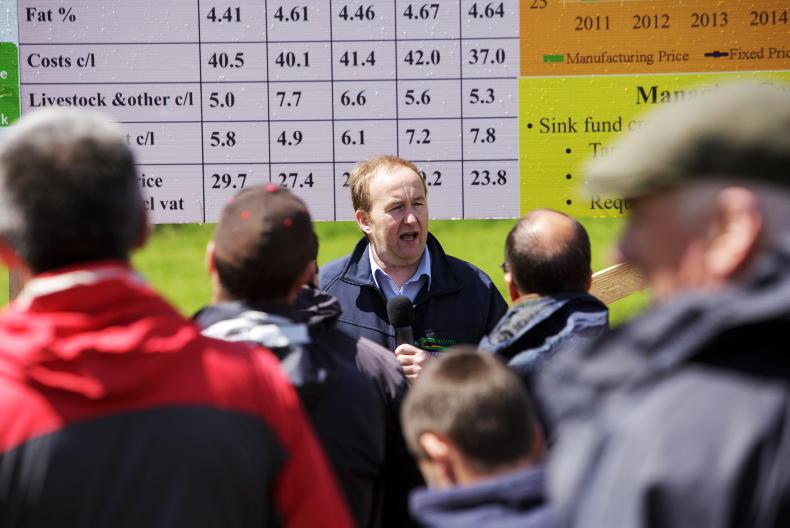
More time must be given to farming to allow a raft of new measures introduced in the latest Nitrates Action Programme (NAP) to impact water quality.
This was the reaction of Teagasc scientist Laurence Shalloo to the latest water quality report from the Environmental Protection Agency (EPA).
“There are lots of new measures being implemented and they need to be given a chance to have an impact. What is the point of implementing measures if they are not going to be given a chance to work?” Shalloo insisted.
The fact that the proportion of rivers that are classed by the EPA as unsatisfactory fell from 47% in 2018-19 to 40% for 2020-22 showed that progress was being made on farms, he said.
“When you look at the EPA report, what we saw was a deterioration in water quality in 2018-19 driven by the drought,” Shalloo explained.
“What we are seeing now, 2020-2022, is that water quality is almost back up to where it was in 2014 to 2016. That is really positive,” he said.
Shalloo maintained that measures in the most recent NAP – such as banding and tighter restrictions on fertiliser usage and slurry spreading – have the potential to further improve water quality if given the time.
Surprising
Commenting on the recent EPA report, Shalloo said that some of the areas identified as having problems with water quality were “extremely surprising”. Equally, he said there were questions around some areas that were not identified as having problems.
“There is further need for discussion, clarification and understanding of where these effects [on water quality] are coming from,” the Teagasc scientist maintained.
With the derogation farms now facing the possibility of the maximum allowable organic N/ha being reduced from 250kgs to 220kgs, Shalloo pointed out that any decision by the European Commission on this front will reverberate beyond dairying.
“The implications of a drop from 250 to 220 [as a consequence of this water quality report] are absolutely unknown,” he said.
“What are the implications for beef farmers, what are the implications for tillage farmers in terms of the demand for land?” Shalloo asked.
The Teagasc scientist also rejected suggestions that changes to Ireland’s derogation were inevitable, given the tighter restrictions being faced by dairy farmers on the continent.
“The Dutch, the Danes, the Belgians; they need a derogation because they are highly stocked. In Ireland it is completely different, we need a derogation because of our [pasture-based] system,” Shalloo explained.
“They have an indoor system; it doesn’t really matter because they export the slurry. But in a pasture-based system like ours it’s impossible to export the slurry,” he pointed out.
“So, it is important to differentiate between the two; one [derogation] is for the stocking rate, one is for the system,” he added.



SHARING OPTIONS