


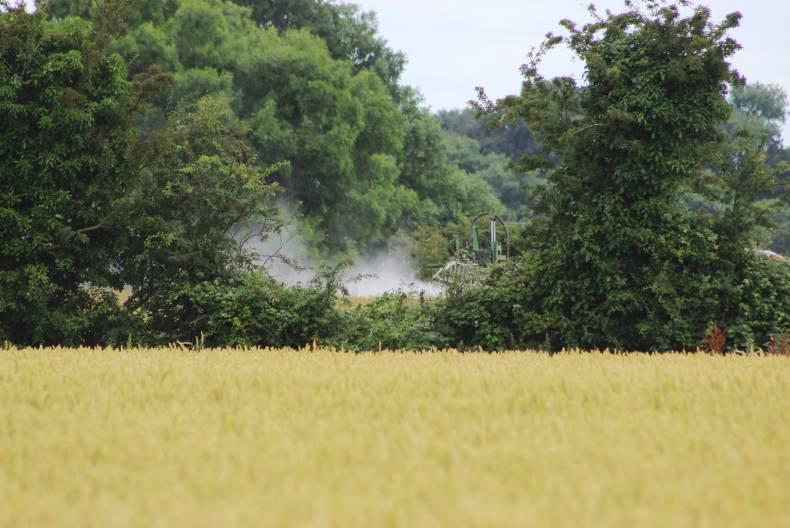
Farmers are increasingly aware of the need to keep pesticides out of water. This means no filling out of rivers or careless disposal of containers or their sealing foils. Obviously, this includes ensuring that sprayer booms do not spray in over waterways and also the prevention of spray drift from moving over water-carrying bodies.
Sprayer operators are obliged to adhere to buffer zones along water-carrying bodies such as watercourses and open drains. Each individual active has its own buffer requirement (a distance that the spray must not be applied relative to water) and the size of each buffer relates to the potential toxicity of the active to aquatic organisms. Basically, the further the sprayer boom is kept away from a water-carrying body, the lower the risk of drift getting into the water.
The risk that drift poses to water is very much related to the concentration of chemical in this drift. A reduced concentration of product in the spray mix will pose lower risk to adjacent water bodies. And if nozzles are used that produce less drift, then this further reduces the likelihood of drift being a carrier of chemical to an adjoining water body.
These two principles were used by staff in the the pesticide registration and control division (PRCD) of the Department of Agriculture to develop an initiative to reduce the buffer requirement of individual sprays. The initiative is called the surface water tool for reducing the impact of pesticides on the environment, or STRIPE for short.
This is a pilot initiative introduced in January of this year to help reduce the buffer requirements of a range of agricultural pesticides through the use of low-drift nozzles and/or reduced rates.
The objective of legislation is to help prevent the contamination of water by pesticides. To help protect water from plant protection products (PPP), the registration process sets minimum distances between the area being treated and bodies carrying water. This no-spray area is referred to as a buffer zone.
While we in Ireland do not have any major problems with pesticides in water, risk mitigation measures such as buffer zones and the use of low-drift application technology are advised to help protect our aquatic environment and to ensure a quality water supply for consumers.
Buffer zones
Buffer zones normally apply adjacent to water, but they can also apply to hedgerows which should not receive direct application of a particular pesticide. The majority of products authorised in the EU require an unsprayed area to be maintained adjacent to rivers, lakes and drains etc. A buffer zone requirement can range from 1m to 15m or more and so they vary considerably based on the perceived risk attributed to each product.
However, in all instances a PPP must not be applied within 1m of any surface water body – this means that a minimum buffer zone of 1m applies to all PPPs, regardless of the rate of application, the type of nozzles used or whether water is present or not in the surface water body at the time of spraying. A surface water body is defined as a feature which is capable of holding water permanently or at any stage during the year.
Low-drift nozzles
Low-drift nozzles are designed to produce fewer small droplets than standard nozzles, but this can result in larger spray droplets which could challenge spray efficiency. Larger droplets are heavier and are less prone to drift and so result in reduced loss of active from the target area.
In the STRIPE scheme, nozzles are described as having reduced drift potential of either 75% or 90%. The list of nozzles in each category can be found at www.pcs.agriculture.gov.ie/media/pesticides/content/plantprotectionproducts/stripe/STRIPE%20Nozzle%20Lists%202015.pdf. If your nozzle is not shown in these tables, then it cannot be used in the STRIPE initiative.
Using this table, you can either search for the nozzles you have fitted to your sprayer or select a new set to purchase that will do the job you need. There are only two categories that matter to STRIPE – nozzles that can give at least 75% reduction in drift risk and those shown to reduce drift risk by 90%. A section of the 90% drift reducing nozzle list is shown below. Each nozzle is listed by manufacturer and by its model and output.
If your nozzle is not on this list, then you cannot claim the 90% drift reduction option in STRIPE. When you use a 90% STRIPE nozzle, the buffer requirement tends to be minimised even at full product rate. However, one must not compromise too far on efficacy, as low drift reduction means bigger droplets and these may adversely affect the efficacy of certain spray jobs, so compromise is generally needed.
Page two of this document lists those nozzles that are rated under STRIPE as having the ability to reduce drift by 75% or more. If you opt to use Agrotop TurboDrop HiSpeed 110-05 nozzles, you can read your buffer obligation from the green columns in the products tables.
But if you choose to use a Hypro ULD DriftBeta 120-04 nozzle (90% reduction), then you get your buffer from the blue column in the products table.
So the combined use of STRIPE drift-reducing nozzles and reduced product rate enables a farmer to minimise the buffer zone requirement to 1m, except for the more potent actives. Remember, the final buffer requirement is set by the biggest buffer required for the products in your tank mix.
Take an example of a tank mix of Frelizon and Proline. The mandatory buffer zone using non-drift-reducing nozzles for these products are 10m and 5m respectively. If one used 75% drift-reducing nozzles and a full rate of each product, the buffer drops to 3m and 1m respectively. So the buffer required for this spray mix would be 3m.
How STRIPE works
The principle behind the system is simple. A reduced rate of product coupled with the use of drift-reducing nozzles lowers the risk of a significant quantity of drift moving towards a water body. And when the risk from drift is lower, the buffer strip can be reduced.
Each chemical is given a minimum aquatic buffer requirement based on its chemical evaluation during registration. For many products, this is a minimum 1m buffer which must be adhered to by all products, even after the STRIPE allowance. So no chemical can be applied within 1m of the top edge of the bank of a drain or watercourse.
The STRIPE initiative enables a grower to reduce the minimum (aquatic) buffer zone requirement of a pesticide to a definable level based on rate reduction and the use of low-drift nozzles. It is not difficult to use but it is important that sprayer operators know what is involved.
The first step in the process is to identify the product(s) you will apply in the tank. This requires knowing your target or targets, whether they be diseases, pests, PGR, etc, and choosing the most appropriate products. Where possible, application should be guided by recognised treatment thresholds where they exist.
Choose the product or products to be applied and check them out on the Department’s Sustainable Use Directive (SUD) website. The following link will take you to the list of fungicides: www.pcs.agriculture.gov.ie/media/pesticides/content/plantprotectionproducts/stripe/Stripe%20Fungicide%20List%20March%202015.pdf.
Part of what you will see in this list is shown in the table (above right). Take the example of Adexar. The table gives you its PCS number, its active ingredients and their concentration in the first few columns. The yellow column gives its mandatory buffer zone at full rate without the use of drift-reducing nozzles.
The four salmon-coloured columns on the right of the table give the buffer zone required when using full, three-quarter, half or quarter-rate doses applied through standard non-drift nozzles. The table shows that the buffer zone decreases from 5m to 4m to 3m and then to 1m at the quarter-rate, when reduced rates are used.
If 75% drift-reducing nozzles are fitted to your sprayer, like Syngenta’s Amistar nozzle, then you are moved to the green columns to get your buffer requirement.
In these columns, you will notice that at full rate of Adexar, the buffer zone is immediately reduced from 5m to 2m just because a 75% drift-reducing nozzle is fitted. And for all the reduced product rates, the buffer is reduced to the minimum 1m width. The pale blue column applies if you have 90% drift-reducing nozzles fitted and this reduces the buffer zone down to the minimum 1m, even where full rate product is used.
So this is how you work your way through the tables. Firstly, know what nozzles you will use and these must reflect the job in hand. Then select the products that will go into the tank and then select the rate(s) appropriate to the job in hand. Take a note of the buffer used for each relevant parcel for your records.
So reduced rate and reduced drift nozzles, on their own or together, can be used to reduce the buffer requirements of most, but not all, products. When you are looking up the fungicides table, take a look at all of the fenpropidin products. These all have a 15m buffer at full rates, but regardless of whether one uses reduced-drift nozzles or reduced application rates, the buffer zone requirement remains at 15m.
The exact same process can be used for both herbicides and insecticides. The herbicide table can be found at www.pcs.agriculture.gov.ie/media/pesticides/content/plantprotectionproducts/stripe/Stripe%20Herbicide%20List%20March%202015.pdf and the insecticides at www.pcs.agriculture.gov.ie/media/pesticides/content/plantprotectionproducts/stripe/Stripe%20Insecticide%20List%20March%202015.pdf.
It must be noted that these are the current water buffer requirements, but these can change over time so you need to continuously check the site when using products.
The presence of buffer requirements means that sprayer operators must calculate the buffer requirement for every spray mix in every field which has a watercourse and work out the best compromise for each. That said, drift-reducing nozzles will become a must on every sprayer boom. Then go on to the website and print out the lists of fungicides, herbicides and insecticides and place them in your spray store for reference.






SHARING OPTIONS