



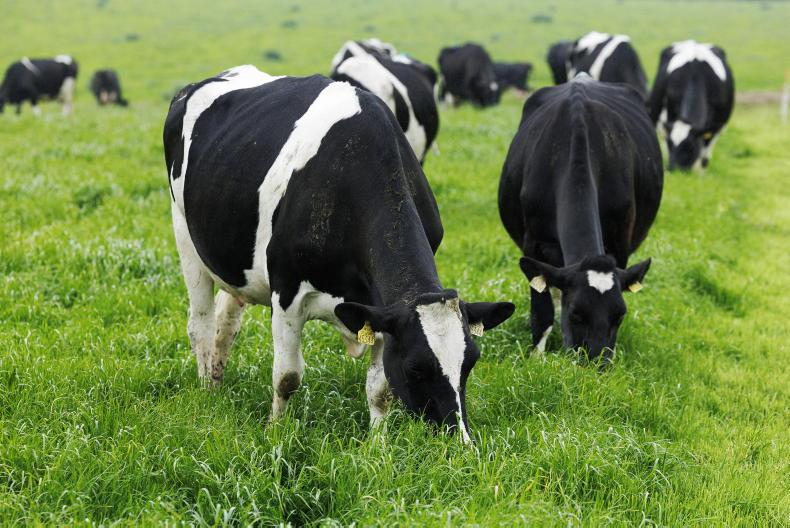
Annual reseeding programmes, together with maintaining the productivity and persistence of swards for up to 10 years after sowing, are key aspects of grassland farming systems. Since 2013, a long-term perennial ryegrass variety study was established on approximately 100 commercial grassland farms across Ireland.
Perennial ryegrass varieties were sown in monoculture on paddocks and data collection was carried out using PastureBase Ireland.
Grazing events
All farmers completed a minimum of 30 grass walks per year, and data was collected for total annual herbage production, seasonal production, number of grazing events per year, silage production and number of silage events annually.
A control grass variety was sown on all farms which was AberGain.
All other varieties were sown on a minimum of 20 farms.
Figure 1 shows data for 17 varieties over the first six years post-sowing (excluding sowing year).
There was little difference between varieties in the first year after sowing, which may be due to increased nitrogen availability following cultivation.
As swards aged, differences in variety performance became more evident.
There was approximately a 2,231kg DM/ha/year difference between the highest and lowest yielding varieties over six years – equating to greater than 13t/ha over this period.
There were 1.7 defoliation events between the highest and lowest varieties.
The varieties with greater grazing efficiency (reflected in the grazeout score in the Pasture Profit Index) are achieving higher number of grazing events on farm and those with low grazing efficiency score are more likely to be harvested as surplus silage during the season, this is very much a farmer decision to overcome poorer graze outs.
There was little difference in persistence between diploid and tetraploid varieties during the first six years after sowing.
On average, annual herbage production declined by 1,015kg DM/ha between year one and year six, with diploid varieties showing a slightly smaller reduction than tetraploids (252kg DM/ha).
However, over the longer term, up to 10 years post-sowing, tetraploid varieties maintained their production better than diploids, with a 762kg DM/ha smaller reduction in annual herbage yield.
These results show that tetraploid varieties can remain productive in swards for up to 10 years and, over the longer term, can outperform diploid varieties for annual herbage production.
In general, tetraploid varieties have improved grazing efficiency, most likely due to increased sward leaf proportion, with lower tiller density making them more grazable.
Choosing more grazing efficient varieties can increase profitability through increased herbage utilisation and reduced requirement for mechanical intervention.
Conclusion
Overall, this study reinforces that variety selection is a key decision at sward establishment, with differences between varieties becoming increasingly evident as swards age.
Selecting varieties with strong productivity indices, good grazing characteristics and persistence are essential for swards capable of supporting profitable pasture-based dairy systems.
This study also provides confidence in the performance and reliability of recommended varieties under a range of commercial farm conditions, with varieties maintaining their relatively high grassland productivity over time.
Ultimately, choosing high-performing, persistent varieties is a simple but effective strategy to maximise pasture productivity, improve grazing utilisation and support the long-term sustainability of grass-based dairy systems.


SHARING OPTIONS