



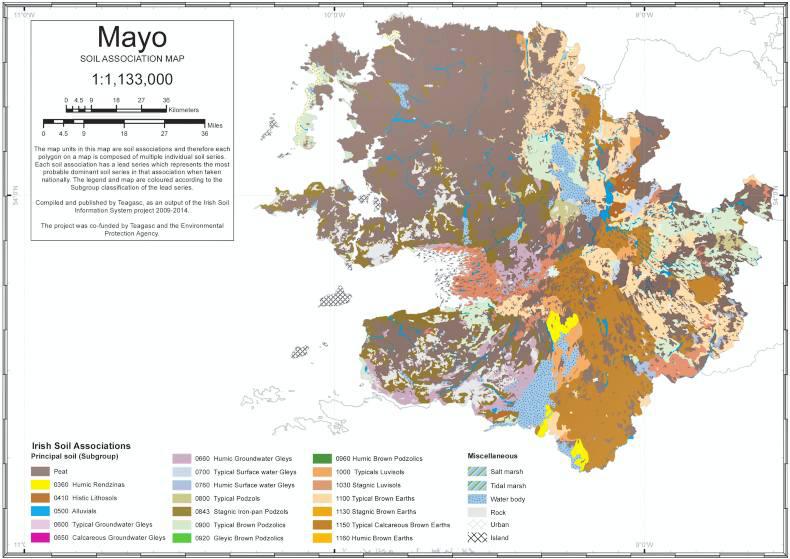
A large portion of Co Mayo is designated for nature conservation, which can be attributed to the rich natural heritage found on the landscape here. The coastline, the longest of any county in Ireland, boasts a wealth of habitats found in the cliffs, estuaries, sandy beaches and offshore islands. Although Mweelrea is the highest mountain in Mayo, Croagh Patrick is certainly the most famous. Those who make the pilgrimage are rewarded with a view that takes in Ireland’s best example of sunken drumlins, found in Clew Bay.
Topographically, the landscape can loosely be divided into two main regions. Firstly, the mountainous upland areas that are found in the western and northern parts of the county; and secondly, the most fertile areas of farmland found in the eastern part of the county. The upland areas are generally characterised with igneous bedrock which tends to be more acidic in upland areas to the west of Lough Mask on the Sheeffry Hills.
In general, peat landscapes dominate in Co Mayo and blanket peat is commonly found in these upland areas associated with the cold wet conditions. Podzol soils (mountainous acidic nutrient-poor) are also commonly found at high altitudes, as is exposed rock, due to the climate and exposed conditions found here. In contrast, as these upland areas give way to the coastline, windblown sand dunes become prevalent at sea level. Towards the east, around Claremorris, the landscape can be described as limestone glacial till lowlands, the majority of which is characterised with luvisol soils (downward clay movement). Besides peats and podzols, brown podzolics are the most frequently found soil types in Mayo. These soils are typically found on the upper slopes of mountainous areas. Here, they are readily found in the tract between Killala and Enniscrone, stretching southwards to Ballyhaunis. A majority of the brown podzolics in Mayo are ‘Cupidstown Hill’ series (found in association 0900h led by subgroup 0900). These soils tend to have an acid upper horizon and present evidence of leaching due to the altitude, higher rainfall and lower temperature. This can give rise to potential drainage or root penetration issues. These soils have a limited use-range in an unimproved state and are most suited to extensive grazing. However, these soils respond well to soil and nutrient amendments, which can extend the use-range. Typical calcareous brown earths are another frequently found soil type and can be found in the area between Castlebar, Claremorris and Ballinrobe. Two major calcareous brown earth series are typical here; the ‘Baggotstown’ series and the ‘Ballinacura’ series (which are found respectively in associations 1150a and 1150b, both led by subgroup 1150). Both of these are comprised of glacial sands and gravels that are of limestone composition, meaning that they are calcareous in nature and so have a high pH. They have a coarse texture, meaning that they can be excessively draining. The Baggotstown series has a wider use-range than the Ballinacurra series due to the latter being a more shallow soil.



SHARING OPTIONS