



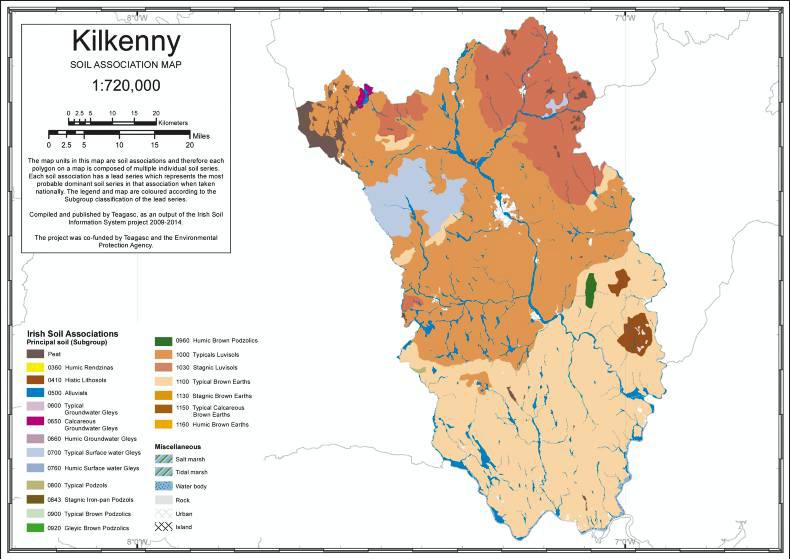
In general, Co Kilkenny enjoys fertile, well-drained soils. The landscape consists of a central plain of flat lowlands, with soil parent material consisting mainly of glacial till of limestone composition. These lowlands are framed with upland areas in the northwest, northeast and the south.
The northeast is home to the Castlecomer plateau and quarrying is an important activity in this area. These plateau areas to the northeast and northwest also consist of glacial till of shale/sandstone and limestone composition and here this gives rise to luvisols (downward movement of clay) and surface-water gleys (slowly permeable sub-surface layer).
To the south of the central lowlands, the landscape becomes more undulated and the glacial drift is composed of shale and sandstones.
Overall, the county is well drained due to the river network, including the River Nore, which drains water from the upland areas to the east and to the west. Both the River Barrow and the River Suir form a natural county boundary to the east and to the south respectively, converging in the southeast.
Overall, luvisols are the most prevalent soil type found in the county. The movement of clay from the topsoil into the subsoil means that these are very good agricultural soils due to their higher clay content, as they retain nutrients well.
However, the increased clay in the subsoil can slow down the movement of water through the profile, meaning that these soils can be moderately to imperfectly draining, depending on the soil texture. Most of the luvisols found here are the ‘Elton’ series (found in association 1000a led by subgroup 1000) and can be found around the Nore catchment. The soil and drainage conditions allow land in these parts to be used for tillage.
Further south, the second most prevalent soil types, brown earths, form a belt along the county boundary. These are mostly of the ‘Clonroche’ series (found in association 1100a led by subgroup 1100).
These soils are well-drained and tend to have a loam texture, resulting in reasonably good nutrient retention, making them good agricultural soils.
Naturally free-draining
Sandwiched between these two soil types, there is an area where brown podzols are the typically found soil type. Brown podzolic soils have lost much of their nutrients (in particular iron and aluminium) as a result of acidic conditions and high rainfall over time, but may benefit from liming periodically. These soils are naturally free-draining, so should not require any additional drainage. In the plateau areas in the northeast and the northwest, stagnic luvisols can be commonly found. These are soils that have a slightly higher clay content at depth, than luvisols, resulting in conditions similar to that of surface-water gleys. They tend not to be wet for long periods, so management of these soils is slightly easier than surface-water gleys.


SHARING OPTIONS