Calving difficulty, as well as perinatal mortality, still accounts for huge economic losses. In 2012, 1.6% of all calves were stillborn in Ireland and an additional 2.3% died before they reached six weeks old. The latter figure is significantly higher in beef calves (2.6%) compared with dairy (1.9%).
It is useful to have a fixed strategy for dealing with calving cows or heifers. In other words, recognise your limits and do not wait to gain experience at the expense of the calf’s life.
Preparation for calving, management of the cow at calving and during the time when the cow is preparing for the next pregnancy can have a key influence on fertility. In this article, we will look at the “where” and the “when” of calving, along with assessing the “how” – some calving techniques.
Unusual cases and presentations occasionally cause problems, so we will briefly look at some of these at the end of the article. Finally, we will briefly review the effect on the cow in terms of subsequently fertility.
Where to calve cows
It is advisable, from a management viewpoint, as well as convenience, to designate a specific location for observing heavily pregnant cows and also to have an area, close by, for restraining cows if assistance is needed – all with facilities for 24-hour lighting.
Seasonally calving herds should have approximately one calving box per 15 cows, thus allowing a new calving box which has been disinfected and containing copious amounts of straw to be available for each cow that calves.
Many still use the crush for restraint, which is not advisable. If the cow goes down, endless problems and delays can arise in manoeuvring her into a manageable position. A useful construction consists of a 12ft long gate, attached by its end to one of the walls of a shed, 2.5ft out from the corner. This allows the animal to be restrained between it and the wall.
Useful additions to such a construction include a ring at the front end, for restraint of the cow with a head rope, and an attachment in the wall behind the gate for tying the gate to trap the animal in place. Such a construction is cheap to erect and easy to remove when the calving season is over. An improvement is to add a crush gate to the front end of this to allow for head restraint.
Maintaining clean calving equipment is important – wash and disinfect after each use. If the calving jack is becoming worn and slips, you should replace it, as this could make the difference between saving a calf or not. Keep multiple head ropes and leg ropes so that there is always a clean set available ready for use. The calf should be landed into an area with plenty of clean straw bedding and its navel should be disinfected to reduce risk of navel ill.
When to intervene
Frequent observation of cows due to calve is paramount so planning to have them closer to the dwelling house helps to make life easier. These animals should be observed approximately every three hours with one observation during the night. If an animal is starting to calve you should observe them frequently.
If an animal appears to be calving and hasn’t been observed for 10 to 12 hours, it is important to realise that she may have been calving for some time.
I recommend a proactive approach to calving. If a cow is seen to lack progress, it is useful to perform a quick and gentle examination of her passage, with a clean, well lubricated hand, to ensure that the calf is arriving correctly.
A cow should be left for a maximum of one hour (heifers – two hours) after first observing her straining, before performing such an examination, if the calving does not seem to be progressing. This can rule out many abnormalities and allow early rectification of problems. In other words. If in doubt, check her out.
A gentle examination will often explain a delay. If it’s a technical difficulty, it gives the veterinary practitioner a better chance of success. Avoid routinely assisting calving, however, unless absolutely necessary. Assisting too soon can lead to a high incidence of womb infection (endometritis), which will affect fertility.
Dealing with problems
We will now take a look at some of the findings of such an examination. If the calving channel is soft, the calf cannot be felt or the calving channel is only open slightly and you can feel the water bag, the cow is either not ready to calve or there is a twisted uterus.
For this, wait at least two hours. If the cervix is open, gently feel that the head and two feet are there without rupturing the water bag. If the situation remains the same afterwards, it may be advisable to seek veterinary advice. Heifers may need longer, eg three hours.
If the calving channel is wide open and the water bag is intact with no obvious reason for the cow not proceeding with calving, then it’s a case of an oversized calf, milk fever, uterine inertia (the womb not contracting properly) or foetal abnormalities. Since the arrival of Schmallenberg virus, these are common. If you suspect a structural abnormality of the calf, it is best to call the vet early as even caesareans on these can be difficult.
To treat an uncomplicated case, put on a head rope without rupturing the water bag and gently ease the calf’s head into the calving channel.
A calving jack should not be used at this stage as jacking the calf’s head into the pelvis is hazardous. If the head fails to enter the pelvis, it is advisable to seek veterinary advice.
Before proceeding further, leave the cow for one to one and a half hours to dilate fully if it advances easily. Administering calcium S/C at this stage may also improve the cow’s ability to force.
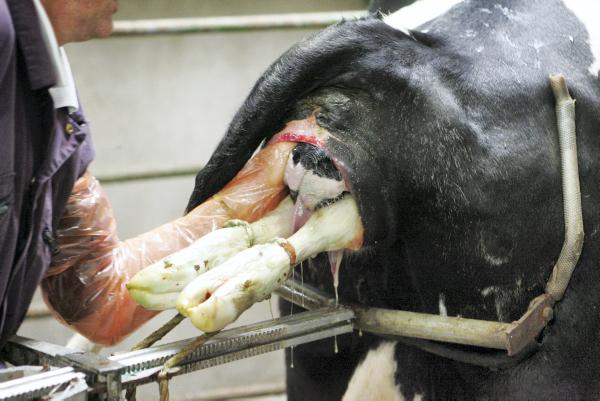
If you find the calf’s nose and feet at the outside, this means that the calf’s head is already through the pelvis, and these should be left no longer than one hour for cows or two hours for heifers before intervening.
Gentle traction, with the aid of the calving jack, helps in dilation.
If a well-lubricated hand is inserted between the calf and the wall of the vagina, and is moved gently to stretch the surrounding tissues with some lubricant pushed into the area, it can be useful in assisting the passage of the calf.
If the calf has proceeded as far as the shoulders and will move no further, it can be due to oversized calves or abnormalities. It is a useful tip to move the calving ropes up above the knees, so that the force being applied is in the correct direction and avoids broken legs lower down.
For hiplock, it is wise to call the vet early. It is best rectified by releasing the calving jack and plunging in plenty of lubricant, so that the hair around the calf’s hips and rump is slippery. Proceed by moving the calving ropes up to surround the calf’s elbows and applying a moderate pull.
Moving the jack from side to side may help release one hip before the other and aid success. If this fails, the vet may be able to extract the calf using more specialist techniques but if the calf is dead, embryotomy (splitting the hips) is the only option.
From 30 to 50 days after calving, two processes must happen to help the cow recover and in order for her to become pregnant again. The ovaries must begin to cycle again and the womb must undergo a process of return to normal size (involution).
The resumption of ovarian activity is affected by a variety of issues such as suckling, nutrition, breed and season. While many cows ovulate for the first time within a month after calving, involution usually takes between 30 and 50 days.
In normal cows, involution is usually a process where bacteria infect the womb causing a mild inflammation which clears quickly and has no adverse effect on fertility. The speed of involution depends largely on the degree of infection with nasty bacteria.
Endometritis (womb infection with nasty bacteria) is a common disease (estimated to affect more than 20% of cows in Ireland) and is probably the single largest contributor to diminished fertility in cows.
Many risk factors can affect the incidence of endometritis. Some are beyond the farmer’s control, such as abnormalities during pregnancy (oedema of the foetal water bags, for example) or failure in the uterine defence mechanism after calving. On the other hand, some of the more common risk factors can be influenced by careful management. These include:
Abnormalities at calving: trauma, difficulty/assisted calving, twins, milk fever – affected by sire selection, nutrition in late pregnancy and other factors.Abnormal immediate post-calving period (retained cleanings and ketosis) affected by nutrition in late pregnancy.Trauma or infection: introduced at insemination.There are different syndromes of endometritis:
Acute post-partum
This occurs in the period between calving and 10 days after calving (with peak incidence from five to nine days afte calving). This syndrome is characterised by a decline in appetite and milk yield, moderate depression, mild fever and a variable amount of visible external discharge.
Sub-acute and chronic
This occurs at least 14 days after calving. These forms of endometritis are characterised by animals with normal appetite and milk yield, abnormal mucus/pus vaginal discharge (which is commonly not visible externally). Cows may be cyclic or non-cyclic, but fertility is impaired.
Pyometra can also occur during the same period as sub-acute and chronic endometritis but is characterised by the presence of a persistent corpus luteum, or yellow body, on the ovary in tandem with the womb becoming a large bag of pus.
Endometritis results in an increased inter-calving interval and one part of the costs can be measured in losses due to reduced fertility.
Total losses due to endometritis are estimated to be as high as €100 per cow per year. Most farmers depend on seeing/smelling a discharge externally before taking action against endometritis.
However, it has been shown that less than half of cases diagnosed as having endometritis by internal visual examination of the vagina have any external discharge. It has also been shown that even internal examination of cows can miss a large proportion of affected cases.
A better way of managing endometritis is to deal with it on a proactive rather than reactive basis. Involving your vet in routine herd fertility visits will pick up these cases earlier, resulting in large savings from reduction in ‘‘days open”. Two approaches are equally valid, though success rate differs:
Using diagnostic ‘tools’: These include internal visual inspection using a vaginoscope or rectal examination by an experienced veterinarian.Not obtaining a specific diagnosis but treating the at-risk group (cows that have retained after-birth, twins, assisted calvings and dead calves).Treatment
Acute endometritis
This is probably the least common form of endometritis as it involves a systemically ill cow. It is best treated with systemic antibiotics and intravenous/oral fluids. Useful choices of injectable antibiotics for this syndrome include ceftiofur or cephalexin injection as both products carry a nil milk withdrawal period and are licensed for treating womb infections.
Sub-acute and
chronic endometritis
This is by far the most common form of endometritis, though largely under-diagnosed by both farmers and vets due to the limitations in diagnostic tools.
Treatment options include:
Do nothing: Clinical trials, where cows were allowed to self-cure (no treatment), showed a negative effect on subsequent fertility and increase in “days open”.Wash-outs: It has, until now, become common practice for farmers, especially those competent in DIY AI, to wash out cows with a variety of solutions containing iodine. This practice is not permitted or advised. This is because no published studies have been carried out to determine if treatment affects subsequent fertility outcome. Treatment undoubtedly resolves clinical signs, but eliminating a discharge, which was visible externally, will not necessarily result in improved fertility. Intra-uterine antibiotics: Only one antibiotic is licensed for this indication containing cephapirin – a cephalosporin with high level effectiveness against the nasty bacteria of endometritis. This product also carries a nil milk withdrawal period and it has been proven to improve fertility, in animals with, or likely to have endometritis. Prostaglandins: Prostaglandins are effective in treating sub-acute and chronic endometritis when a functional corpus luteum is present on the ovaries. Certain studies have demonstrated a negative effect on subsequent fertility of treatment with prostaglandins in the absence of a functional corpus luteum. Indeed, other studies have shown no effect while further studies again have shown a positive effect on fertility in treated cows. However, prostaglandins are really the only treatment option for pyometra in conjunction with intra-uterine antibiotics though success rates in these cases can be low.Management issues remain critical to success. Keep an eye on body condition score in late pregnancy, at calving and in the weeks after calving. Screening for mineral deficiencies and other diseases which affect fertility (BVD, Leptospirosis, IBR, Schmallenberg) is worth considering in the early post-partum period. Farmers should consider independent assistance from a vet or adviser.
Calving difficulty, as well as perinatal mortality, still accounts for huge economic losses. In 2012, 1.6% of all calves were stillborn in Ireland and an additional 2.3% died before they reached six weeks old. The latter figure is significantly higher in beef calves (2.6%) compared with dairy (1.9%).
It is useful to have a fixed strategy for dealing with calving cows or heifers. In other words, recognise your limits and do not wait to gain experience at the expense of the calf’s life.
Preparation for calving, management of the cow at calving and during the time when the cow is preparing for the next pregnancy can have a key influence on fertility. In this article, we will look at the “where” and the “when” of calving, along with assessing the “how” – some calving techniques.
Unusual cases and presentations occasionally cause problems, so we will briefly look at some of these at the end of the article. Finally, we will briefly review the effect on the cow in terms of subsequently fertility.
Where to calve cows
It is advisable, from a management viewpoint, as well as convenience, to designate a specific location for observing heavily pregnant cows and also to have an area, close by, for restraining cows if assistance is needed – all with facilities for 24-hour lighting.
Seasonally calving herds should have approximately one calving box per 15 cows, thus allowing a new calving box which has been disinfected and containing copious amounts of straw to be available for each cow that calves.
Many still use the crush for restraint, which is not advisable. If the cow goes down, endless problems and delays can arise in manoeuvring her into a manageable position. A useful construction consists of a 12ft long gate, attached by its end to one of the walls of a shed, 2.5ft out from the corner. This allows the animal to be restrained between it and the wall.
Useful additions to such a construction include a ring at the front end, for restraint of the cow with a head rope, and an attachment in the wall behind the gate for tying the gate to trap the animal in place. Such a construction is cheap to erect and easy to remove when the calving season is over. An improvement is to add a crush gate to the front end of this to allow for head restraint.
Maintaining clean calving equipment is important – wash and disinfect after each use. If the calving jack is becoming worn and slips, you should replace it, as this could make the difference between saving a calf or not. Keep multiple head ropes and leg ropes so that there is always a clean set available ready for use. The calf should be landed into an area with plenty of clean straw bedding and its navel should be disinfected to reduce risk of navel ill.
When to intervene
Frequent observation of cows due to calve is paramount so planning to have them closer to the dwelling house helps to make life easier. These animals should be observed approximately every three hours with one observation during the night. If an animal is starting to calve you should observe them frequently.
If an animal appears to be calving and hasn’t been observed for 10 to 12 hours, it is important to realise that she may have been calving for some time.
I recommend a proactive approach to calving. If a cow is seen to lack progress, it is useful to perform a quick and gentle examination of her passage, with a clean, well lubricated hand, to ensure that the calf is arriving correctly.
A cow should be left for a maximum of one hour (heifers – two hours) after first observing her straining, before performing such an examination, if the calving does not seem to be progressing. This can rule out many abnormalities and allow early rectification of problems. In other words. If in doubt, check her out.
A gentle examination will often explain a delay. If it’s a technical difficulty, it gives the veterinary practitioner a better chance of success. Avoid routinely assisting calving, however, unless absolutely necessary. Assisting too soon can lead to a high incidence of womb infection (endometritis), which will affect fertility.
Dealing with problems
We will now take a look at some of the findings of such an examination. If the calving channel is soft, the calf cannot be felt or the calving channel is only open slightly and you can feel the water bag, the cow is either not ready to calve or there is a twisted uterus.
For this, wait at least two hours. If the cervix is open, gently feel that the head and two feet are there without rupturing the water bag. If the situation remains the same afterwards, it may be advisable to seek veterinary advice. Heifers may need longer, eg three hours.
If the calving channel is wide open and the water bag is intact with no obvious reason for the cow not proceeding with calving, then it’s a case of an oversized calf, milk fever, uterine inertia (the womb not contracting properly) or foetal abnormalities. Since the arrival of Schmallenberg virus, these are common. If you suspect a structural abnormality of the calf, it is best to call the vet early as even caesareans on these can be difficult.
To treat an uncomplicated case, put on a head rope without rupturing the water bag and gently ease the calf’s head into the calving channel.
A calving jack should not be used at this stage as jacking the calf’s head into the pelvis is hazardous. If the head fails to enter the pelvis, it is advisable to seek veterinary advice.
Before proceeding further, leave the cow for one to one and a half hours to dilate fully if it advances easily. Administering calcium S/C at this stage may also improve the cow’s ability to force.
If you find the calf’s nose and feet at the outside, this means that the calf’s head is already through the pelvis, and these should be left no longer than one hour for cows or two hours for heifers before intervening.
Gentle traction, with the aid of the calving jack, helps in dilation.
If a well-lubricated hand is inserted between the calf and the wall of the vagina, and is moved gently to stretch the surrounding tissues with some lubricant pushed into the area, it can be useful in assisting the passage of the calf.
If the calf has proceeded as far as the shoulders and will move no further, it can be due to oversized calves or abnormalities. It is a useful tip to move the calving ropes up above the knees, so that the force being applied is in the correct direction and avoids broken legs lower down.
For hiplock, it is wise to call the vet early. It is best rectified by releasing the calving jack and plunging in plenty of lubricant, so that the hair around the calf’s hips and rump is slippery. Proceed by moving the calving ropes up to surround the calf’s elbows and applying a moderate pull.
Moving the jack from side to side may help release one hip before the other and aid success. If this fails, the vet may be able to extract the calf using more specialist techniques but if the calf is dead, embryotomy (splitting the hips) is the only option.
From 30 to 50 days after calving, two processes must happen to help the cow recover and in order for her to become pregnant again. The ovaries must begin to cycle again and the womb must undergo a process of return to normal size (involution).
The resumption of ovarian activity is affected by a variety of issues such as suckling, nutrition, breed and season. While many cows ovulate for the first time within a month after calving, involution usually takes between 30 and 50 days.
In normal cows, involution is usually a process where bacteria infect the womb causing a mild inflammation which clears quickly and has no adverse effect on fertility. The speed of involution depends largely on the degree of infection with nasty bacteria.
Endometritis (womb infection with nasty bacteria) is a common disease (estimated to affect more than 20% of cows in Ireland) and is probably the single largest contributor to diminished fertility in cows.
Many risk factors can affect the incidence of endometritis. Some are beyond the farmer’s control, such as abnormalities during pregnancy (oedema of the foetal water bags, for example) or failure in the uterine defence mechanism after calving. On the other hand, some of the more common risk factors can be influenced by careful management. These include:
Abnormalities at calving: trauma, difficulty/assisted calving, twins, milk fever – affected by sire selection, nutrition in late pregnancy and other factors.Abnormal immediate post-calving period (retained cleanings and ketosis) affected by nutrition in late pregnancy.Trauma or infection: introduced at insemination.There are different syndromes of endometritis:
Acute post-partum
This occurs in the period between calving and 10 days after calving (with peak incidence from five to nine days afte calving). This syndrome is characterised by a decline in appetite and milk yield, moderate depression, mild fever and a variable amount of visible external discharge.
Sub-acute and chronic
This occurs at least 14 days after calving. These forms of endometritis are characterised by animals with normal appetite and milk yield, abnormal mucus/pus vaginal discharge (which is commonly not visible externally). Cows may be cyclic or non-cyclic, but fertility is impaired.
Pyometra can also occur during the same period as sub-acute and chronic endometritis but is characterised by the presence of a persistent corpus luteum, or yellow body, on the ovary in tandem with the womb becoming a large bag of pus.
Endometritis results in an increased inter-calving interval and one part of the costs can be measured in losses due to reduced fertility.
Total losses due to endometritis are estimated to be as high as €100 per cow per year. Most farmers depend on seeing/smelling a discharge externally before taking action against endometritis.
However, it has been shown that less than half of cases diagnosed as having endometritis by internal visual examination of the vagina have any external discharge. It has also been shown that even internal examination of cows can miss a large proportion of affected cases.
A better way of managing endometritis is to deal with it on a proactive rather than reactive basis. Involving your vet in routine herd fertility visits will pick up these cases earlier, resulting in large savings from reduction in ‘‘days open”. Two approaches are equally valid, though success rate differs:
Using diagnostic ‘tools’: These include internal visual inspection using a vaginoscope or rectal examination by an experienced veterinarian.Not obtaining a specific diagnosis but treating the at-risk group (cows that have retained after-birth, twins, assisted calvings and dead calves).Treatment
Acute endometritis
This is probably the least common form of endometritis as it involves a systemically ill cow. It is best treated with systemic antibiotics and intravenous/oral fluids. Useful choices of injectable antibiotics for this syndrome include ceftiofur or cephalexin injection as both products carry a nil milk withdrawal period and are licensed for treating womb infections.
Sub-acute and
chronic endometritis
This is by far the most common form of endometritis, though largely under-diagnosed by both farmers and vets due to the limitations in diagnostic tools.
Treatment options include:
Do nothing: Clinical trials, where cows were allowed to self-cure (no treatment), showed a negative effect on subsequent fertility and increase in “days open”.Wash-outs: It has, until now, become common practice for farmers, especially those competent in DIY AI, to wash out cows with a variety of solutions containing iodine. This practice is not permitted or advised. This is because no published studies have been carried out to determine if treatment affects subsequent fertility outcome. Treatment undoubtedly resolves clinical signs, but eliminating a discharge, which was visible externally, will not necessarily result in improved fertility. Intra-uterine antibiotics: Only one antibiotic is licensed for this indication containing cephapirin – a cephalosporin with high level effectiveness against the nasty bacteria of endometritis. This product also carries a nil milk withdrawal period and it has been proven to improve fertility, in animals with, or likely to have endometritis. Prostaglandins: Prostaglandins are effective in treating sub-acute and chronic endometritis when a functional corpus luteum is present on the ovaries. Certain studies have demonstrated a negative effect on subsequent fertility of treatment with prostaglandins in the absence of a functional corpus luteum. Indeed, other studies have shown no effect while further studies again have shown a positive effect on fertility in treated cows. However, prostaglandins are really the only treatment option for pyometra in conjunction with intra-uterine antibiotics though success rates in these cases can be low.Management issues remain critical to success. Keep an eye on body condition score in late pregnancy, at calving and in the weeks after calving. Screening for mineral deficiencies and other diseases which affect fertility (BVD, Leptospirosis, IBR, Schmallenberg) is worth considering in the early post-partum period. Farmers should consider independent assistance from a vet or adviser. 





SHARING OPTIONS