



Most Irish cubicles have concrete base and rubber cubicle mats. Some older sheds are designed with deep beds, filled with sand or straw, but these are in the minority. Cubicle mats provide extra comfort and heat for cows, and are pretty much standard issue in most cubicle sheds.
However, while cubicle mats will provide comfort, hygiene is down to good management. There are a number of steps farmers can take to improve the cleanliness and hygiene in cubicle sheds.
Bacteria
The first thing to remember is that there are bacteria everywhere in the environment. Good hygiene will help to prevent these bacteria from causing infection. The dairy cow is four-times more likely to get an infection than a bullock, because she has four teats with open ends. In the natural environment, when a cow is standing or walking the teats are dangling in mid-air – with no contact from bacteria.
Risk occurs when a cow lies down. If given a choice, cows will lie in a clean, dry and sheltered spot. But in a shed, this choice is taken away, so it is up to the farmer to ensure that where the cow lies is clean. If bacteria enter the teat canal the body’s defence mechanism kicks into action; the flow of white blood cells to the udder increases, as does body temperature in a bid to kill the bacteria causing the infection. This presents itself as mastitis.
As farmers, we want to reduce the risk of mastitis. What we do over the winter to do this largely depends on the risks involved. The cows at most risk of infection are milking cows, because their teat canals are open for at least two or three hours per day.
Recently dried off and close to calving cows are the next-highest risk group. These cows often leak milk for a few days after drying off or just before calving. If milk is going out, then bacteria can go in.
Dry cows, more than a week after drying off, are at the lowest risk of infection. These cows should not be leaking milk and the sphincter muscle in the teat canal should be closed. Cows that have been correctly teat sealed will have an added barrier to infection.
Prevention
The effort put in to keeping cubicle beds clean should be proportionate to the risk and your tolerance for SCC. At a minimum, cubicle beds should be scraped down daily with a hand scraper. Many milking machine agents sell special hand scrapers that are made of aluminium, with a rubber blade on one side and a flat aluminium blade on the other for clearing tougher or dried on manure. The rubber blade leaves a nice clean and close finish on the cubicle bed.
Milking cow beds should be scraped twice a day, before the cows return from milking. Remember, after milking is when the cow is at the highest risk of infection as the teat canal is still open.
While scraping the beds will help to remove most of the muck, the cubicle bed still won’t be clean of bacteria.
We know that bacteria like warm, damp and pH neutral conditions to grow. A wet cubicle bed provides the ideal environment, especially when there are traces of faeces on the bed. Cows generate heat, which will allow bacteria to grow and multiply.
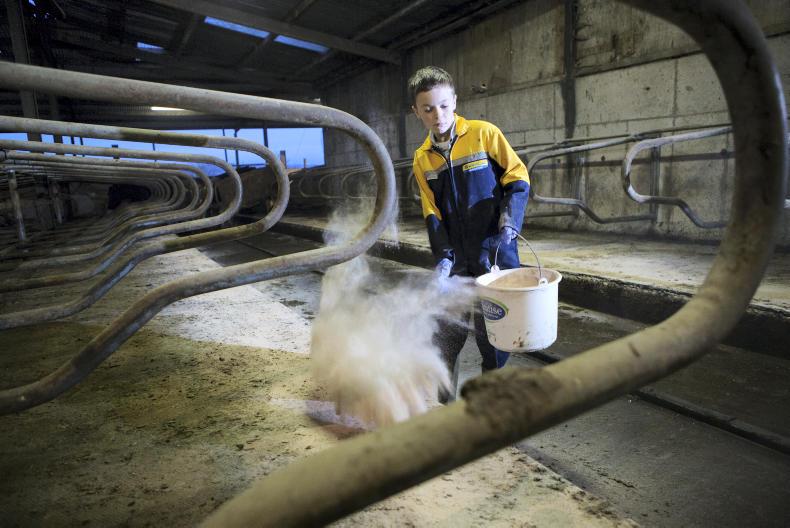
We can’t influence the heat generated by cows, but we can provide a dry lying area which removes one of the ways for bacteria to grow. To do so, some form of bedding material should be spread on the cubicle bed to absorb moisture and keep the lying area dry.
The most common material used is lime. Other farmers use sawdust or sand, while some farmers use peat.
The big advantage of lime is that it increases the pH of the lying area up to around a pH of 12.4. Once the pH of the lying area goes above 12 most bacteria should not be able to survive. Many farmers who use sawdust or peat will add lime to this to increase the pH.
However, you need to be sure about what type of lime to use. There are three types of lime on the market – ground limestone, hydrated lime and a mix of hydrated and ground limestone.
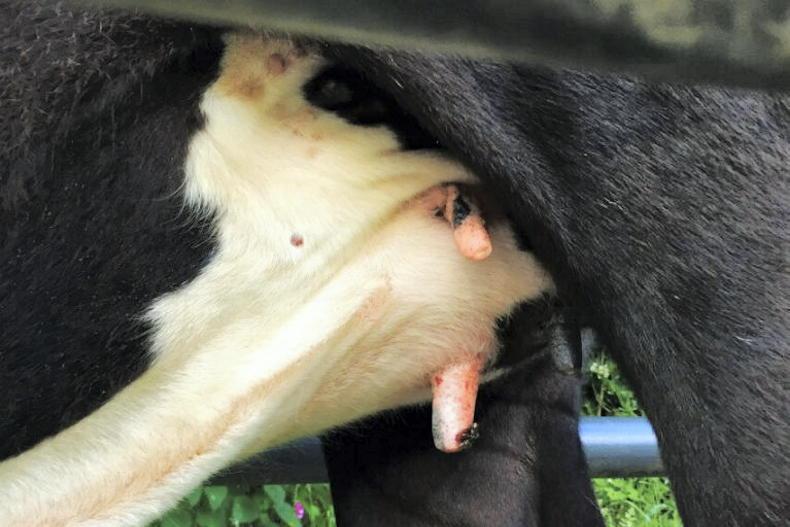
Hydrated lime is caustic, and some farmers report that it causes sores and scabs on teats, especially when used in conjunction with iodine teat-sprays.
However, an experiment conducted at Moorepark in 2013, found no adverse reaction from using hydrated lime over and above ground limestone or a combination of ground limestone and hydrated lime. The experiment involved teat-spraying with iodine and chlorohexidine based teat-sprays. There was no significant difference in SCC between the quarters in the various treatments six weeks after calving, and there were no lesions observed in the legs or udder, with only very slight changes to the teat condition over time. The conclusion was that hydrated lime is safe to use for animal bedding.
Of course, a lot depends on price, and hydrated lime is usually more expensive than ground limestone. Hydrated lime has finer particles, is cleaner and easier to spread. Many lime merchants offer a blend of hydrated and ground limestone.
Add hydrated lime to both sawdust and peat to increase the pH and prevent the growth of bacteria. Sawdust is particularly high-risk for bacteria growth. Some merchants sell sawdust and peat with lime already mixed through. The big advantage of these products are that they are easier to handle and less dusty than spreading lime. However, sand-bedded cubicles can present problems when emptying slurry.
Cubicle design
The design of the cubicle can also make a big difference when it comes to hygiene. The key thing here is the position of the brisket board. Many cubicles on Irish farms don’t have any brisket board, or else it is placed in the wrong position.
The brisket board should be on, or just above the mat and is there to stop the cow from lying too far up the cubicle. Ideally, the cow’s rear-end should be slightly overhanging the edge of the cubicle, so any faeces produced while lying down will fall on to the passage and not on the cubicle bed.
Brisket boards can be made from timber, half-pipe or nylon straps. Whatever the design, make sure they are adjustable and are adjusted based on the size of your cows.
Scrapers
The frequency with which passages are scraped also has a big influence on cubicle bed hygiene. If cows are walking on dirty passageways then they will bring dirt and faeces into the cubicle as they go to lie down.
Ideally, passages should be scraped four times per day. On very long cubicle sheds this may mean that automatic scrapers need to be going for longer.




SHARING OPTIONS